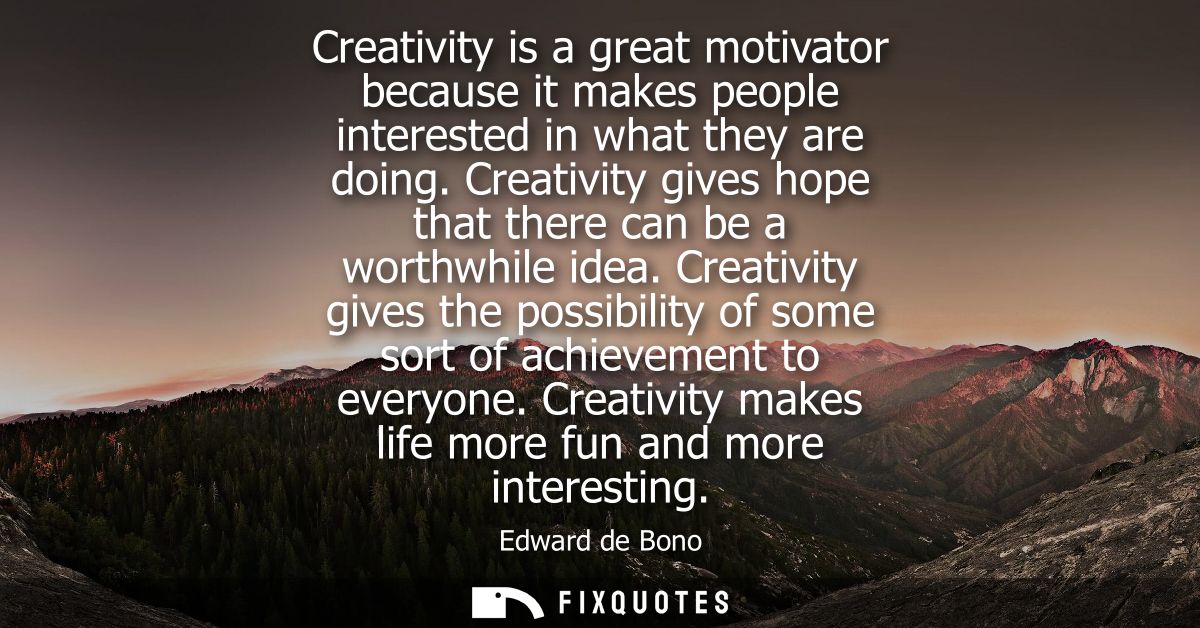
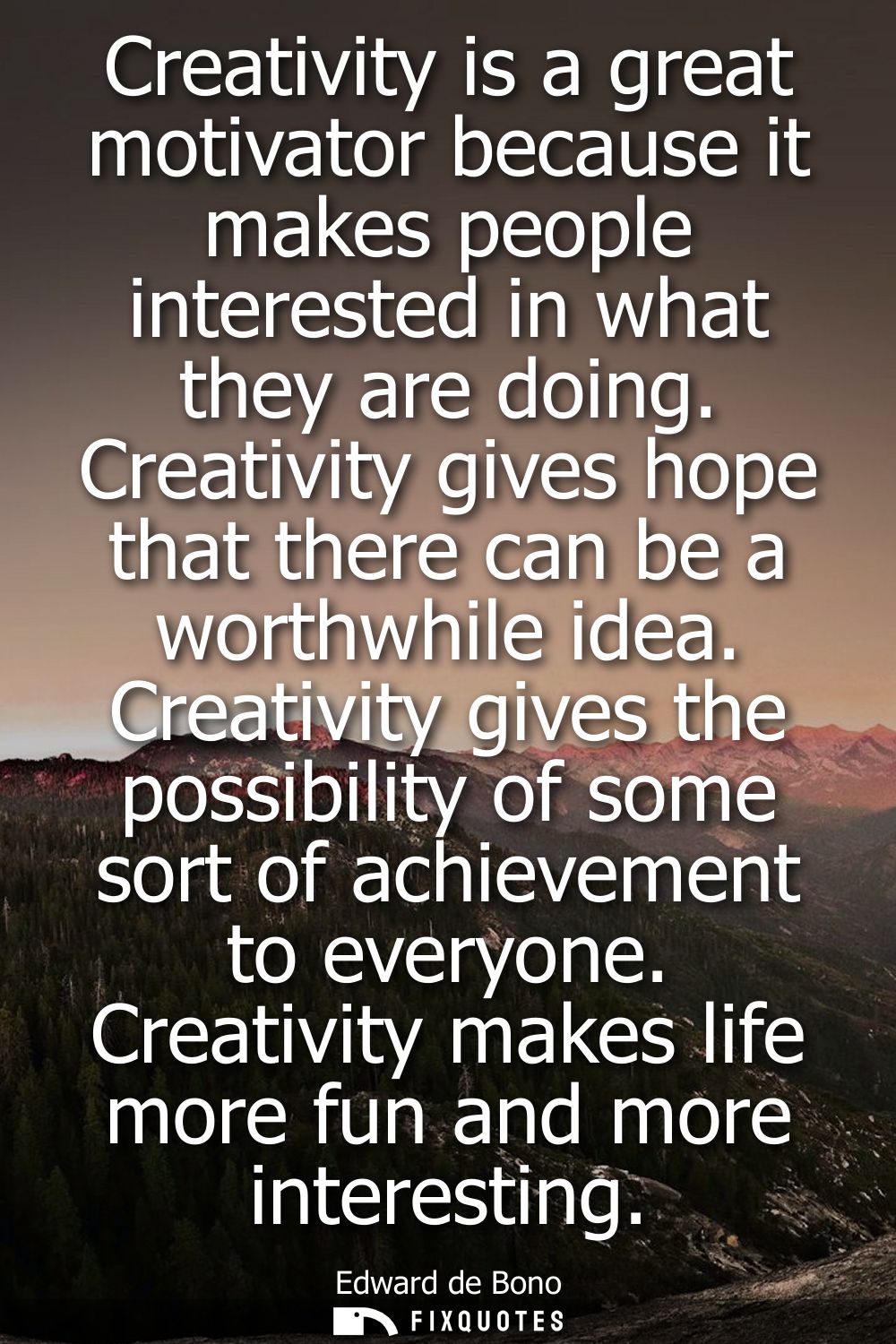
"Creativity is a great motivator because it makes people interested in what they are doing. Creativity gives hope that there can be a worthwhile idea. Creativity gives the possibility of some sort of achievement to everyone. Creativity makes life more fun and more interesting"
About this Quote
Creativity energizes action by shifting work from obligation to curiosity. When people can transform a task into an exploration, attention deepens and persistence rises. Interest is not a luxury; it is fuel. It aligns effort with intrinsic motivation, making long hours feel less like endurance and more like discovery.
Hope sits at the core of creative effort. The possibility that the next connection or variation might open a path keeps people trying in the face of uncertainty. That hope is not naive; it is a pragmatic stance that treats problems as open systems rather than fixed puzzles. It invites iteration, reframing, and resilience, because a failed attempt becomes raw material for the next idea.
By claiming that creativity offers achievement to everyone, Edward de Bono challenges the myth that success belongs only to those with rare gifts. His work on lateral thinking argued that progress often comes from arranging known elements in unfamiliar ways, not from sheer brilliance. Techniques that suspend early judgment and deliberately seek alternative perspectives make room for contributions across skill levels and backgrounds. A new recipe, a reworked workflow, a surprising question in a meeting — these are not lesser forms of creativity but the everyday engine of improvement.
Life becomes more fun and interesting when novelty and play are permitted. Moments of flow emerge when challenge meets capability, and creative play supplies both. The emotional payoff is not only pleasure; it is a sense of agency. People feel that they can change their circumstances rather than merely endure them.
De Bono’s broader message to schools and organizations follows: design environments that value idea generation before evaluation, normalize experiment, and reward reframing. Carrots and sticks can move bodies; curiosity moves minds. When creativity is cultivated as a habit rather than a rare spark, motivation compounds, hope stays alive, and achievement becomes a shared, ongoing practice.
Hope sits at the core of creative effort. The possibility that the next connection or variation might open a path keeps people trying in the face of uncertainty. That hope is not naive; it is a pragmatic stance that treats problems as open systems rather than fixed puzzles. It invites iteration, reframing, and resilience, because a failed attempt becomes raw material for the next idea.
By claiming that creativity offers achievement to everyone, Edward de Bono challenges the myth that success belongs only to those with rare gifts. His work on lateral thinking argued that progress often comes from arranging known elements in unfamiliar ways, not from sheer brilliance. Techniques that suspend early judgment and deliberately seek alternative perspectives make room for contributions across skill levels and backgrounds. A new recipe, a reworked workflow, a surprising question in a meeting — these are not lesser forms of creativity but the everyday engine of improvement.
Life becomes more fun and interesting when novelty and play are permitted. Moments of flow emerge when challenge meets capability, and creative play supplies both. The emotional payoff is not only pleasure; it is a sense of agency. People feel that they can change their circumstances rather than merely endure them.
De Bono’s broader message to schools and organizations follows: design environments that value idea generation before evaluation, normalize experiment, and reward reframing. Carrots and sticks can move bodies; curiosity moves minds. When creativity is cultivated as a habit rather than a rare spark, motivation compounds, hope stays alive, and achievement becomes a shared, ongoing practice.
Quote Details
| Topic | Motivational |
|---|
More Quotes by Edward
Add to List