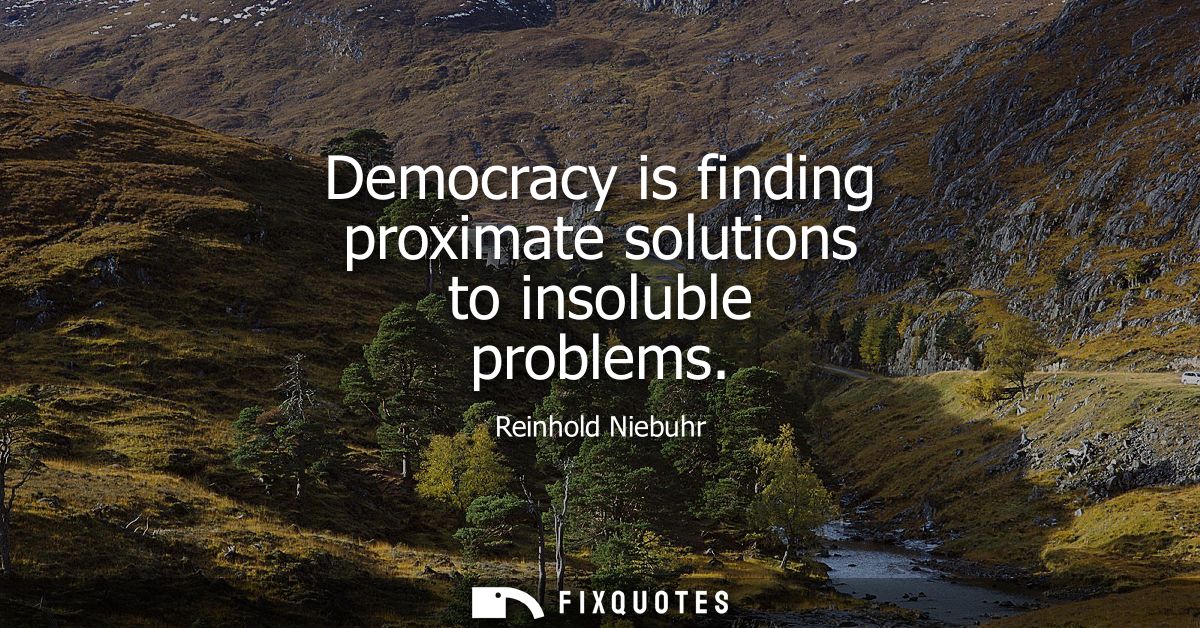
"Democracy is finding proximate solutions to insoluble problems"
About this Quote
Democracy, in Niebuhr's framing, is not a feel-good ritual of ballots and civic pieties; it's an admission of limits dressed up as a governing philosophy. "Proximate solutions" sounds almost like technical jargon, but the phrase is doing moral work: it insists that politics operates in the realm of the partial, the temporary, the compromised. The "insoluble problems" are the ones we keep pretending can be finished - inequality, power, human selfishness, fear, the tendency to turn ideals into weapons. Niebuhr, the theologian of Christian realism, is smuggling anthropology into civics: people are flawed, groups are worse, and history doesn't deliver clean endings.
The intent is bracingly anti-utopian. Democracy isn't redeemed by purity; it's justified by its capacity to correct itself, to negotiate between competing goods without claiming final truth. "Finding" matters, too. It's active, experimental, iterative - a process, not a verdict. That quietly rebukes both technocratic fantasies (that smart policy can solve politics) and revolutionary fantasies (that one sweeping transformation can solve humanity).
Context sharpens the edge. Writing in the shadow of depression, fascism, and world war, Niebuhr watched grand ideologies promise salvation and deliver catastrophe. Against that, democracy becomes a disciplined form of humility: a system built to handle our permanent disagreements without turning them into permanent enemies. The subtext is a warning and a reassurance: expect disappointment, but prefer a politics that can survive it.
The intent is bracingly anti-utopian. Democracy isn't redeemed by purity; it's justified by its capacity to correct itself, to negotiate between competing goods without claiming final truth. "Finding" matters, too. It's active, experimental, iterative - a process, not a verdict. That quietly rebukes both technocratic fantasies (that smart policy can solve politics) and revolutionary fantasies (that one sweeping transformation can solve humanity).
Context sharpens the edge. Writing in the shadow of depression, fascism, and world war, Niebuhr watched grand ideologies promise salvation and deliver catastrophe. Against that, democracy becomes a disciplined form of humility: a system built to handle our permanent disagreements without turning them into permanent enemies. The subtext is a warning and a reassurance: expect disappointment, but prefer a politics that can survive it.
Quote Details
| Topic | Decision-Making |
|---|
More Quotes by Reinhold
Add to List