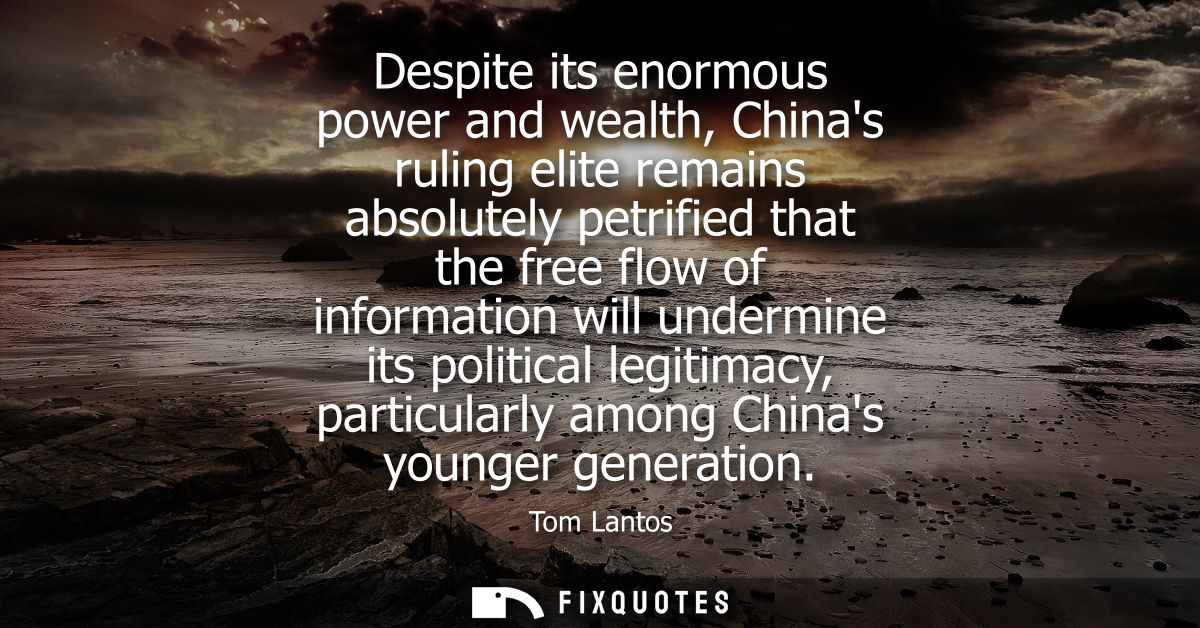
"Despite its enormous power and wealth, China's ruling elite remains absolutely petrified that the free flow of information will undermine its political legitimacy, particularly among China's younger generation"
About this Quote
Tom Lantos points to a paradox at the heart of Chinese governance: a state with vast coercive and economic resources that remains anxious about unfiltered information. The fear is not irrational. Political legitimacy in China rests less on electoral consent than on performance, nationalism, and the promise of stability. Uncontrolled flows of data, stories, and history can puncture each of those pillars by exposing corruption, policy failures, inequality, or suppressed memories such as 1989, and by offering alternative narratives about what a good society should look like.
Younger Chinese sit at the center of this anxiety. They are digital natives, attuned to global culture and skilled at reading between the lines of official discourse. They may not share the lived memory of scarcity that fortified earlier generations loyalty, and their expectations for personal autonomy and opportunity are higher. Even as many are proud of the countrys rise, they are unusually sensitive to hypocrisy and spin. That combination makes information control both more difficult and more essential for rulers who equate public doubt with potential instability.
The state has built formidable defenses: the Great Firewall, real-name registration, algorithmic content curation, and a sprawling propaganda apparatus that now speaks fluently in memes and short video. It suppresses inconvenient stories and amplifies patriotic ones, while mining social media to sense public mood. These tools have worked well enough to blunt dissent and channel debate. Yet their very necessity signals vulnerability. The tighter the grip, the more obvious the insecurity, and the more inventive young people become at expressing skepticism through satire, coded language, and ephemeral trends.
Lantos, a longtime human rights advocate, underscored that information is not a neutral commodity in an authoritarian system; it is a force that can reorder loyalties. In a landscape where trust must be managed rather than earned, the free flow of information threatens to replace managed consent with genuine judgment. That prospect is precisely why a powerful elite remains uneasy in the face of curious youth and a networked world.
Younger Chinese sit at the center of this anxiety. They are digital natives, attuned to global culture and skilled at reading between the lines of official discourse. They may not share the lived memory of scarcity that fortified earlier generations loyalty, and their expectations for personal autonomy and opportunity are higher. Even as many are proud of the countrys rise, they are unusually sensitive to hypocrisy and spin. That combination makes information control both more difficult and more essential for rulers who equate public doubt with potential instability.
The state has built formidable defenses: the Great Firewall, real-name registration, algorithmic content curation, and a sprawling propaganda apparatus that now speaks fluently in memes and short video. It suppresses inconvenient stories and amplifies patriotic ones, while mining social media to sense public mood. These tools have worked well enough to blunt dissent and channel debate. Yet their very necessity signals vulnerability. The tighter the grip, the more obvious the insecurity, and the more inventive young people become at expressing skepticism through satire, coded language, and ephemeral trends.
Lantos, a longtime human rights advocate, underscored that information is not a neutral commodity in an authoritarian system; it is a force that can reorder loyalties. In a landscape where trust must be managed rather than earned, the free flow of information threatens to replace managed consent with genuine judgment. That prospect is precisely why a powerful elite remains uneasy in the face of curious youth and a networked world.
Quote Details
| Topic | Freedom |
|---|
More Quotes by Tom
Add to List