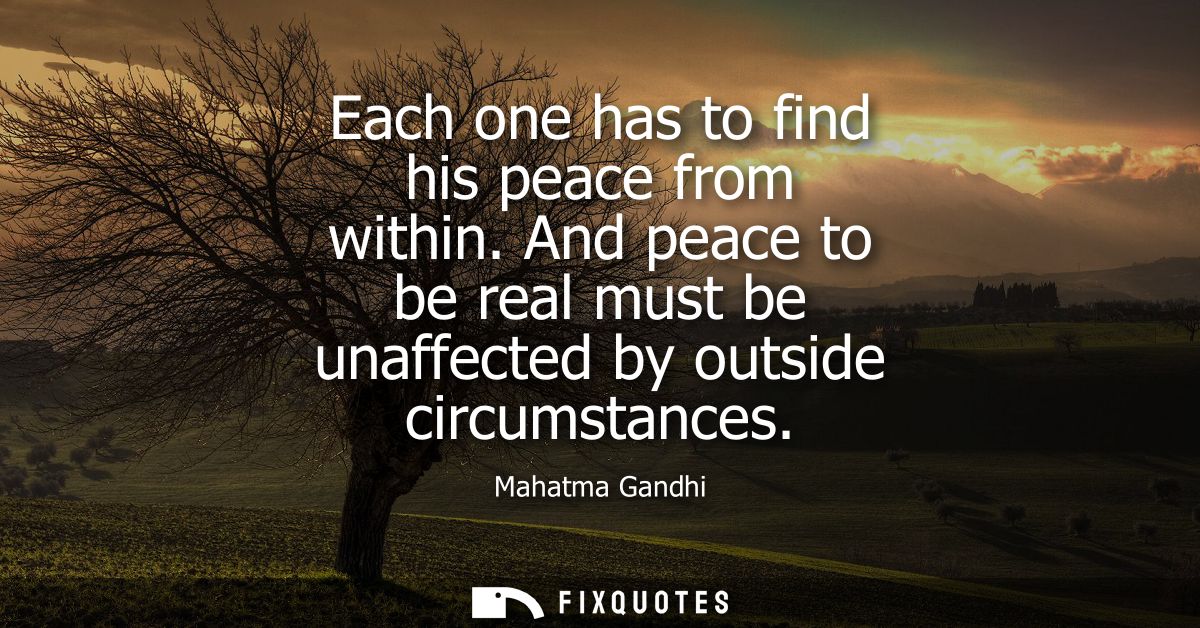
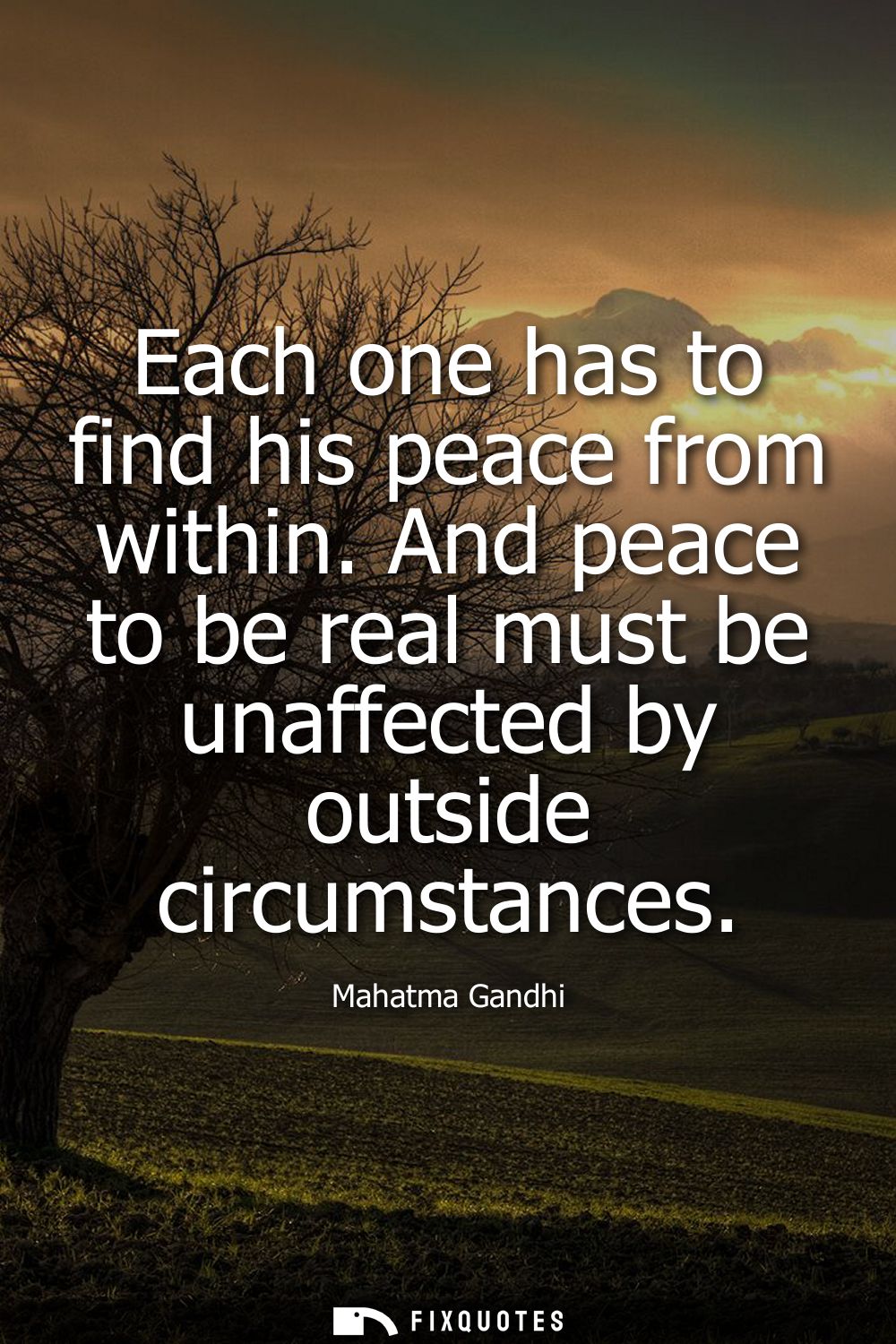
"Each one has to find his peace from within. And peace to be real must be unaffected by outside circumstances"
About this Quote
Gandhi’s line doesn’t flatter the reader with easy serenity; it issues a demand. “Find his peace from within” sounds like private self-help until the second sentence turns it into political doctrine: peace “must be unaffected by outside circumstances.” That’s a radical standard in a life built around outside circumstances - empire, imprisonment, communal violence, hunger, and the daily humiliations of colonial rule. He’s not arguing that the world can’t hurt you; he’s arguing that if your inner state is hostage to events, you’re already governed.
The specific intent is strategic as much as spiritual. Nonviolent resistance depends on a psychological backbone: the ability to absorb provocation without becoming the thing you oppose. If peace collapses the moment a baton swings or a boycott costs you work, the movement becomes reactive, easily manipulated by authorities who understand escalation. Gandhi frames peace as sovereignty - an internal independence that makes external independence possible.
The subtext is also a rebuke to performative calm. “To be real” implies counterfeit versions: peace as comfort, peace as avoidance, peace as the quiet that comes when you finally get your way. Gandhi’s peace is closer to discipline than mood, a practiced steadiness that survives insult and uncertainty. That’s why the sentence feels austere. It refuses the common bargain: I’ll be peaceful when the world behaves.
Read in context, it’s less a meditation cushion than a marching instruction. The point isn’t withdrawal from politics; it’s the creation of a self that can endure politics without being deformed by it.
The specific intent is strategic as much as spiritual. Nonviolent resistance depends on a psychological backbone: the ability to absorb provocation without becoming the thing you oppose. If peace collapses the moment a baton swings or a boycott costs you work, the movement becomes reactive, easily manipulated by authorities who understand escalation. Gandhi frames peace as sovereignty - an internal independence that makes external independence possible.
The subtext is also a rebuke to performative calm. “To be real” implies counterfeit versions: peace as comfort, peace as avoidance, peace as the quiet that comes when you finally get your way. Gandhi’s peace is closer to discipline than mood, a practiced steadiness that survives insult and uncertainty. That’s why the sentence feels austere. It refuses the common bargain: I’ll be peaceful when the world behaves.
Read in context, it’s less a meditation cushion than a marching instruction. The point isn’t withdrawal from politics; it’s the creation of a self that can endure politics without being deformed by it.
Quote Details
| Topic | Peace |
|---|---|
| Source | Help us find the source |
More Quotes by Mahatma
Add to List