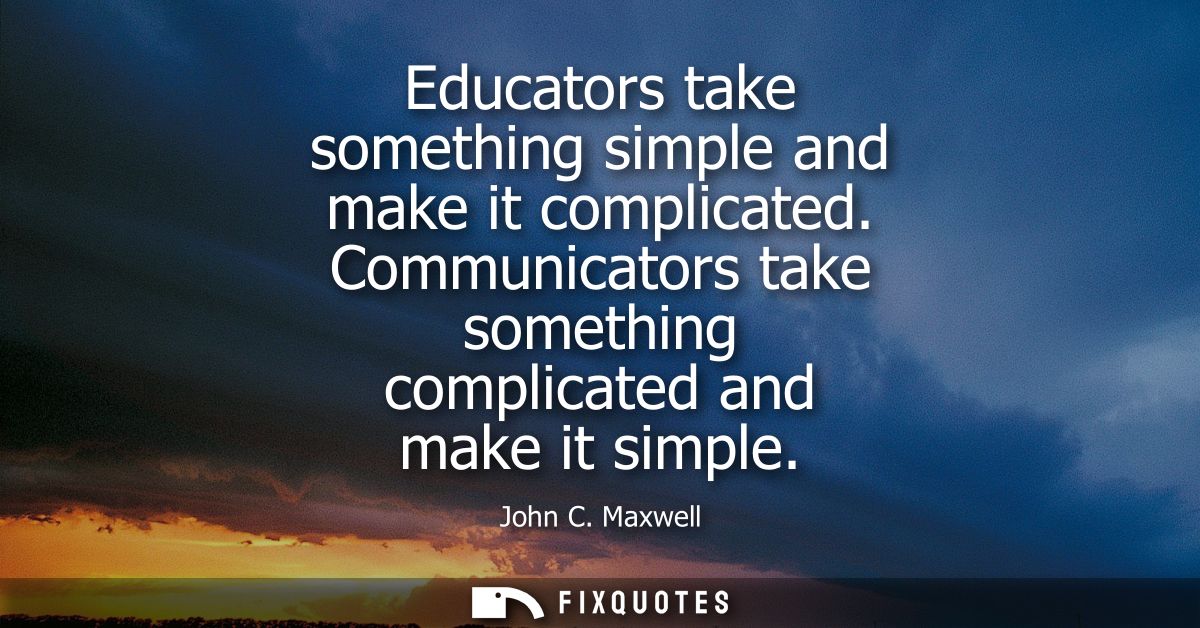
"Educators take something simple and make it complicated. Communicators take something complicated and make it simple"
About this Quote
Maxwell’s line is a neat piece of leadership-era provocation: it flatters the audience’s impatience with jargon while quietly reframing what “teaching” is supposed to do. The first clause lands like a complaint you’ve heard in every workplace training, sermon, and freshman lecture: smart people building elaborate scaffolding around ideas that were never meant to be that hard. It’s a caricature of “educators,” but a useful one, because it sets up the contrast that really matters to Maxwell’s brand of practical ministry and management advice.
The second clause elevates “communicators” into a kind of moral and professional ideal. Subtext: clarity is not just a skill; it’s a form of service. If you can’t make the complex legible, you may be protecting your status rather than helping your audience. That’s a very pastoral, very leadership-coach move: shifting the burden from the listener (“you’re not getting it”) to the speaker (“I haven’t earned your understanding”).
The intent isn’t anti-education so much as anti-obscurity. Maxwell is speaking from pulpits, conference stages, and bestselling paperbacks where attention is scarce and trust is fragile. In that setting, complicated language reads as evasion. The line also smuggles in a power dynamic: educators “take” and “make,” implying control; communicators “make it simple,” implying translation and empathy. It’s an argument for humility disguised as a slogan, and it works because it gives readers permission to demand plain speech from people who usually get rewarded for sounding complex.
The second clause elevates “communicators” into a kind of moral and professional ideal. Subtext: clarity is not just a skill; it’s a form of service. If you can’t make the complex legible, you may be protecting your status rather than helping your audience. That’s a very pastoral, very leadership-coach move: shifting the burden from the listener (“you’re not getting it”) to the speaker (“I haven’t earned your understanding”).
The intent isn’t anti-education so much as anti-obscurity. Maxwell is speaking from pulpits, conference stages, and bestselling paperbacks where attention is scarce and trust is fragile. In that setting, complicated language reads as evasion. The line also smuggles in a power dynamic: educators “take” and “make,” implying control; communicators “make it simple,” implying translation and empathy. It’s an argument for humility disguised as a slogan, and it works because it gives readers permission to demand plain speech from people who usually get rewarded for sounding complex.
Quote Details
| Topic | Teaching |
|---|
More Quotes by John
Add to List