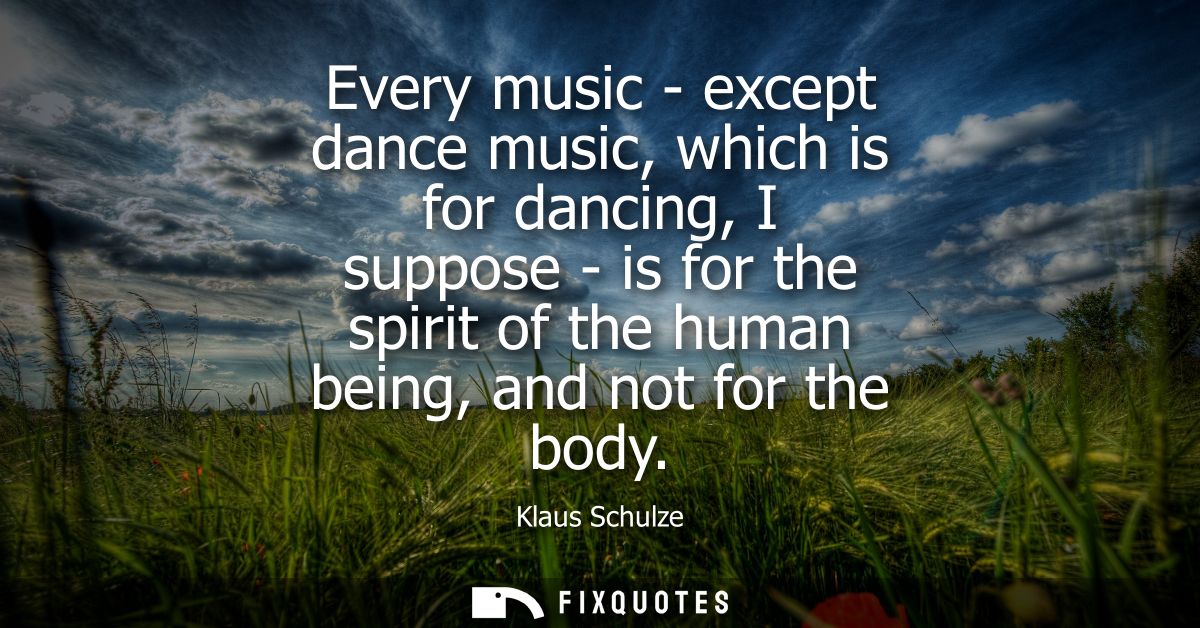
"Every music - except dance music, which is for dancing, I suppose - is for the spirit of the human being, and not for the body"
About this Quote
Schulze’s line flatters music by demoting the body, but it does so with a wink: “I suppose” is a sly little shrug that undercuts the rule even as he states it. The aside admits the obvious (dance music is for dancing) while revealing his real target: the expectation that electronic music should justify itself through movement, utility, or club function. Coming from a composer who helped define kosmische and Berlin School electronics - long-form, sequencer-driven pieces built for immersion rather than choreography - it reads like a manifesto disguised as a quip.
The specific intent is boundary-setting. Schulze is defending listening as an active, interior act, not a byproduct of rhythm. He’s also protecting a certain seriousness: if music is “for the spirit,” then it deserves the same contemplative status as literature or cinema, not just the role of soundtrack to nightlife. That’s a familiar anxiety in electronic culture, where a genre’s value often gets measured by the crowd’s legs.
The subtext, though, is complicated. By splitting spirit from body, he echoes an old Western hierarchy that treats thinking as higher than sensation. Yet Schulze’s own work confounds that split: repetition, pulse, and timbre hit the nervous system first, then bloom into something like reverie. His comment is less a denial of the body than a refusal to let the dance floor be the only courtroom where music gets judged. In that sense, it’s a plea for private intensity in a world that keeps asking art to be functional.
The specific intent is boundary-setting. Schulze is defending listening as an active, interior act, not a byproduct of rhythm. He’s also protecting a certain seriousness: if music is “for the spirit,” then it deserves the same contemplative status as literature or cinema, not just the role of soundtrack to nightlife. That’s a familiar anxiety in electronic culture, where a genre’s value often gets measured by the crowd’s legs.
The subtext, though, is complicated. By splitting spirit from body, he echoes an old Western hierarchy that treats thinking as higher than sensation. Yet Schulze’s own work confounds that split: repetition, pulse, and timbre hit the nervous system first, then bloom into something like reverie. His comment is less a denial of the body than a refusal to let the dance floor be the only courtroom where music gets judged. In that sense, it’s a plea for private intensity in a world that keeps asking art to be functional.
Quote Details
| Topic | Music |
|---|
More Quotes by Klaus
Add to List