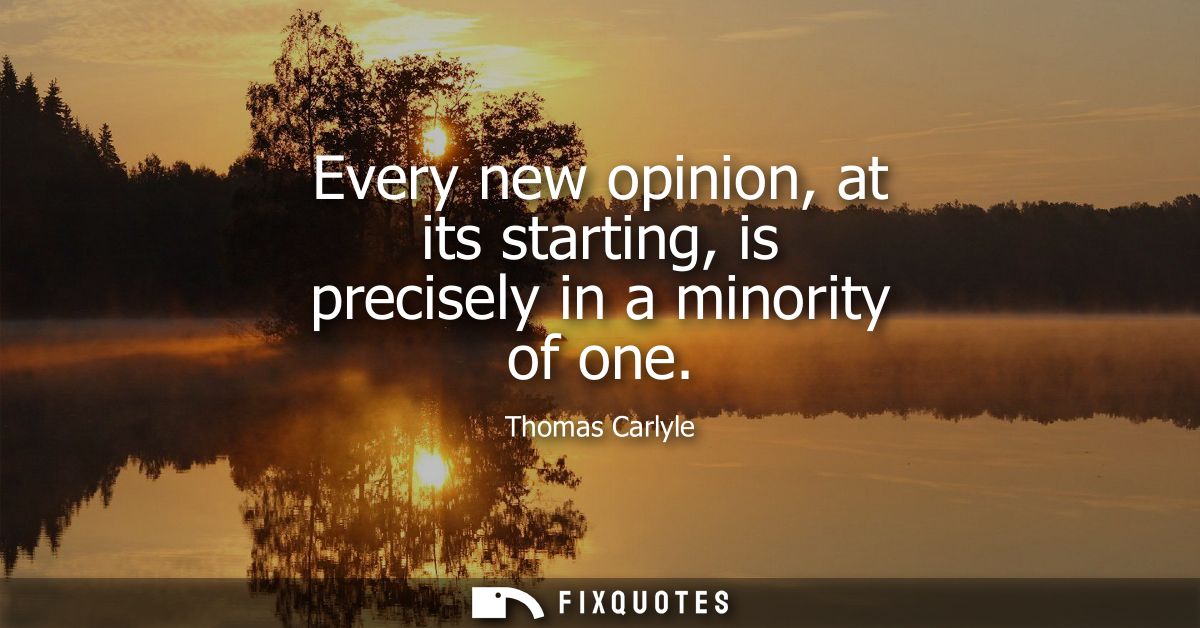
"Every new opinion, at its starting, is precisely in a minority of one"
About this Quote
Every new idea begins with a single mind standing apart from the crowd. Carlyle compresses a hard psychological and social truth: originality is lonely at first. An opinion that did not start in one person’s conviction would be an echo, not a beginning. By insisting on the minority of one, he underscores the courage and patience required to think independently before allies arrive, if they ever do.
The line fits Carlyle’s broader view of history as driven by individuals of character. He distrusted the complacency of majorities and the flattening effects of mere consensus. For him, the decisive force was the person who sees what others do not yet see and is willing to carry that vision through misunderstanding, mockery, or indifference. From scientific revolutions to moral reforms, the first mover bears the cost of dissent.
Yet minority status is not a halo. Being alone does not make one right; it makes one unproven. Solitary insight must submit to time, evidence, and the testing of other minds. Carlyle’s aphorism honors individual resolve without absolving it from rigor. The same solitude that shelters genius can also shelter folly. What distinguishes the former is not isolation itself, but a fierce honesty, the discipline to confront counterarguments, and the willingness to revise or endure.
The thought resonates in a world teeming with instant consensus. Social media can conjure swift majorities, but they are often built on reflex and mimicry. True innovation still requires the capacity to think without the crutch of applause, to tolerate the chill of early disbelief. It also asks a community to grant space for solitary beginnings, to withhold the reflex to conflate unfamiliar with false.
Carlyle points to a paradox of progress: every shared conviction must first pass through one person’s solitude. Respect that passage, and ideas gain the room they need to grow.
The line fits Carlyle’s broader view of history as driven by individuals of character. He distrusted the complacency of majorities and the flattening effects of mere consensus. For him, the decisive force was the person who sees what others do not yet see and is willing to carry that vision through misunderstanding, mockery, or indifference. From scientific revolutions to moral reforms, the first mover bears the cost of dissent.
Yet minority status is not a halo. Being alone does not make one right; it makes one unproven. Solitary insight must submit to time, evidence, and the testing of other minds. Carlyle’s aphorism honors individual resolve without absolving it from rigor. The same solitude that shelters genius can also shelter folly. What distinguishes the former is not isolation itself, but a fierce honesty, the discipline to confront counterarguments, and the willingness to revise or endure.
The thought resonates in a world teeming with instant consensus. Social media can conjure swift majorities, but they are often built on reflex and mimicry. True innovation still requires the capacity to think without the crutch of applause, to tolerate the chill of early disbelief. It also asks a community to grant space for solitary beginnings, to withhold the reflex to conflate unfamiliar with false.
Carlyle points to a paradox of progress: every shared conviction must first pass through one person’s solitude. Respect that passage, and ideas gain the room they need to grow.
Quote Details
| Topic | Wisdom |
|---|
More Quotes by Thomas
Add to List