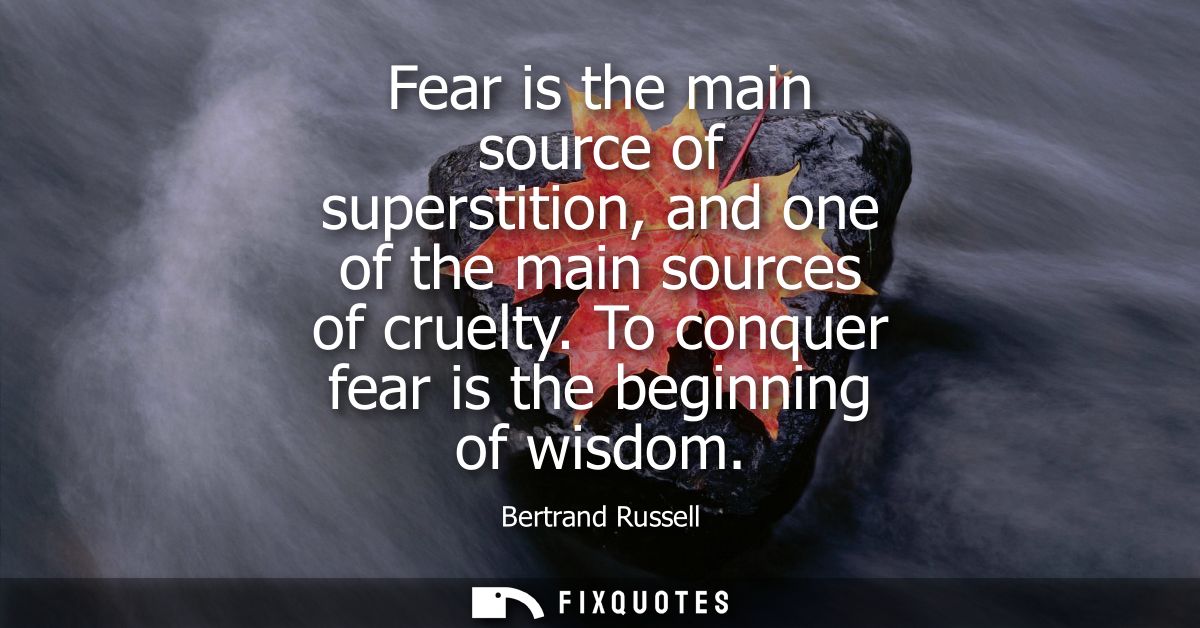
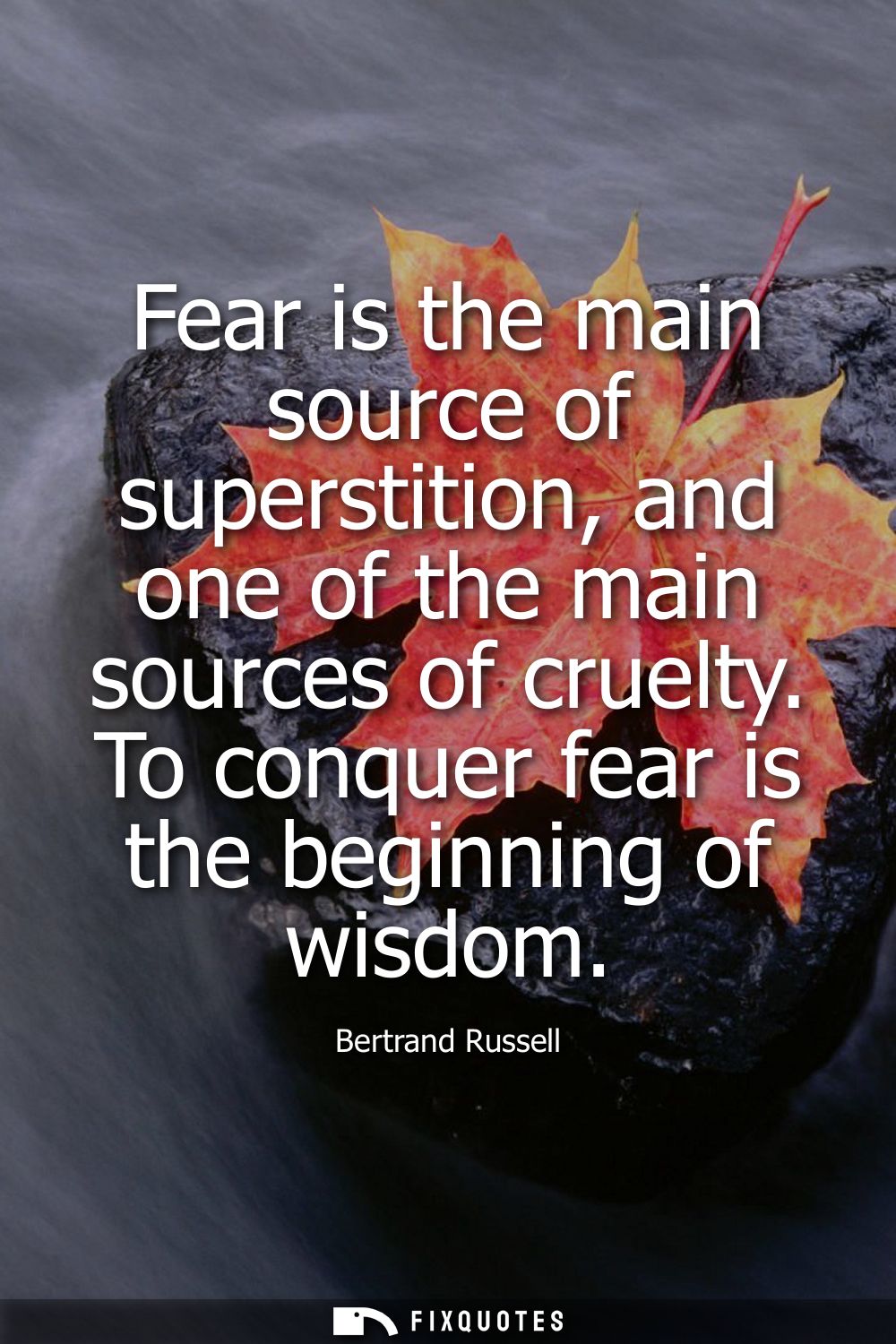
"Fear is the main source of superstition, and one of the main sources of cruelty. To conquer fear is the beginning of wisdom"
About this Quote
Russell cuts straight to the ugly machinery behind our supposedly lofty beliefs: fear doesn’t just make us cautious, it makes us credulous. Superstition, in his framing, isn’t a quaint cultural artifact; it’s a psychological shortcut taken when reality feels unmanageable. When you can’t predict the world, you start bargaining with it - rituals, omens, scapegoats - anything that offers the illusion of control. The line works because it treats irrationality as an emotional coping strategy, not an intellectual mistake, which is why it still reads like a diagnosis of modern life rather than a Victorian lecture.
The second punch is sharper: fear doesn’t merely distort what we believe, it deforms how we treat other people. Cruelty becomes fear with a moral alibi - the violent enforcement of “purity,” the panic-driven hunt for enemies, the preemptive strike dressed up as duty. Russell, a pacifist who lived through two world wars and the rise of mass propaganda, is speaking from a century where fear was industrialized: governments, churches, and mobs all learned to weaponize anxiety into obedience.
“To conquer fear” isn’t motivational fluff; it’s Russell’s minimalist definition of enlightenment. Wisdom begins not with more information, but with a steadier nervous system: the ability to sit with uncertainty without reaching for myths or punishments. The subtext is bracingly political: a less frightened public is harder to rule through superstition, harder to herd into cruelty, and more capable of ethical clarity.
The second punch is sharper: fear doesn’t merely distort what we believe, it deforms how we treat other people. Cruelty becomes fear with a moral alibi - the violent enforcement of “purity,” the panic-driven hunt for enemies, the preemptive strike dressed up as duty. Russell, a pacifist who lived through two world wars and the rise of mass propaganda, is speaking from a century where fear was industrialized: governments, churches, and mobs all learned to weaponize anxiety into obedience.
“To conquer fear” isn’t motivational fluff; it’s Russell’s minimalist definition of enlightenment. Wisdom begins not with more information, but with a steadier nervous system: the ability to sit with uncertainty without reaching for myths or punishments. The subtext is bracingly political: a less frightened public is harder to rule through superstition, harder to herd into cruelty, and more capable of ethical clarity.
Quote Details
| Topic | Fear |
|---|
More Quotes by Bertrand
Add to List