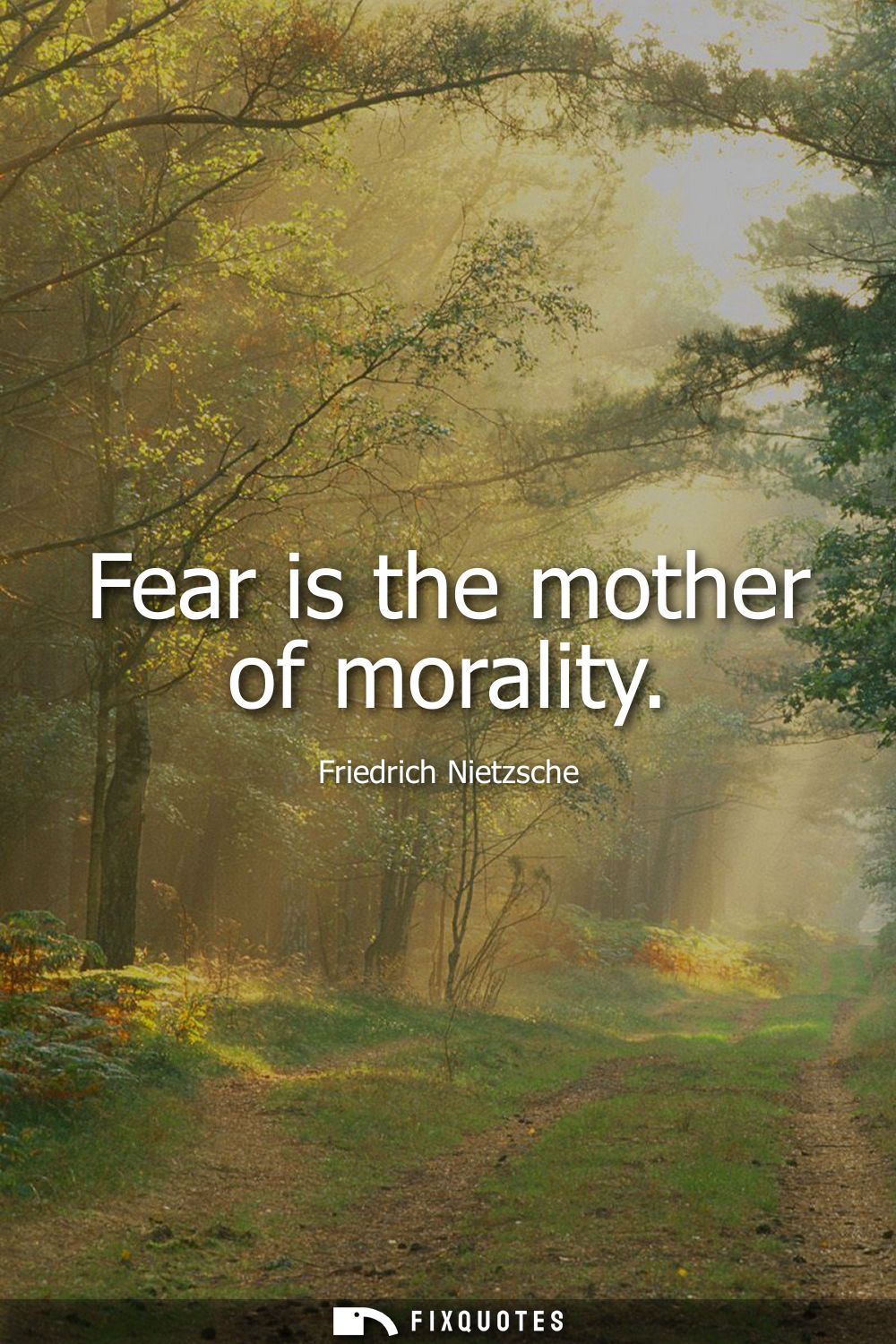
"Fear is the mother of morality"
About this Quote
Nietzsche’s line lands like a taunt aimed at respectable society: what you call “morality” is often just fear in a tuxedo. Not fear in the melodramatic sense of panic, but the quieter, more civilizing dread of punishment, exile, hunger, ridicule, divine retribution. He’s needling the comforting story that morals descend from reason or pure altruism. Instead, he points to the origin point most people would rather not claim: self-preservation.
The intent is diagnostic. Nietzsche is less interested in praising fear as a virtue than in exposing how moral codes get manufactured and maintained. A community discovers that certain impulses (violence, sex, appetite, dominance) are disruptive, then builds a system of “oughts” to manage them. Fear becomes the enforcement mechanism: fear of the law, fear of God, fear of being cast out. Once internalized, that external threat turns into conscience, guilt, the feeling that the prohibition is somehow sacred. That’s the subtext: morality’s halo may be a historical afterimage of coercion.
Context matters: Nietzsche is writing in the aftermath of Christianity’s cultural supremacy and amid modernity’s erosion of religious authority. He’s suspicious of “slave morality,” the set of values that bless meekness and call strength sinful, not because they’re true but because they’re useful for the vulnerable to restrain the powerful. The line works because it flips a compliment into an accusation. If morality is mothered by fear, it’s less a beacon than a coping strategy - and Nietzsche wants you to notice who benefits from it.
The intent is diagnostic. Nietzsche is less interested in praising fear as a virtue than in exposing how moral codes get manufactured and maintained. A community discovers that certain impulses (violence, sex, appetite, dominance) are disruptive, then builds a system of “oughts” to manage them. Fear becomes the enforcement mechanism: fear of the law, fear of God, fear of being cast out. Once internalized, that external threat turns into conscience, guilt, the feeling that the prohibition is somehow sacred. That’s the subtext: morality’s halo may be a historical afterimage of coercion.
Context matters: Nietzsche is writing in the aftermath of Christianity’s cultural supremacy and amid modernity’s erosion of religious authority. He’s suspicious of “slave morality,” the set of values that bless meekness and call strength sinful, not because they’re true but because they’re useful for the vulnerable to restrain the powerful. The line works because it flips a compliment into an accusation. If morality is mothered by fear, it’s less a beacon than a coping strategy - and Nietzsche wants you to notice who benefits from it.
Quote Details
| Topic | Ethics & Morality |
|---|
More Quotes by Friedrich
Add to List