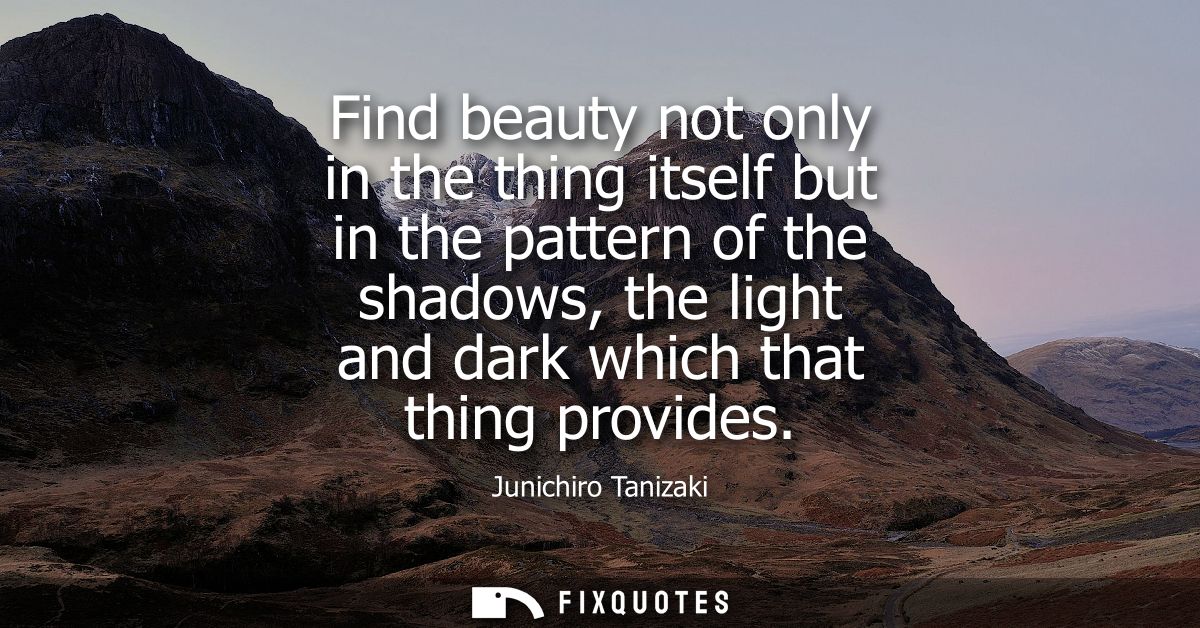
"Find beauty not only in the thing itself, but in the pattern of the shadows, the light and dark which that thing provides"
About this Quote
The intent is both artistic and polemical. Tanizaki is writing out of a Japan rapidly refitted with Western lighting, white walls, chrome, and the cult of clarity. In that context, insisting on “light and dark” reads as a defense of a sensibility threatened by electrification and standardization. It’s not nostalgia for dim rooms; it’s a critique of a civilization that equates brightness with truth and cleanliness with value. Shadows, here, aren’t concealment but texture, the place where nuance lives.
Subtext: the object alone is never the full story. A lacquer bowl, a face, a sentence - their depth depends on what’s withheld, softened, partially obscured. Tanizaki’s phrasing turns perception into ethics: to find beauty in shadows is to respect ambiguity, to accept that refinement can be indirect. The quote works because it flips the hierarchy. The “thing” is merely the anchor; meaning happens in the gradients around it, where the eye and the imagination have room to collaborate.
Quote Details
| Topic | Art |
|---|---|
| Source | Evidence: Such is our way of thinking, we find beauty not in the thing itself but in the patterns of shadows, the light and the darkness, that one thing against another creates. (Page 30 (English translation; Leete's Island Books/Harper & Seidensticker translation)). The wording you provided ("Find beauty not only in the thing itself, but in the pattern of the shadows, the light and dark which that thing provides") is a loosened/altered paraphrase that circulates online. The closest primary-source match I can verify in Tanizaki’s own work appears in his essay In'ei Raisan (陰翳礼讃), commonly known in English as In Praise of Shadows, first published in Japan in 1933. In the commonly-cited English translation (Harper & Seidensticker; first published by Leete's Island Books in 1977), the verified sentence occurs on p. 30 and reads as quoted above. The 'We Orientals...' variant also circulates, but the primary-source sentence in the checked translation uses 'Such is our way of thinking, '. Other candidates (1) Anime and Memory (Dani Cavallaro, 2014) compilation96.3% ... Find beauty not only in the thing itself but in the pattern of the shadows, the light and dark which that thing p... |
| Cite |
Citation Formats
APA Style (7th ed.)
Tanizaki, Junichiro. (2026, February 24). Find beauty not only in the thing itself, but in the pattern of the shadows, the light and dark which that thing provides. FixQuotes. https://fixquotes.com/quotes/find-beauty-not-only-in-the-thing-itself-but-in-62976/
Chicago Style
Tanizaki, Junichiro. "Find beauty not only in the thing itself, but in the pattern of the shadows, the light and dark which that thing provides." FixQuotes. February 24, 2026. https://fixquotes.com/quotes/find-beauty-not-only-in-the-thing-itself-but-in-62976/.
MLA Style (9th ed.)
"Find beauty not only in the thing itself, but in the pattern of the shadows, the light and dark which that thing provides." FixQuotes, 24 Feb. 2026, https://fixquotes.com/quotes/find-beauty-not-only-in-the-thing-itself-but-in-62976/. Accessed 2 Apr. 2026.