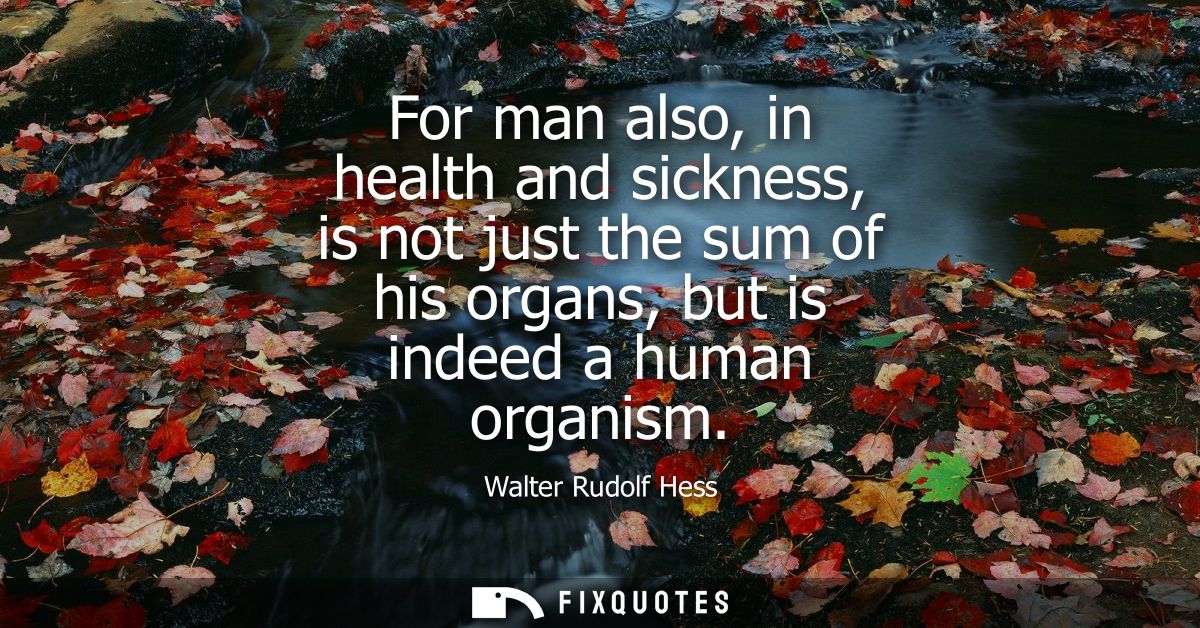
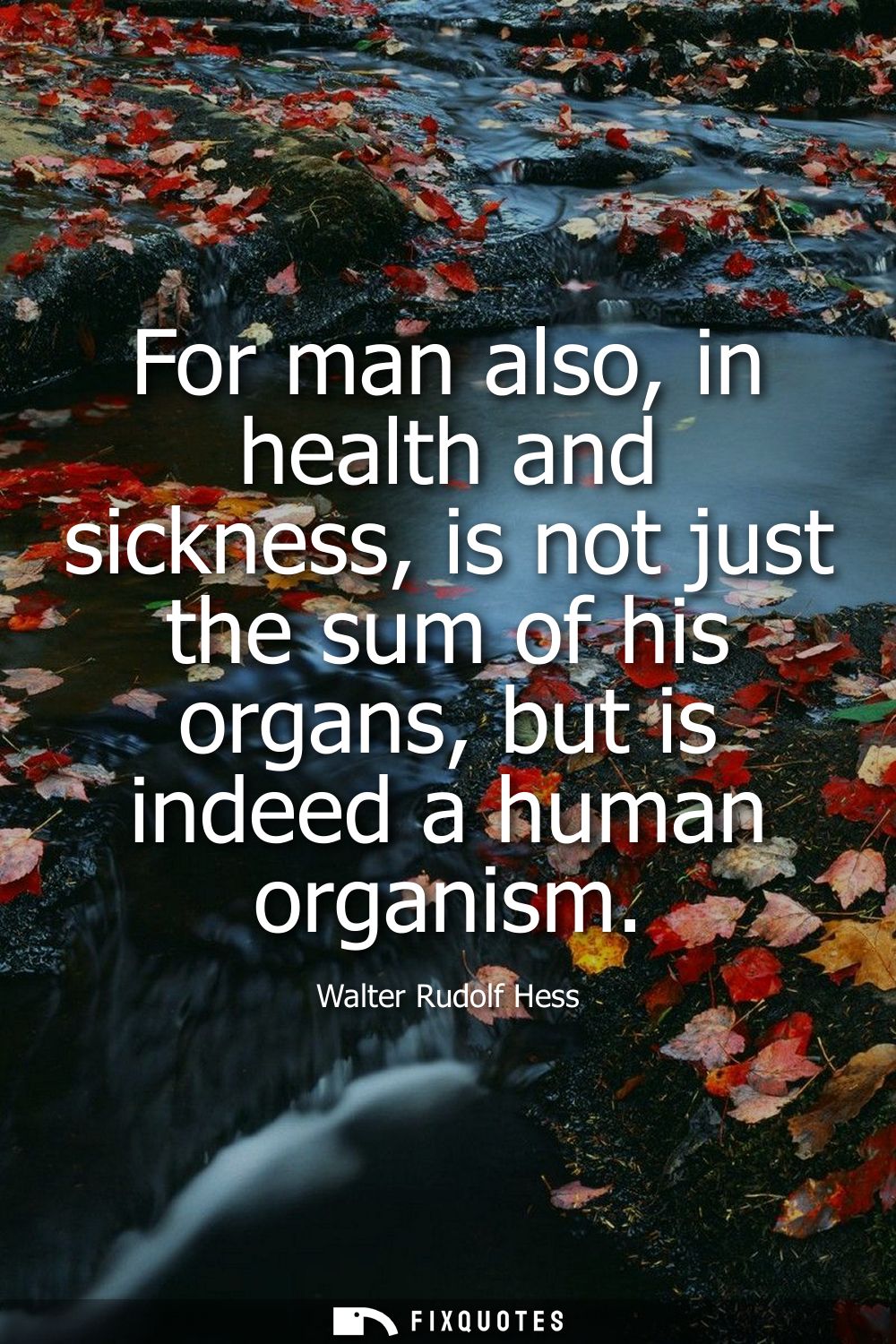
"For man also, in health and sickness, is not just the sum of his organs, but is indeed a human organism"
About this Quote
Walter Rudolf Hess, a significant physiologist, encapsulates a profound understanding of the human condition in his quote: "For guy likewise, in health and sickness, is not simply the amount of his organs, however is certainly a human organism". This statement accentuates the holistic nature of human beings, highlighting that people can not be merely reduced to their physical components.
At its core, this quote challenges the reductionist point of view that tends to view the body as a collection of different, functional parts. While the heart pumps blood, the lungs assist in respiration, and the brain coordinates activities, each organ works within a complex, interconnected system. This systems-based method suggests that the body operates as a merged whole, wherein the interaction between organs is as significant as the organs themselves. Anomalies or diseases often can not be totally understood through the examination of separated signs; instead, they need consideration of the underlying biological networks.
Additionally, Hess's recommendation to the "human organism" underscores the vibrant and adaptive nature of people. An organism is identified not simply by its fixed parts, however by its capability to grow, adjust, and preserve homeostasis in reaction to internal and external obstacles. Health, therefore, is not simply the lack of illness but a state of dynamic stability within this organism.
In sickness, this interconnectedness becomes a lot more pronounced as the disruption in one part of the system can waterfall, impacting overall wellness. Western medicine, often critiqued for its concentrate on treating symptoms instead of causes, can take advantage of embracing Hess's philosophy by embracing a more integrated technique to healthcare, one that appreciates the intricacy and special coherence of the human organism.
On a more comprehensive level, Hess's insight extends beyond biology, welcoming reflection on mental, social, and ecological factors that contribute to human wellness. Eventually, this perspective advocates for a detailed approach to comprehending health, one that values the indivisible unity of the human organism in all its aspects.
More details
About the Author