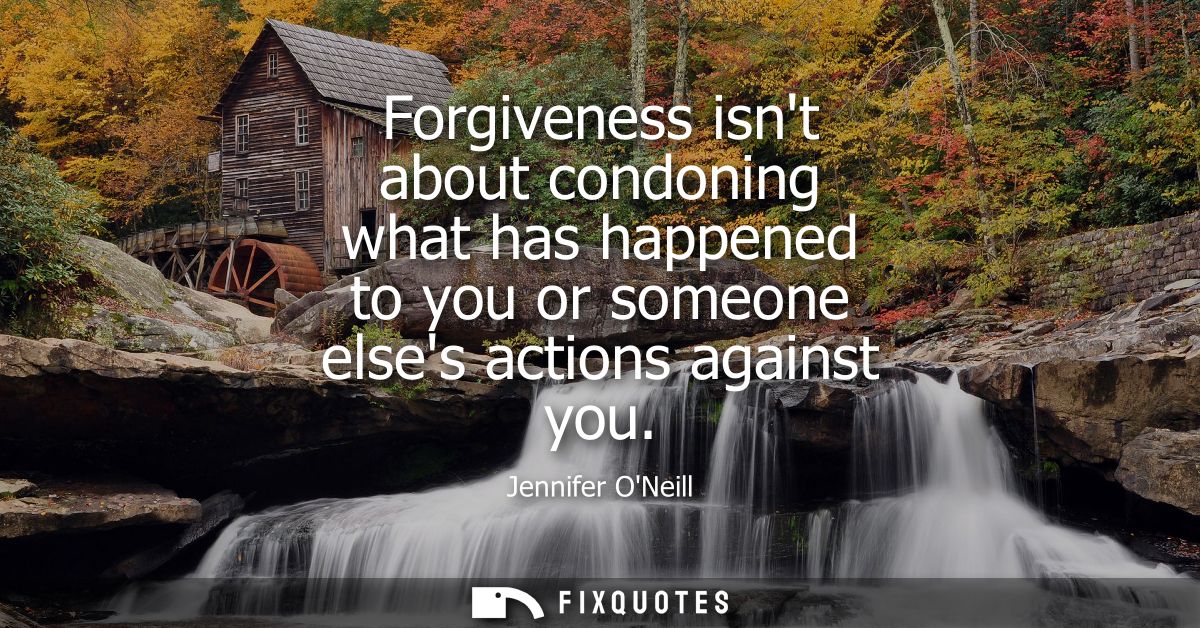
"Forgiveness isn't about condoning what has happened to you or someone else's actions against you"
About this Quote
The intent is corrective. By separating forgiveness from condoning, O'Neill gives people permission to reclaim a word that gets weaponized against them. "Condoning" is the key verb: it drags in moral approval, complicity, even social pressure to smile and move on. She refuses that deal. Forgiveness becomes an internal act, not a social verdict; it can coexist with anger, with memory, with consequences, with distance.
The subtext is about power. Survivors are often nudged toward forgiveness as a performance of being "healed" - something legible to family, courts, churches, talk shows. O'Neill's sentence insists that your interior peace doesn't have to be purchased by rewriting the past or sanitizing harm. You can release the grip of an injury without recasting the injurer as misunderstood.
Context matters here: celebrities are trained to sell redemption arcs, to compress messy human ruptures into a usable narrative. O'Neill's quote resists that script. It offers a more realistic ethic: forgiveness as self-protection, not absolution; closure without collusion.
Quote Details
| Topic | Forgiveness |
|---|---|
| Source | Help us find the source |
| Cite |
Citation Formats
APA Style (7th ed.)
O'Neill, Jennifer. (2026, January 15). Forgiveness isn't about condoning what has happened to you or someone else's actions against you. FixQuotes. https://fixquotes.com/quotes/forgiveness-isnt-about-condoning-what-has-91501/
Chicago Style
O'Neill, Jennifer. "Forgiveness isn't about condoning what has happened to you or someone else's actions against you." FixQuotes. January 15, 2026. https://fixquotes.com/quotes/forgiveness-isnt-about-condoning-what-has-91501/.
MLA Style (9th ed.)
"Forgiveness isn't about condoning what has happened to you or someone else's actions against you." FixQuotes, 15 Jan. 2026, https://fixquotes.com/quotes/forgiveness-isnt-about-condoning-what-has-91501/. Accessed 12 Feb. 2026.