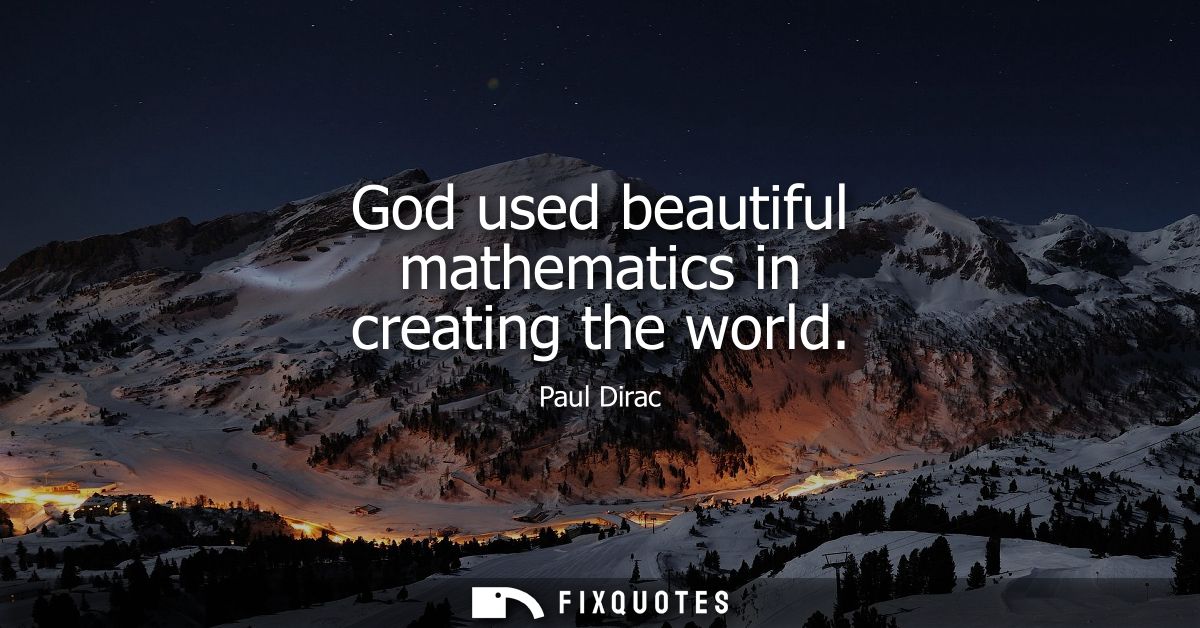
"God used beautiful mathematics in creating the world"
About this Quote
Dirac turns a scientific credo into something that reads like a private prayer: the universe is not just intelligible, it is elegant. Coming from one of the 20th century’s most austere minds, the word “God” lands less as Sunday-school doctrine than as a placeholder for whatever sits behind physical law. It’s rhetorical jujitsu: he borrows theology’s authority to elevate a methodological hunch - that beauty is a reliable compass in physics - into a statement about reality itself.
The real action is in “beautiful mathematics.” Dirac isn’t praising math as a convenient language; he’s insisting it’s the blueprint. That’s the subtext of his career, from the Dirac equation to the audacious prediction of antimatter: if an equation has the right kind of symmetry and simplicity, nature is likely to comply. In a field where experiments can be rare, delayed, or technologically out of reach, aesthetic judgment becomes a form of disciplined betting. Dirac is just unusually candid about the wager.
Context matters: early- to mid-century physics was a sequence of shocks - relativity, quantum mechanics - where reality kept outrunning common sense. Beauty offered a steadier criterion than intuition. Still, the line carries a sly provocation. If “God” writes in mathematics, then the messy parts of human life - politics, morality, suffering - aren’t the main text. They’re marginalia. Dirac’s sentence comforts and unsettles at once: it promises order, but it also implies we’re not the intended audience, just the readers trying to catch up.
The real action is in “beautiful mathematics.” Dirac isn’t praising math as a convenient language; he’s insisting it’s the blueprint. That’s the subtext of his career, from the Dirac equation to the audacious prediction of antimatter: if an equation has the right kind of symmetry and simplicity, nature is likely to comply. In a field where experiments can be rare, delayed, or technologically out of reach, aesthetic judgment becomes a form of disciplined betting. Dirac is just unusually candid about the wager.
Context matters: early- to mid-century physics was a sequence of shocks - relativity, quantum mechanics - where reality kept outrunning common sense. Beauty offered a steadier criterion than intuition. Still, the line carries a sly provocation. If “God” writes in mathematics, then the messy parts of human life - politics, morality, suffering - aren’t the main text. They’re marginalia. Dirac’s sentence comforts and unsettles at once: it promises order, but it also implies we’re not the intended audience, just the readers trying to catch up.
Quote Details
| Topic | God |
|---|
More Quotes by Paul
Add to List