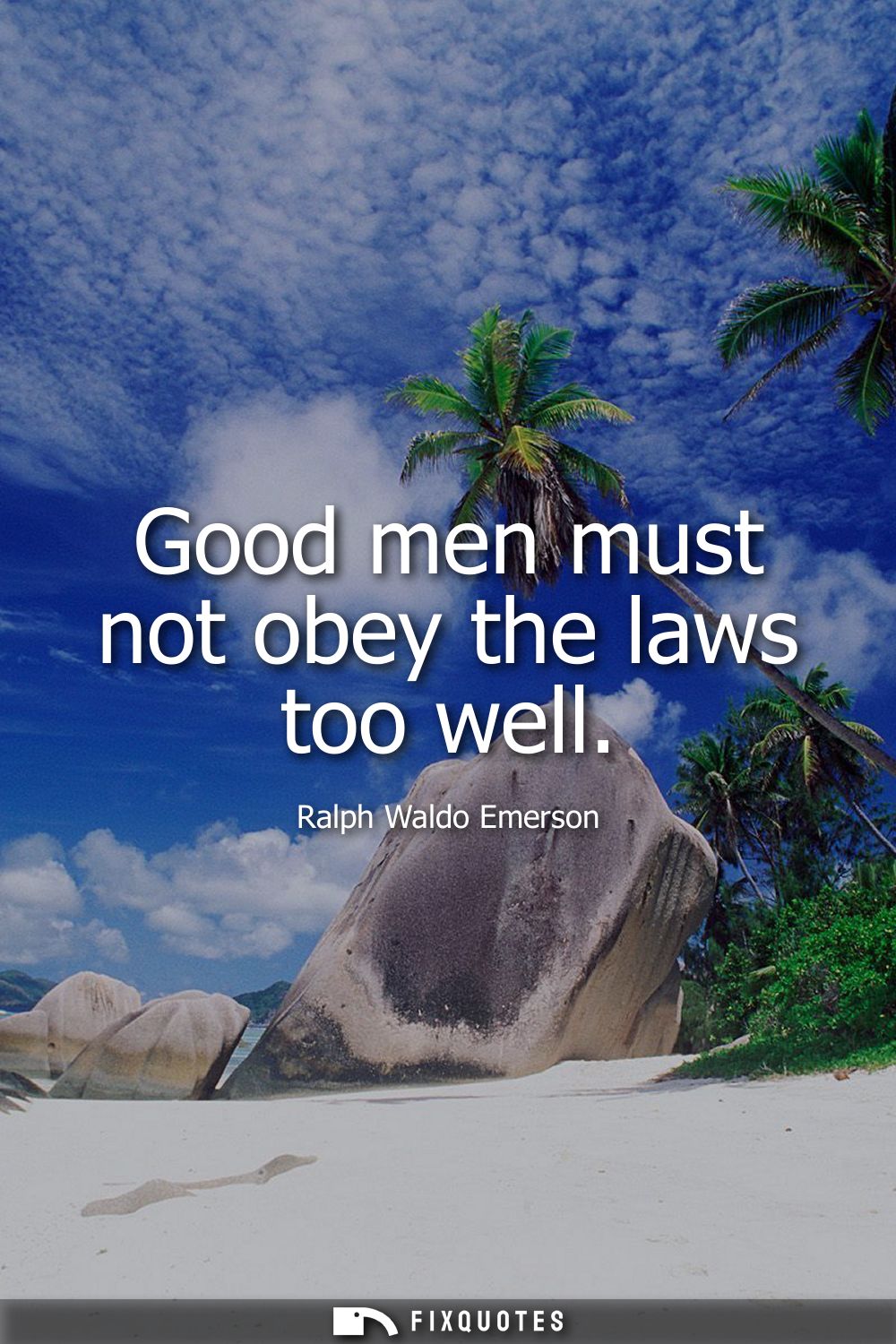
"Good men must not obey the laws too well"
About this Quote
Emerson’s line is a polite-sounding hand grenade: it praises “good men” while quietly accusing the law of being morally insufficient. The target isn’t order; it’s obedience as a substitute for conscience. “Too well” is the needle. It implies that compliance can become its own vice, a kind of moral sleepwalking where legality is mistaken for legitimacy. Emerson isn’t licensing chaos so much as warning that a well-run state can still run in the wrong direction.
The subtext is a theory of complicity. Laws don’t merely restrain bad actors; they recruit decent people into systems that need their cooperation to function. When the law is unjust, the “good” citizen who follows it diligently becomes the most valuable employee of injustice: predictable, disciplined, clean-handed. Emerson’s suspicion of institutions shows up as a rhetorical judo move: the sentence flatters virtue, then redefines virtue as the willingness to be a problem.
Context matters. In the mid-19th century, American law was braided with slavery and enforced through instruments like the Fugitive Slave Act, which deputized ordinary Northerners into returning escaped people to bondage. Emerson’s broader transcendentalist project prized individual moral perception over inherited authority, and his contemporaries (Thoreau, especially) would sharpen this into civil disobedience as a civic obligation.
What makes the line work is its restraint. It doesn’t scream revolt; it nudges the reader toward an uncomfortable thought: if you’re never in conflict with the law, you might be outsourcing your ethics.
The subtext is a theory of complicity. Laws don’t merely restrain bad actors; they recruit decent people into systems that need their cooperation to function. When the law is unjust, the “good” citizen who follows it diligently becomes the most valuable employee of injustice: predictable, disciplined, clean-handed. Emerson’s suspicion of institutions shows up as a rhetorical judo move: the sentence flatters virtue, then redefines virtue as the willingness to be a problem.
Context matters. In the mid-19th century, American law was braided with slavery and enforced through instruments like the Fugitive Slave Act, which deputized ordinary Northerners into returning escaped people to bondage. Emerson’s broader transcendentalist project prized individual moral perception over inherited authority, and his contemporaries (Thoreau, especially) would sharpen this into civil disobedience as a civic obligation.
What makes the line work is its restraint. It doesn’t scream revolt; it nudges the reader toward an uncomfortable thought: if you’re never in conflict with the law, you might be outsourcing your ethics.
Quote Details
| Topic | Ethics & Morality |
|---|
More Quotes by Ralph
Add to List