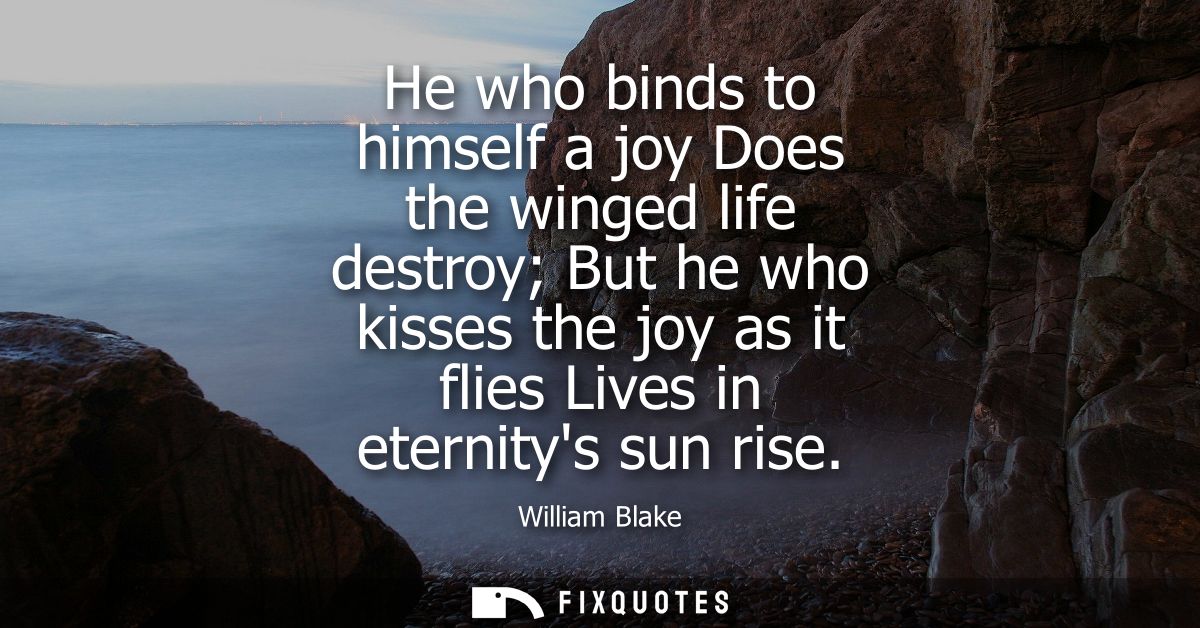
"He who binds to himself a joy Does the winged life destroy; But he who kisses the joy as it flies Lives in eternity's sun rise"
About this Quote
Blake laces a love poem with a warning: possessiveness is a kind of violence, even when the thing you’re grabbing is “joy.” The verb “binds” is doing the dirty work here. It turns happiness into a captive animal, and the penalty is swift and almost ecological: you don’t just lose the joy, you “destroy” the “winged life” itself. Joy, in Blake’s imagination, is not a mood you hoard; it’s a living creature whose nature is motion. Trying to own it is a category error.
The counter-image is exquisitely physical: “kisses the joy as it flies.” A kiss is intimate but nonbinding, a contact that honors transience rather than denying it. Blake’s spiritual logic is paradoxical in the best way: you get something lasting only by refusing to clutch at it. “Eternity’s sun rise” isn’t a trophy you win; it’s the state of being aligned with how life actually moves - cyclical, luminous, perpetually arriving.
Context matters: Blake is writing against a culture (industrial, moralistic, increasingly mechanized) that wants to measure, regulate, and possess. His broader project pits living vision against dead restraint - the same tension that runs through Songs of Innocence and of Experience. The subtext is almost political: control masquerades as care, and the urge to secure pleasure becomes the habit that kills it. Blake offers a discipline that looks like softness but is really radical acceptance: meet joy fully, release it cleanly, and you step into a time larger than your grasping self.
The counter-image is exquisitely physical: “kisses the joy as it flies.” A kiss is intimate but nonbinding, a contact that honors transience rather than denying it. Blake’s spiritual logic is paradoxical in the best way: you get something lasting only by refusing to clutch at it. “Eternity’s sun rise” isn’t a trophy you win; it’s the state of being aligned with how life actually moves - cyclical, luminous, perpetually arriving.
Context matters: Blake is writing against a culture (industrial, moralistic, increasingly mechanized) that wants to measure, regulate, and possess. His broader project pits living vision against dead restraint - the same tension that runs through Songs of Innocence and of Experience. The subtext is almost political: control masquerades as care, and the urge to secure pleasure becomes the habit that kills it. Blake offers a discipline that looks like softness but is really radical acceptance: meet joy fully, release it cleanly, and you step into a time larger than your grasping self.
Quote Details
| Topic | Live in the Moment |
|---|---|
| Source | Eternity — short four-line poem by William Blake containing the lines “He who binds to himself a joy… Lives in eternity’s sunrise.” Commonly anthologized in Blake's collected poems. |
More Quotes by William
Add to List