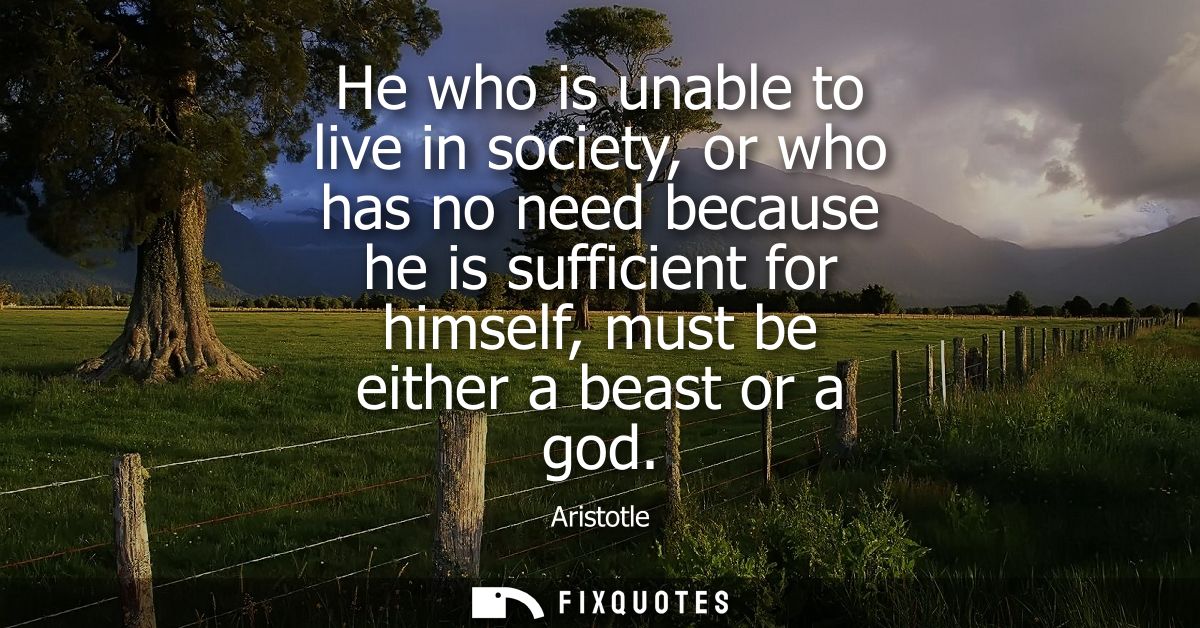
"He who is unable to live in society, or who has no need because he is sufficient for himself, must be either a beast or a god"
About this Quote
The subtext is an argument for the polis as a moral technology. For Aristotle, society isn’t merely where humans happen to live; it’s where reason, character, and accountability get exercised into existence. Outside the web of laws, customs, and mutual recognition, you don’t become freer - you become less formed. That’s why he pairs “unable” with “no need”: whether you’re excluded by incapacity or repelled by pride, the outcome is the same removal from the arena where virtue can be practiced.
Context matters. Aristotle is writing in a world of city-states where citizenship isn’t a vibe but a role with duties, privileges, and public scrutiny. The quote quietly polices that boundary: it elevates civic participation as the default and casts the antisocial as suspect. It also anticipates a modern tension. Today’s cult of autonomy sells self-sufficiency as enlightenment; Aristotle calls it either predation or fantasy, and insists that the human animal is made human only among others.
Quote Details
| Topic | Wisdom |
|---|---|
| Source | Verified source: Politics (Aristotle, 1885)
Evidence: But he who is unable to live in society, or who has no need because he is sufficient for himself, must be either a beast or a god: he is no part of a state. (Book I, Chapter 2 (Bekker 1253a.27)). This wording is the standard English rendering commonly attributed to Aristotle, and it corresponds to Aristotle, Politics, Book I, ch. 2, Bekker 1253a.27 (Greek: “ἢ θηρίον ἢ θεός”). The underlying PRIMARY source is Aristotle’s Politics (4th century BCE), but Aristotle did not ‘publish’ in the modern sense; the earliest identifiable publication details for this exact English sentence are from an English translation tradition. The quote is not misattributed to Aristotle; it is a translation of a genuine passage in Politics. Other candidates (1) Vitoria: Political Writings (Francisco de Vitoria, 1991) compilation97.2% ... Aristotle's assertion that ' he who is unable to live in society , or who has no need because he is sufficient fo... |
| Cite |
Citation Formats
APA Style (7th ed.)
Aristotle. (2026, February 11). He who is unable to live in society, or who has no need because he is sufficient for himself, must be either a beast or a god. FixQuotes. https://fixquotes.com/quotes/he-who-is-unable-to-live-in-society-or-who-has-no-29219/
Chicago Style
Aristotle. "He who is unable to live in society, or who has no need because he is sufficient for himself, must be either a beast or a god." FixQuotes. February 11, 2026. https://fixquotes.com/quotes/he-who-is-unable-to-live-in-society-or-who-has-no-29219/.
MLA Style (9th ed.)
"He who is unable to live in society, or who has no need because he is sufficient for himself, must be either a beast or a god." FixQuotes, 11 Feb. 2026, https://fixquotes.com/quotes/he-who-is-unable-to-live-in-society-or-who-has-no-29219/. Accessed 11 Feb. 2026.