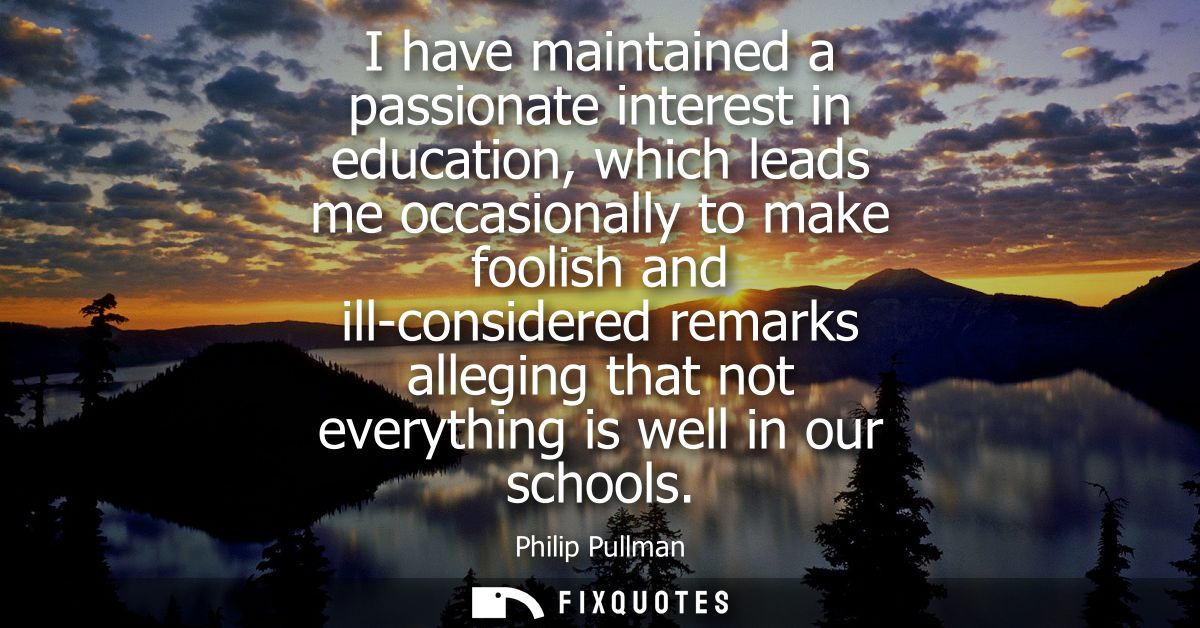
"I have maintained a passionate interest in education, which leads me occasionally to make foolish and ill-considered remarks alleging that not everything is well in our schools"
About this Quote
Pullman opens with the posture of a civic-minded adult and immediately undercuts it with a wink: his "passionate interest in education" doesn’t lead to policy papers or polite panel talk, it leads him to say the unsayable in a culture that often treats schooling as either sacred or untouchable. The punchline is in the false confession. By calling his critiques "foolish and ill-considered", he’s not actually retracting them; he’s parodying the way institutions demand deference. The irony is that the truly "ill-considered" position, he suggests, is the automatic claim that "everything is well."
The line works because it mimics the ritual language of self-censorship: the public intellectual who must apologize for noticing. Pullman is a novelist steeped in arguments about authority, imagination, and the policing of curiosity; he’s also an outspoken critic of reductive testing regimes and the moralizing control adults try to exert over what children read and think. That background makes the sentence feel less like a one-off quip and more like a compressed manifesto: education matters too much to be protected by public-relations optimism.
Subtextually, Pullman is pointing at a familiar inversion. The people most invested in schools, the ones who care enough to be "passionate", are often framed as troublemakers the moment they challenge complacency. He’s mocking the defensive reflex of bureaucracies and politicians who prefer reassuring narratives to honest diagnosis, and he’s inviting readers to hear critique not as betrayal but as a form of loyalty.
The line works because it mimics the ritual language of self-censorship: the public intellectual who must apologize for noticing. Pullman is a novelist steeped in arguments about authority, imagination, and the policing of curiosity; he’s also an outspoken critic of reductive testing regimes and the moralizing control adults try to exert over what children read and think. That background makes the sentence feel less like a one-off quip and more like a compressed manifesto: education matters too much to be protected by public-relations optimism.
Subtextually, Pullman is pointing at a familiar inversion. The people most invested in schools, the ones who care enough to be "passionate", are often framed as troublemakers the moment they challenge complacency. He’s mocking the defensive reflex of bureaucracies and politicians who prefer reassuring narratives to honest diagnosis, and he’s inviting readers to hear critique not as betrayal but as a form of loyalty.
Quote Details
| Topic | Learning |
|---|
More Quotes by Philip
Add to List