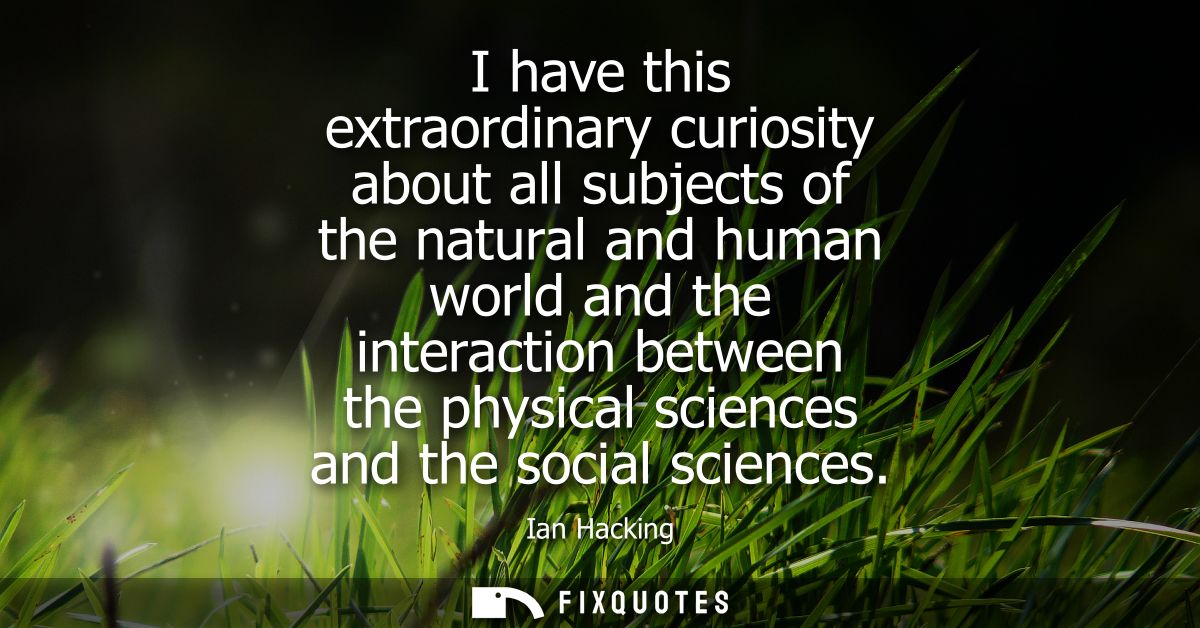
"I have this extraordinary curiosity about all subjects of the natural and human world and the interaction between the physical sciences and the social sciences"
About this Quote
In this quote by Ian Hacking, the speaker reveals a deep and extensive interest in understanding a wide selection of topics covering both the natural world and human society. Ian Hacking, a prominent theorist understood for his work in the philosophy of science, suggests an intellectual interest that does not restrict itself to a single discipline. Rather, he reveals an eager interest in the interconnectedness in between numerous fields, particularly the physical sciences and the social sciences.
The term "amazing curiosity" implies more than a passing interest; it is a driving force for expedition and discovery. This type of interest is not restricted by standard borders or disciplinary silos. Instead, it motivates a holistic technique to learning that acknowledges the intricacies and interdependencies of the world around us.
Hacking's reference to the "natural and human world" encapsulates a broad spectrum of questions. The natural world generally includes the physical sciences-- fields like physics, chemistry, and biology-- that check out the principles governing the physical universe. On the other hand, the human world includes the social sciences-- locations such as sociology, sociology, and psychology-- that concentrate on human habits, societies, and cultures.
By highlighting the "interaction between the physical sciences and the social sciences", Hacking stresses the significance of interdisciplinary research study. For example, comprehending ecological concerns like climate modification requires insights from both natural sciences (to comprehend physical procedures) and social sciences (to attend to human behavior and policy). Similarly, advancements in innovation (an item of the physical sciences) have considerable social implications that are studied within the social sciences.
Eventually, Hacking's quote encourages a synthesis of knowledge across disciplines, cultivating an extensive understanding of the world. This viewpoint is indispensable in taking on the complex, multifaceted obstacles dealt with by society today, where solutions often lie at the intersection of varied understanding fields.
About the Author