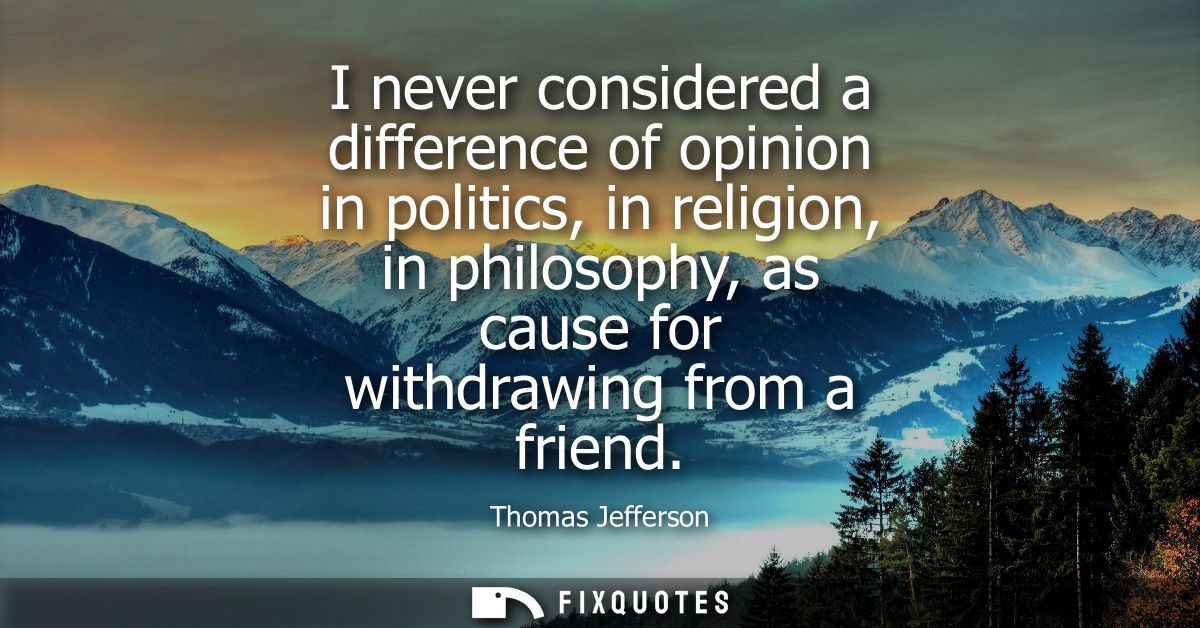
"I never considered a difference of opinion in politics, in religion, in philosophy, as cause for withdrawing from a friend"
About this Quote
There is a practiced civility in Jefferson's line that reads like an early American user manual for pluralism: disagreement is inevitable, friendship is optional, and maturity is measured by whether you can keep the latter intact. The sentence is engineered to sound private and principled, but it also performs public leadership. By stacking "politics, religion, philosophy" he names the three classic tripwires of social rupture, then refuses to grant them veto power over human ties. It's an argument for restraint disguised as a personal preference.
The intent is partly aspirational, partly tactical. Jefferson lived in a political culture that was inventing parties while pretending to hate them. His era's pamphlet wars were vicious; Federalists and Republicans accused each other of monarchism, atheism, treason. Against that backdrop, the quote offers a counter-script: you can fight like hell over the republic and still treat the other person as a person. It implicitly asks citizens to distinguish between convictions and identities, between arguing ideas and exiling people.
The subtext carries a more complicated irony. Jefferson benefited from a social world where "friendship" often meant a network of elite peers who could afford ideological flexibility without risking livelihoods. His own record includes hard-edged partisan combat and private judgments that did, at times, curdle relationships. That tension is what makes the line work: it isn't naive. It's a self-conscious bid to tame politics' centrifugal force, to keep the young country's disagreements from becoming permanent social secession. In 2026 terms, it's a rebuke to the logic of the block button - and a reminder that democracies don't just need votes, they need tolerable neighbors.
The intent is partly aspirational, partly tactical. Jefferson lived in a political culture that was inventing parties while pretending to hate them. His era's pamphlet wars were vicious; Federalists and Republicans accused each other of monarchism, atheism, treason. Against that backdrop, the quote offers a counter-script: you can fight like hell over the republic and still treat the other person as a person. It implicitly asks citizens to distinguish between convictions and identities, between arguing ideas and exiling people.
The subtext carries a more complicated irony. Jefferson benefited from a social world where "friendship" often meant a network of elite peers who could afford ideological flexibility without risking livelihoods. His own record includes hard-edged partisan combat and private judgments that did, at times, curdle relationships. That tension is what makes the line work: it isn't naive. It's a self-conscious bid to tame politics' centrifugal force, to keep the young country's disagreements from becoming permanent social secession. In 2026 terms, it's a rebuke to the logic of the block button - and a reminder that democracies don't just need votes, they need tolerable neighbors.
Quote Details
| Topic | Friendship |
|---|---|
| Source | Help us find the source |
More Quotes by Thomas
Add to List