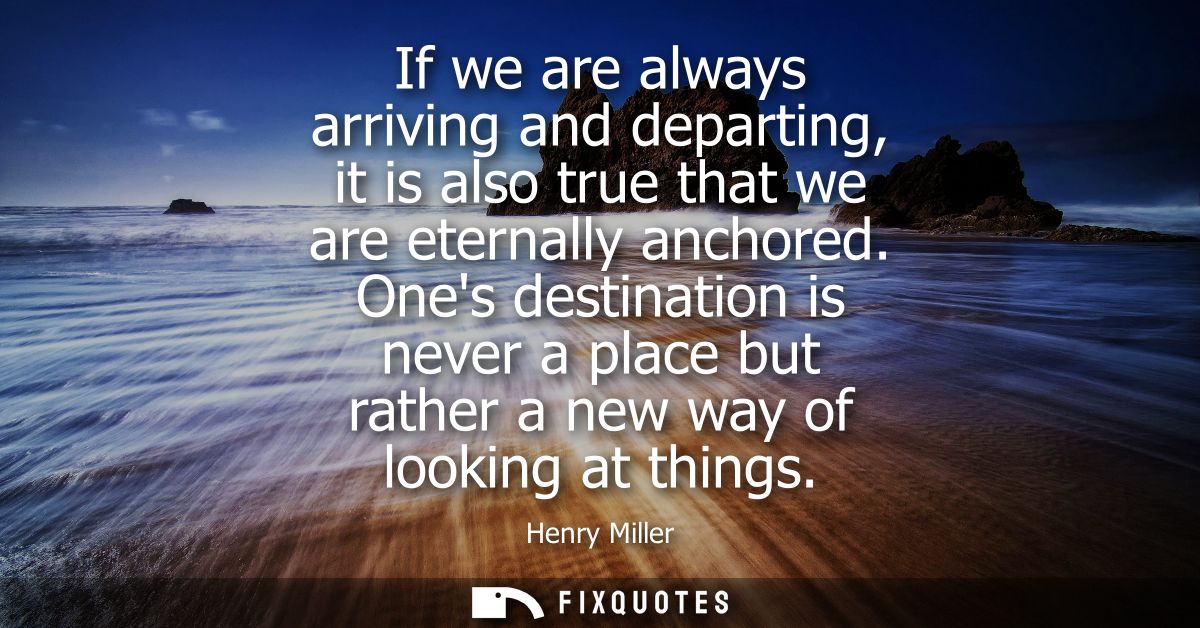
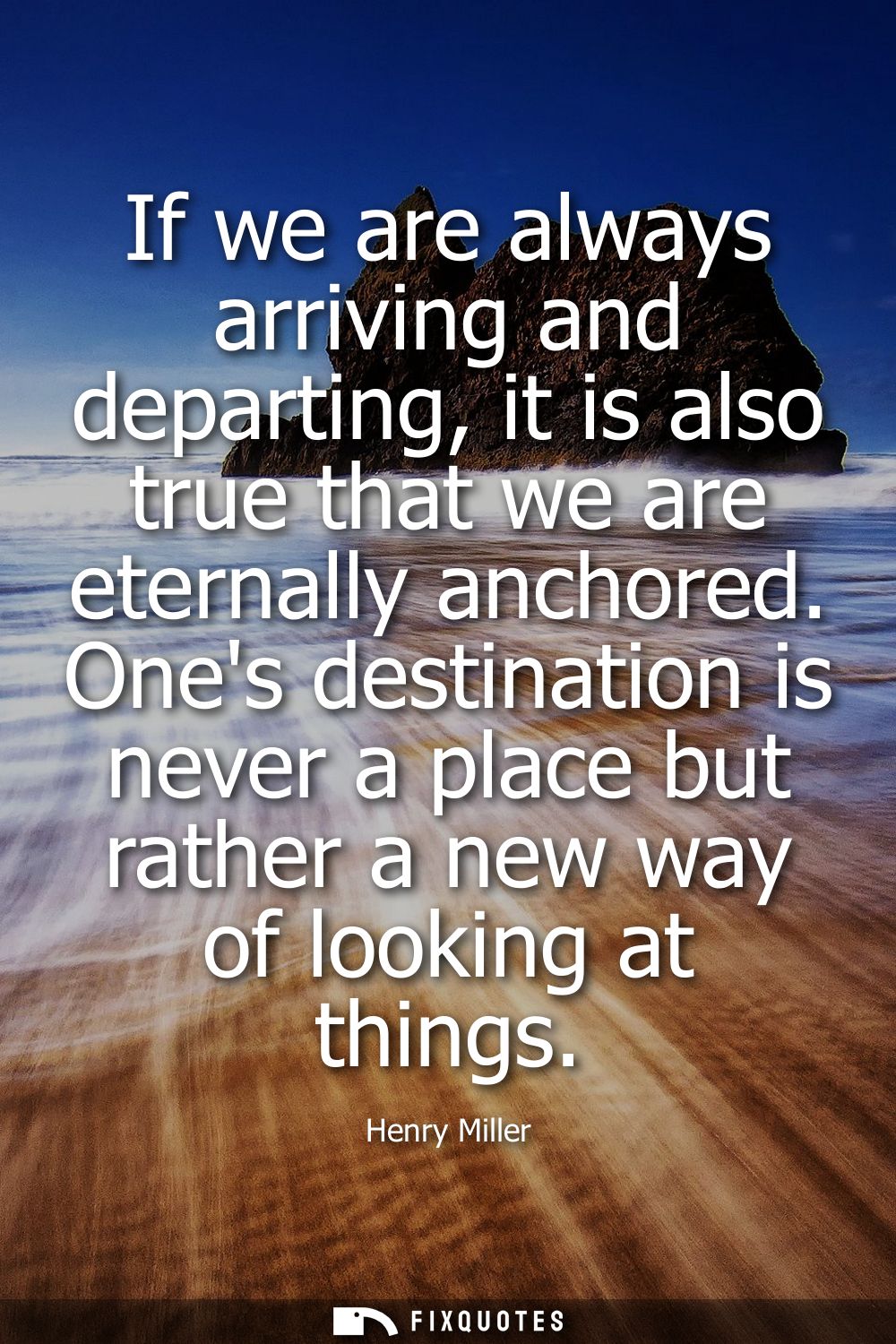
"If we are always arriving and departing, it is also true that we are eternally anchored. One's destination is never a place but rather a new way of looking at things"
About this Quote
Restlessness is Miller's native element, but he refuses to let it stay a lifestyle brand. The line opens on a paradox - always arriving and departing, yet "eternally anchored" - and that tension is the engine of his work: the body in motion, the mind stuck with itself. Travel, in Miller's hands, is less passport stamp than psychic weather. You can flee Brooklyn for Paris, but you bring your hungers, resentments, and private mythologies as carry-on.
The intent here is almost corrective. Miller is needling the romantic fantasy that geography will do your inner work for you. By insisting that the anchor is eternal, he's smuggling in a harder truth: you don't outpace your own consciousness. What changes, if anything changes, is perception. "Destination" becomes an optical metaphor, not a coordinate on a map. That shift makes the sentence function like a small trapdoor; it takes a familiar travel narrative and drops it into a philosophy of attention.
Context matters. Miller wrote out of the early 20th-century expatriate churn, when artists sold Europe as both escape hatch and reinvention kit. His novels - especially the Tropic books - are full of motion and encounter, but also of repetition: the same loops of desire, the same dissatisfaction, the same self-mockery. This quote distills that worldview into a clean aphorism. Its subtext is unsentimental, almost stern: if you're chasing novelty, don't confuse it with transformation. The real itinerary is internal, and the ticket is how you look.
The intent here is almost corrective. Miller is needling the romantic fantasy that geography will do your inner work for you. By insisting that the anchor is eternal, he's smuggling in a harder truth: you don't outpace your own consciousness. What changes, if anything changes, is perception. "Destination" becomes an optical metaphor, not a coordinate on a map. That shift makes the sentence function like a small trapdoor; it takes a familiar travel narrative and drops it into a philosophy of attention.
Context matters. Miller wrote out of the early 20th-century expatriate churn, when artists sold Europe as both escape hatch and reinvention kit. His novels - especially the Tropic books - are full of motion and encounter, but also of repetition: the same loops of desire, the same dissatisfaction, the same self-mockery. This quote distills that worldview into a clean aphorism. Its subtext is unsentimental, almost stern: if you're chasing novelty, don't confuse it with transformation. The real itinerary is internal, and the ticket is how you look.
Quote Details
| Topic | Wisdom |
|---|---|
| Source | Help us find the source |
More Quotes by Henry
Add to List