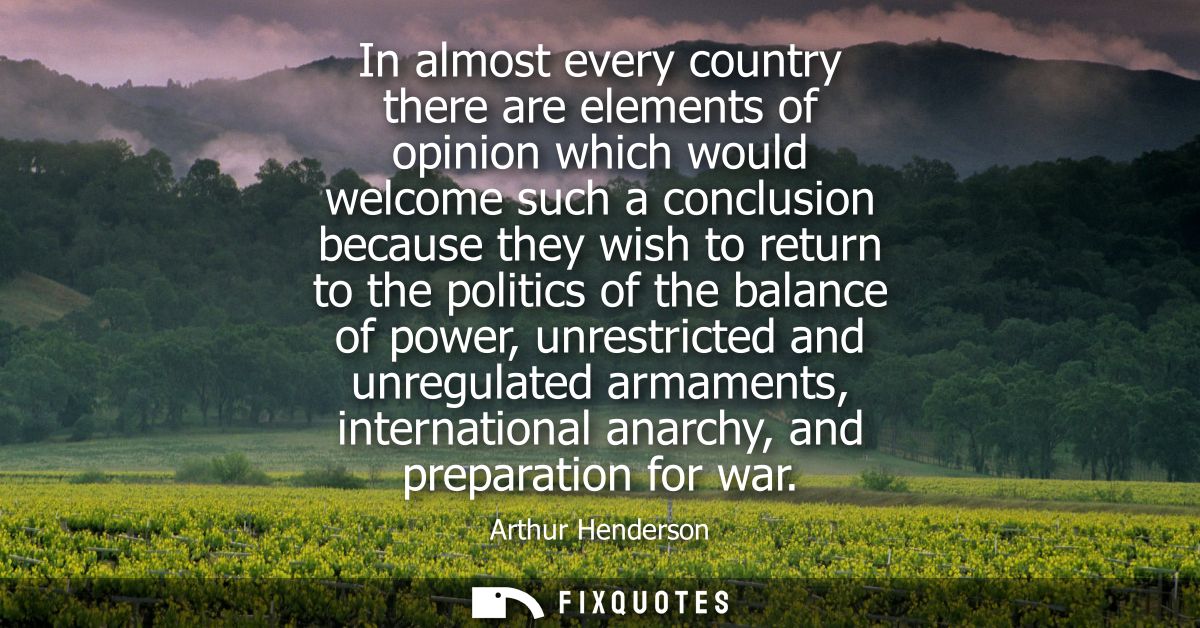
"In almost every country there are elements of opinion which would welcome such a conclusion because they wish to return to the politics of the balance of power, unrestricted and unregulated armaments, international anarchy, and preparation for war"
About this Quote
Arthur Henderson's quote reflects on the geopolitical beliefs and characteristics of the interwar duration, especially in the context of post-World War I international relations. The quote recommends there are factions, or "aspects of opinion", within different countries that favor going back to a traditional method to worldwide politics identified by competitive power politics, instead of cooperative and regulated structures.
The "politics of the balance of power" refers to a historical technique where states looked for to prevent any one nation from becoming too powerful by balancing the military capabilities of different countries. This often involved forming alliances and counter-alliances, which can cause an unsteady worldwide environment. Henderson recommends that some factions long for a return to this system, potentially as a way to keep national sovereignty and assert supremacy on the worldwide phase.
The reference to "unrestricted and unregulated armaments" points to the desire of these groups to engage in an arms race, collecting weapons without global treaties or guidelines to limit their military abilities. This unlimited weaponry is often a precursor to dispute, as nations view that they should continually build up their armed forces to deter potential threats.
"International anarchy" is a term used to describe a state of affairs where there is no central authority to implement guidelines or mediate disagreements, resulting in a chaotic global system where might makes right. The factions Henderson refers to are portrayed as preferring such anarchy, where power rather than law governs global relations.
Lastly, "preparation for war" underscores a mindset concentrated on militarization and the anticipation of dispute as inevitable. These factions see war as a tool of diplomacy and nationwide policy, entrenched in war preparedness rather than peacebuilding.
Henderson's issue is that, by yearning for these aspects, these groups threaten efforts towards accomplishing lasting peace through disarmament, diplomacy, and worldwide cooperation, concepts he and the League of Nations advocated for in the interwar years.
More details
About the Author