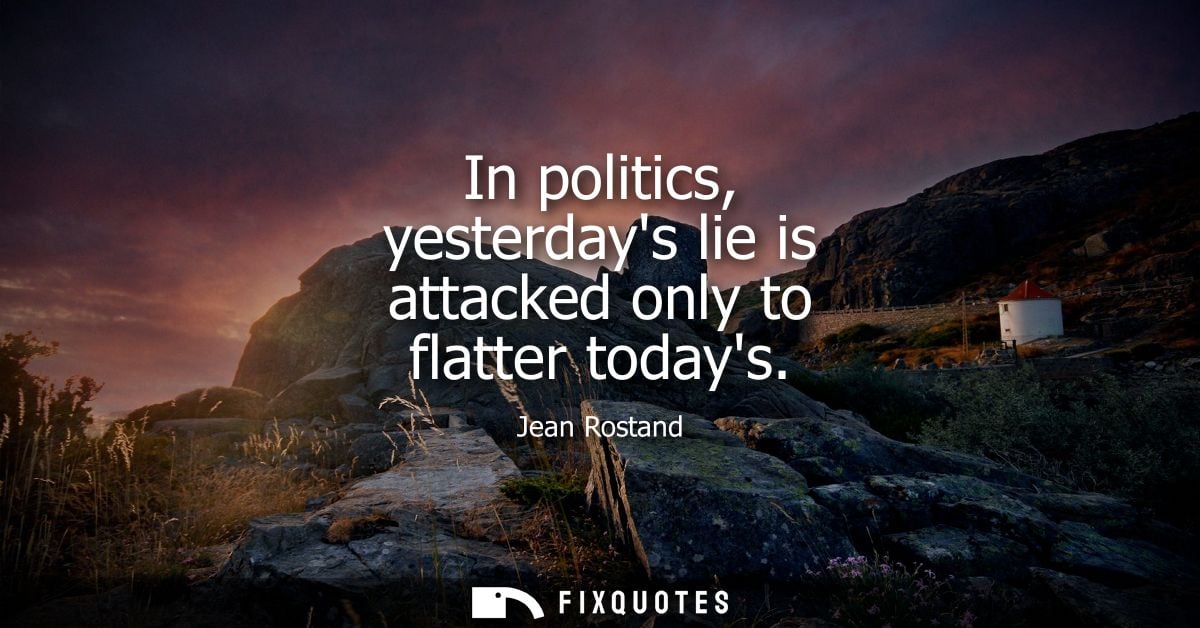
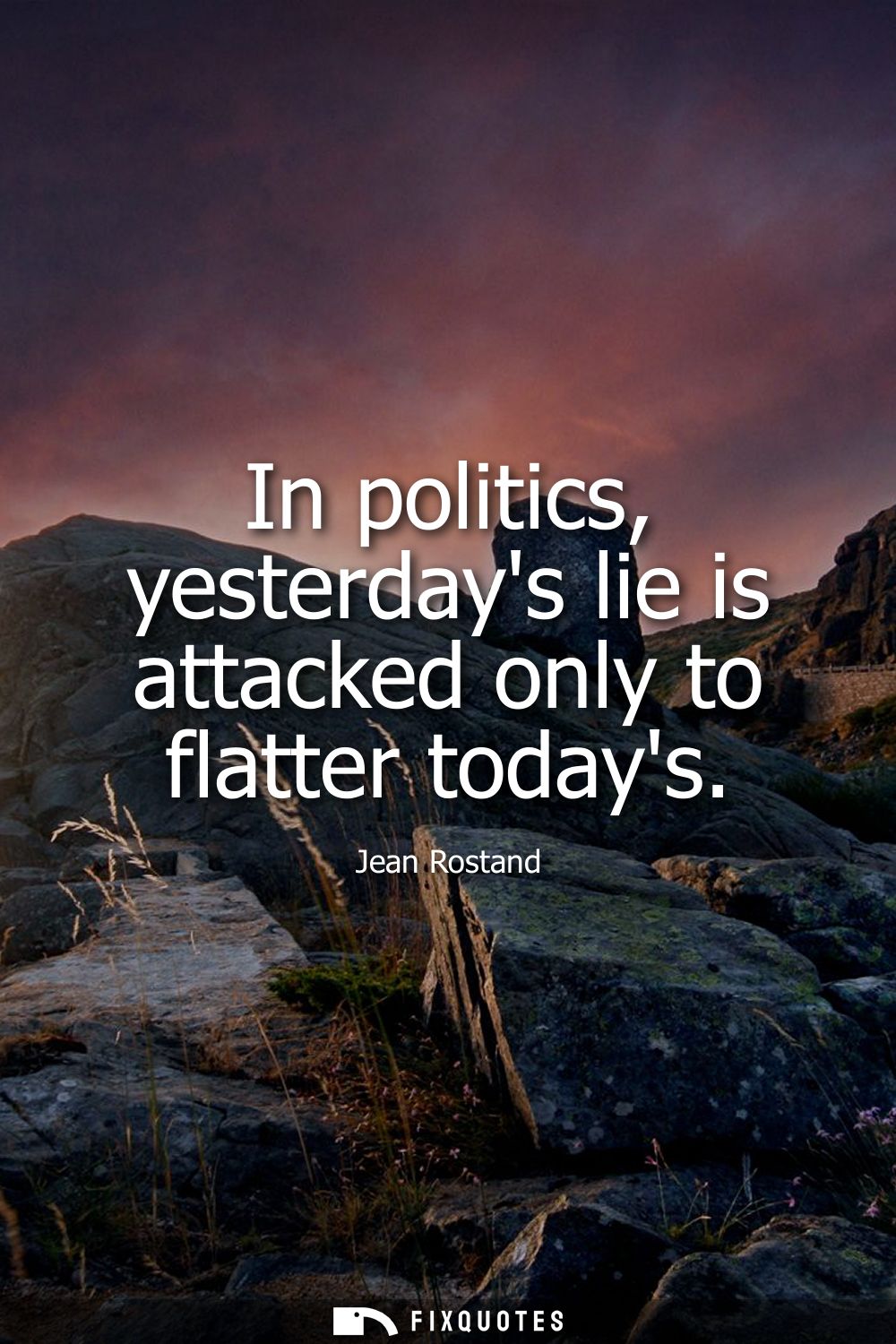
"In politics, yesterday's lie is attacked only to flatter today's"
About this Quote
Politics doesn’t punish lying; it rotates lies the way fashion rotates hemlines. Rostand’s line lands because it treats “attack” as performance, not accountability. The target isn’t deception itself, but the rival lie that’s gone stale. Yesterday’s falsehood becomes useful again only as a prop to endorse the newer one: outrage deployed as marketing copy.
The syntax does the work. “Attacked only to flatter” is a brutal reversal of what democratic debate claims to be. Attack is supposed to be corrective, a cleansing moment where facts reassert themselves. Rostand suggests the opposite: the takedown is instrumental, a tactical feint that clears narrative space for the next convenient fabrication. It’s cynicism, but not lazy cynicism; it’s observational, almost clinical. That tracks with a scientist’s sensibility: look past stated motives, measure incentives, describe the system’s behavior.
The subtext is about temporality and attention. “Yesterday” and “today” aren’t calendar markers so much as news cycles. Lies expire, not because they’re disproven, but because they stop yielding power. When a politician denounces a prior claim, Rostand implies, the audience should ask: what story is being installed in its place? The moral theater of repudiation becomes the lubricant of continuity.
Contextually, Rostand lived through propaganda’s industrial age: mass newspapers, radio, two world wars, competing ideologies selling reality as a product. His warning feels contemporary because our platforms intensify the same mechanism. The fact-check may trend, but it often functions as a launchpad for the next myth with better branding.
The syntax does the work. “Attacked only to flatter” is a brutal reversal of what democratic debate claims to be. Attack is supposed to be corrective, a cleansing moment where facts reassert themselves. Rostand suggests the opposite: the takedown is instrumental, a tactical feint that clears narrative space for the next convenient fabrication. It’s cynicism, but not lazy cynicism; it’s observational, almost clinical. That tracks with a scientist’s sensibility: look past stated motives, measure incentives, describe the system’s behavior.
The subtext is about temporality and attention. “Yesterday” and “today” aren’t calendar markers so much as news cycles. Lies expire, not because they’re disproven, but because they stop yielding power. When a politician denounces a prior claim, Rostand implies, the audience should ask: what story is being installed in its place? The moral theater of repudiation becomes the lubricant of continuity.
Contextually, Rostand lived through propaganda’s industrial age: mass newspapers, radio, two world wars, competing ideologies selling reality as a product. His warning feels contemporary because our platforms intensify the same mechanism. The fact-check may trend, but it often functions as a launchpad for the next myth with better branding.
Quote Details
| Topic | Honesty & Integrity |
|---|
More Quotes by Jean
Add to List