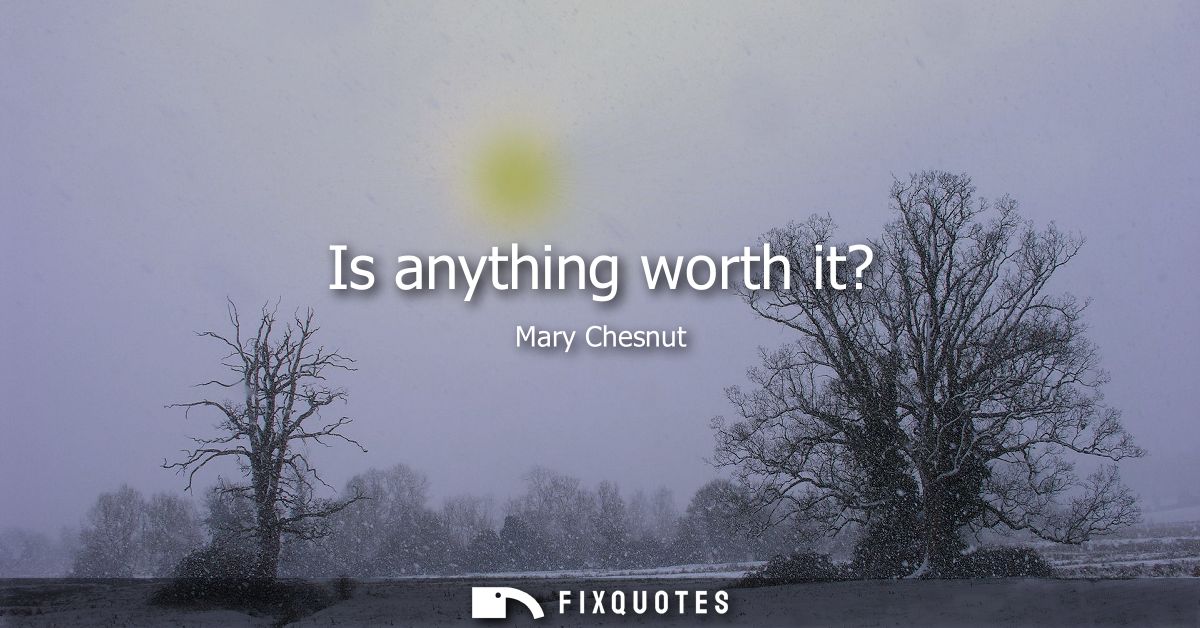
"Is anything worth it?"
About this Quote
A bare question like "Is anything worth it?" is the kind of sentence that pretends to be philosophical while really being diagnostic: a pulse check on the soul when the world has stopped cooperating. In Mary Chesnut's hands, it lands with particular force because her writing comes from a society mid-collapse, where "worth" is not an abstract category but a ledger item measured in blood, status, property, and self-deception.
Chesnut, the sharpest diarist of the Confederate elite, had a gift for watching the machinery of power from the inside and refusing to romanticize it. That makes the line read less like a private sigh and more like a quietly corrosive verdict. The question is so general it becomes an indictment: if the grand cause, the sacrifices, the elaborate codes of honor are all supposedly meaningful, why does the lived experience feel so thin, so punishing, so morally compromised?
The intent isn’t to solicit an answer; it’s to expose a widening gap between public scripts and private reality. It’s also a subtle act of rebellion. For a woman in Chesnut’s position, direct political agency was constrained, but the rhetorical move of doubt is power: it withdraws consent from the story everyone is required to tell. The subtext is exhaustion, yes, but also clarity. When systems justify themselves through slogans, a simple question becomes a weapon. Chesnut’s brilliance is that she doesn’t swing it dramatically. She just lets it hang there, unanswered, and the silence does the work.
Chesnut, the sharpest diarist of the Confederate elite, had a gift for watching the machinery of power from the inside and refusing to romanticize it. That makes the line read less like a private sigh and more like a quietly corrosive verdict. The question is so general it becomes an indictment: if the grand cause, the sacrifices, the elaborate codes of honor are all supposedly meaningful, why does the lived experience feel so thin, so punishing, so morally compromised?
The intent isn’t to solicit an answer; it’s to expose a widening gap between public scripts and private reality. It’s also a subtle act of rebellion. For a woman in Chesnut’s position, direct political agency was constrained, but the rhetorical move of doubt is power: it withdraws consent from the story everyone is required to tell. The subtext is exhaustion, yes, but also clarity. When systems justify themselves through slogans, a simple question becomes a weapon. Chesnut’s brilliance is that she doesn’t swing it dramatically. She just lets it hang there, unanswered, and the silence does the work.
Quote Details
| Topic | Meaning of Life |
|---|
More Quotes by Mary
Add to List