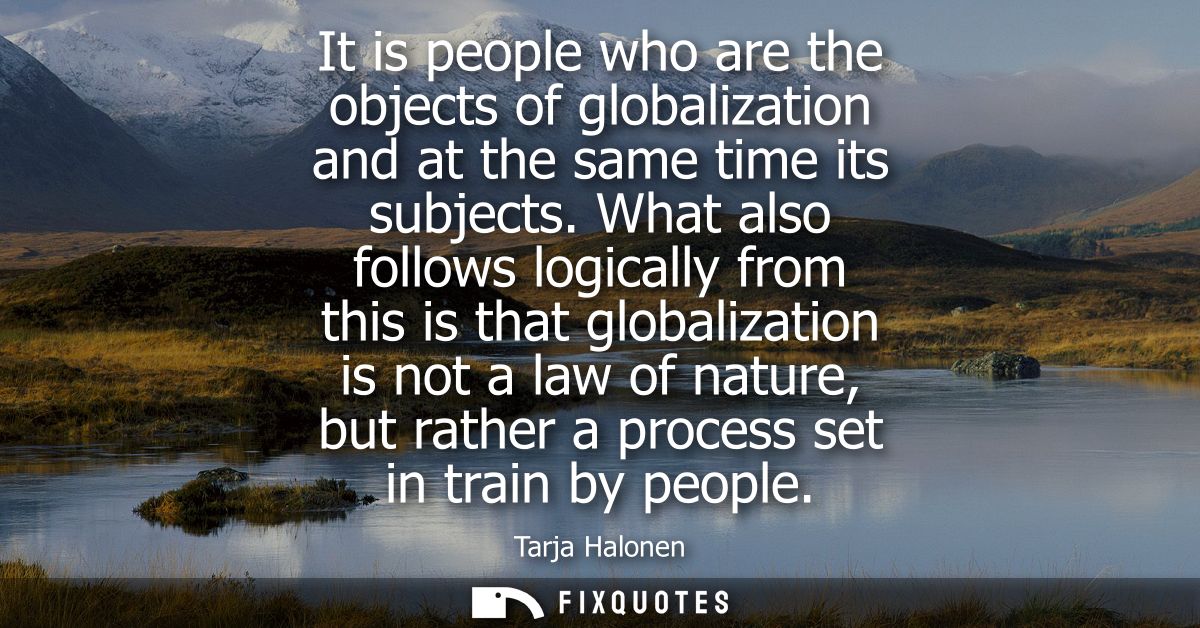
"It is people who are the objects of globalization and at the same time its subjects. What also follows logically from this is that globalization is not a law of nature, but rather a process set in train by people"
About this Quote
Halonen’s line does a neat political reversal: globalization isn’t the weather, it’s policy. By insisting that people are both the objects and the subjects of globalization, she punctures a common rhetorical escape hatch used by governments and corporations alike - the idea that “global forces” simply happen to us, and that leaders can only manage the fallout. Her syntax matters here. “Objects” evokes bodies moved by decisions made elsewhere: jobs outsourced, borders hardened, data extracted, welfare states pressured into “competitiveness.” “Subjects” reclaims agency, implying citizens, workers, and voters are not just impacted populations but the authors of the rules, treaties, and institutions that shape cross-border life.
The subtext is a warning about accountability. If globalization is “not a law of nature,” then its winners and losers are not accidents; they’re design outcomes. Halonen, coming from Finland’s social-democratic tradition and a small-state perspective, is implicitly defending the legitimacy of political choice against the fatalism of “there is no alternative.” For small countries especially, treating globalization as inevitable can become a convenient excuse for shrinking labor protections, underfunding public goods, or accepting asymmetrical trade arrangements.
There’s also a democratic dare embedded in the phrasing: if people set the process in train, people can reset its direction. The quote isn’t anti-globalization so much as anti-mystification. It asks the reader to look past the abstraction and name the actual actors - legislators, CEOs, central bankers, voters - and then to argue, openly, about what kind of global integration we want and who it should serve.
The subtext is a warning about accountability. If globalization is “not a law of nature,” then its winners and losers are not accidents; they’re design outcomes. Halonen, coming from Finland’s social-democratic tradition and a small-state perspective, is implicitly defending the legitimacy of political choice against the fatalism of “there is no alternative.” For small countries especially, treating globalization as inevitable can become a convenient excuse for shrinking labor protections, underfunding public goods, or accepting asymmetrical trade arrangements.
There’s also a democratic dare embedded in the phrasing: if people set the process in train, people can reset its direction. The quote isn’t anti-globalization so much as anti-mystification. It asks the reader to look past the abstraction and name the actual actors - legislators, CEOs, central bankers, voters - and then to argue, openly, about what kind of global integration we want and who it should serve.
Quote Details
| Topic | Human Rights |
|---|
More Quotes by Tarja
Add to List