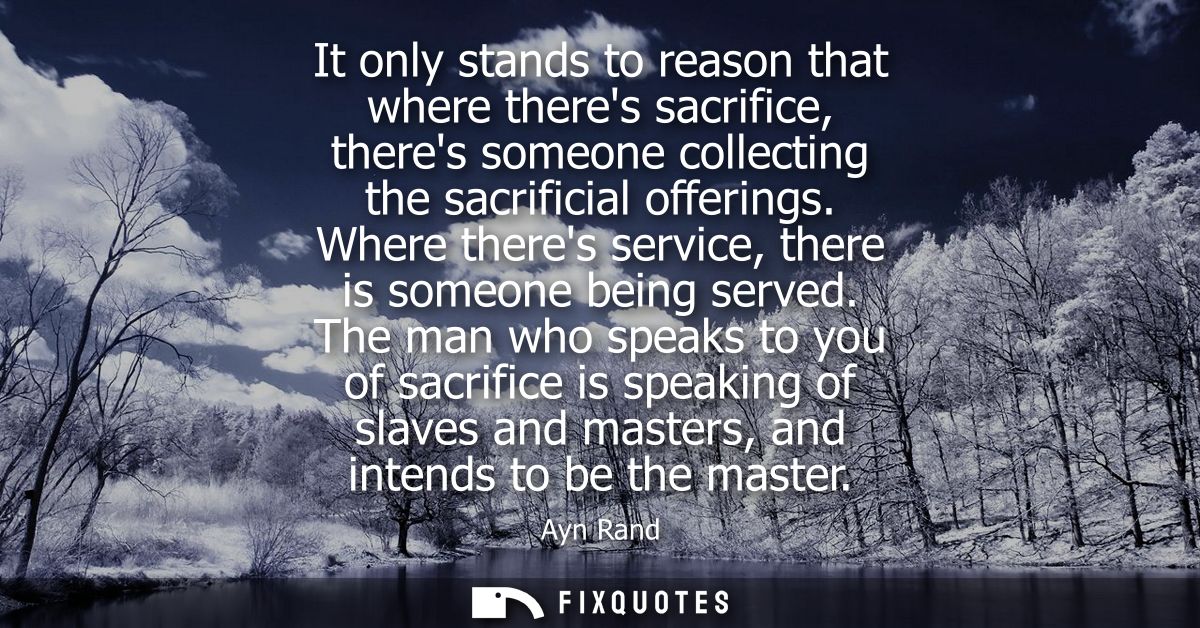
"It only stands to reason that where there's sacrifice, there's someone collecting the sacrificial offerings. Where there's service, there is someone being served. The man who speaks to you of sacrifice is speaking of slaves and masters, and intends to be the master"
About this Quote
Sacrifice, in Ayn Rand's vocabulary, is not noble self-restraint; it is the surrender of a higher value to a lower one. Follow that definition and the moral glow around self-sacrifice fades into a concrete transaction: someone gives up, someone else takes in. The language of service similarly implies a beneficiary. Rand urges you to look behind exhortations to serve and ask who gains power, prestige, or material advantage from your loss.
This is the polemical core of her ethics of rational self-interest. She does not condemn generosity or love; she condemns a moral code that treats your life as a claim others can file. Voluntary help to those you value can be an exchange of values that enriches both sides; coerced abnegation demanded as duty turns the relationship into a hierarchy of masters and slaves. The person who preaches sacrifice, she suggests, is not inviting shared flourishing but seeking sanction to rule.
The historical backdrop matters. Having fled Soviet Russia, Rand distrusted collectivist appeals to the common good and religious calls to self-denial, seeing in them the same mechanism of control. Her novels dramatize producers and creators being morally disarmed by guilt, then exploited by bureaucrats, intellectuals, and political looters who claim the right to redistribute their effort. The rhetoric of morality becomes a tool of power.
Critics argue that this misses the reality of mutual aid and civic responsibility, yet the provocation remains a useful test: if a code of virtue requires your silence, your guilt, and your exhaustion while others issue orders and collect the rewards, you are not witnessing morality but domination. Applied to modern life, the warning reaches from state policy to corporate culture, where calls to serve the mission can mask one-way extraction. Rand counters with an alternative ideal: pride in productive work, trade by consent, and relationships chosen without self-immolation, where no one owns another under the banner of virtue.
This is the polemical core of her ethics of rational self-interest. She does not condemn generosity or love; she condemns a moral code that treats your life as a claim others can file. Voluntary help to those you value can be an exchange of values that enriches both sides; coerced abnegation demanded as duty turns the relationship into a hierarchy of masters and slaves. The person who preaches sacrifice, she suggests, is not inviting shared flourishing but seeking sanction to rule.
The historical backdrop matters. Having fled Soviet Russia, Rand distrusted collectivist appeals to the common good and religious calls to self-denial, seeing in them the same mechanism of control. Her novels dramatize producers and creators being morally disarmed by guilt, then exploited by bureaucrats, intellectuals, and political looters who claim the right to redistribute their effort. The rhetoric of morality becomes a tool of power.
Critics argue that this misses the reality of mutual aid and civic responsibility, yet the provocation remains a useful test: if a code of virtue requires your silence, your guilt, and your exhaustion while others issue orders and collect the rewards, you are not witnessing morality but domination. Applied to modern life, the warning reaches from state policy to corporate culture, where calls to serve the mission can mask one-way extraction. Rand counters with an alternative ideal: pride in productive work, trade by consent, and relationships chosen without self-immolation, where no one owns another under the banner of virtue.
Quote Details
| Topic | Freedom |
|---|
More Quotes by Ayn
Add to List