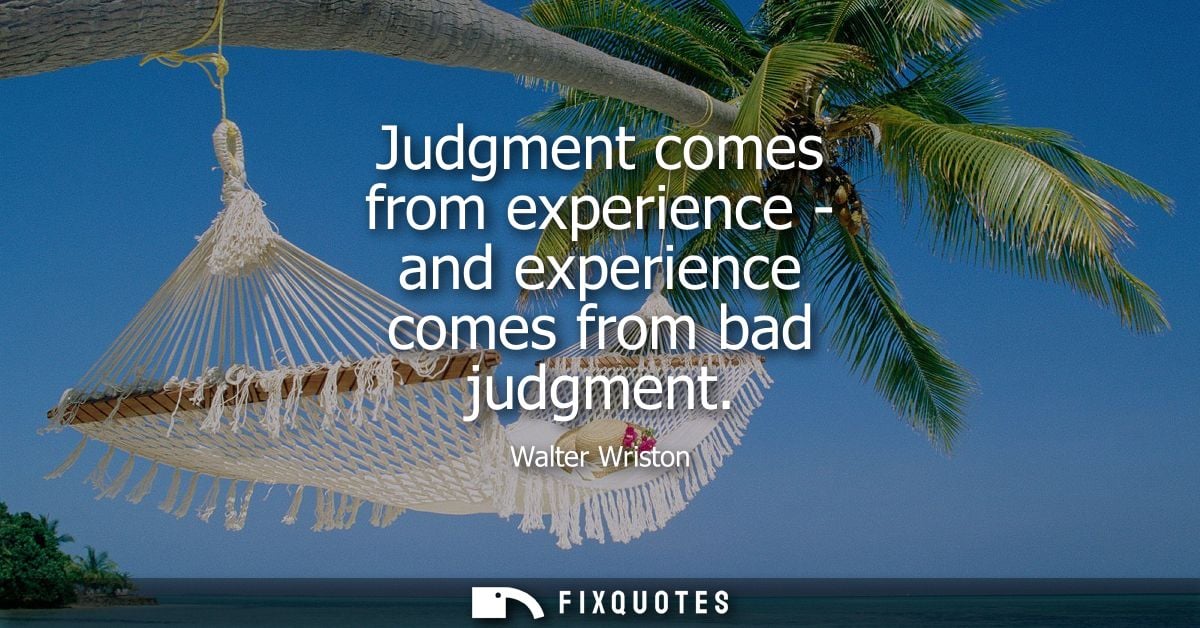
"Judgment comes from experience - and experience comes from bad judgment"
About this Quote
Wriston’s line has the clipped confidence of a man who spent his career betting on uncertainty and pretending it was a science. “Judgment” is usually marketed as an executive virtue, something you accumulate like frequent-flyer miles: sit through enough meetings, read enough reports, and wisdom arrives on schedule. He punctures that fantasy with a grin. The only reliable factory for judgment is experience, and the raw material for experience is error. Not just any error, either: “bad judgment,” the kind that stings, costs money, dents reputations, and can’t be polished into a neat PowerPoint lesson until after the damage is done.
The subtext is almost managerial heresy. It quietly absolves failure while refusing to romanticize it. Wriston isn’t saying mistakes are good; he’s saying they’re inevitable, and the people most worth trusting are the ones who’ve already paid tuition. Coming from a titan of late-20th-century finance, that matters. Wriston helped shape the modern banking ethos: globalized capital, larger bets, sophisticated risk models, the sense that complexity could be mastered. This quote is the necessary antidote to that swagger, a reminder that models don’t produce judgment, consequences do.
It also functions as a cultural permission slip inside high-stakes institutions: stop demanding spotless resumes, stop punishing every misstep as moral failure, and start building organizations where errors are survivable and therefore instructive. The wisdom lands because it’s brutally recursive: if you want better leaders, you have to tolerate the very thing you claim to hate.
The subtext is almost managerial heresy. It quietly absolves failure while refusing to romanticize it. Wriston isn’t saying mistakes are good; he’s saying they’re inevitable, and the people most worth trusting are the ones who’ve already paid tuition. Coming from a titan of late-20th-century finance, that matters. Wriston helped shape the modern banking ethos: globalized capital, larger bets, sophisticated risk models, the sense that complexity could be mastered. This quote is the necessary antidote to that swagger, a reminder that models don’t produce judgment, consequences do.
It also functions as a cultural permission slip inside high-stakes institutions: stop demanding spotless resumes, stop punishing every misstep as moral failure, and start building organizations where errors are survivable and therefore instructive. The wisdom lands because it’s brutally recursive: if you want better leaders, you have to tolerate the very thing you claim to hate.
Quote Details
| Topic | Learning from Mistakes |
|---|
More Quotes by Walter
Add to List