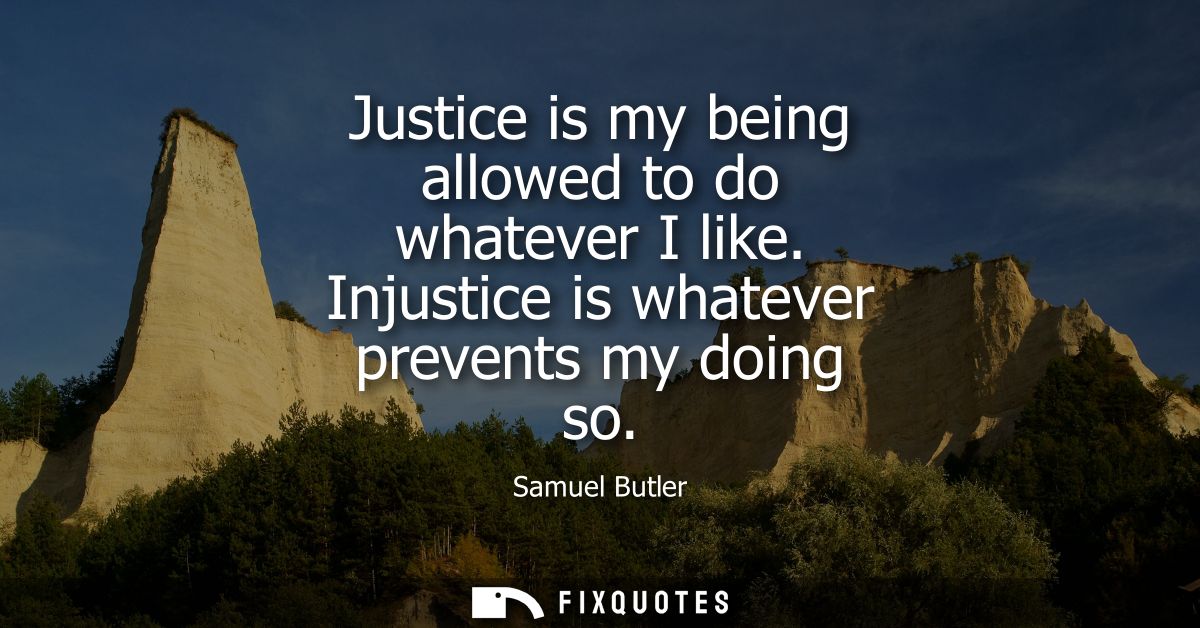
"Justice is my being allowed to do whatever I like. Injustice is whatever prevents my doing so"
About this Quote
Samuel Butler’s definition of justice and injustice is deliberately provocative, laying bare the inherent subjectivity of human desires when faced with the structures of law, society, and morality. By equating justice with unrestrained personal liberty, doing whatever one pleases, Butler constructs a vision radically at odds with traditional ideals of justice as fairness, virtue, or adherence to social norms. He frames justice not as an objective standard but as an individual’s perfect freedom, centering ego and personal desire as the criterion for what is right.
In his formulation, injustice is simply anything that restricts this personal freedom. Here, Butler exposes two intertwined themes: the tension between individual will and societal constraints, and the tendency of people to define virtue and vice in terms amenable to their own interests. This perspective spotlights a kind of moral solipsism, where the self interprets the world exclusively through its own wants. He performs a subtle satire of human self-centeredness; the reader is forced to confront how their own interpretations of justice are often colored by personal advantage or inconvenience.
Yet, Butler’s words also underscore the impossibility and chaos inherent in absolute personal liberty. If everyone defines justice as whatever pleases them and injustice as whatever impedes them, society cannot function. The inevitable clash of desires would make coexistence untenable. Rules, laws, and shared understandings of justice emerge precisely because unbridled freedom for all is self-defeating; my freedom to act may directly prevent yours. Butler’s aphorism, then, contains a critique of both untempered individualism and the hypocrisy with which people invoke justice. It functions both as a mirror and as a warning, alerting us to the dangers of self-interest masquerading as moral right. The quote unsettles easy assumptions about justice, encouraging deeper reflection on the delicate balance between personal freedom and collective order.
About the Author