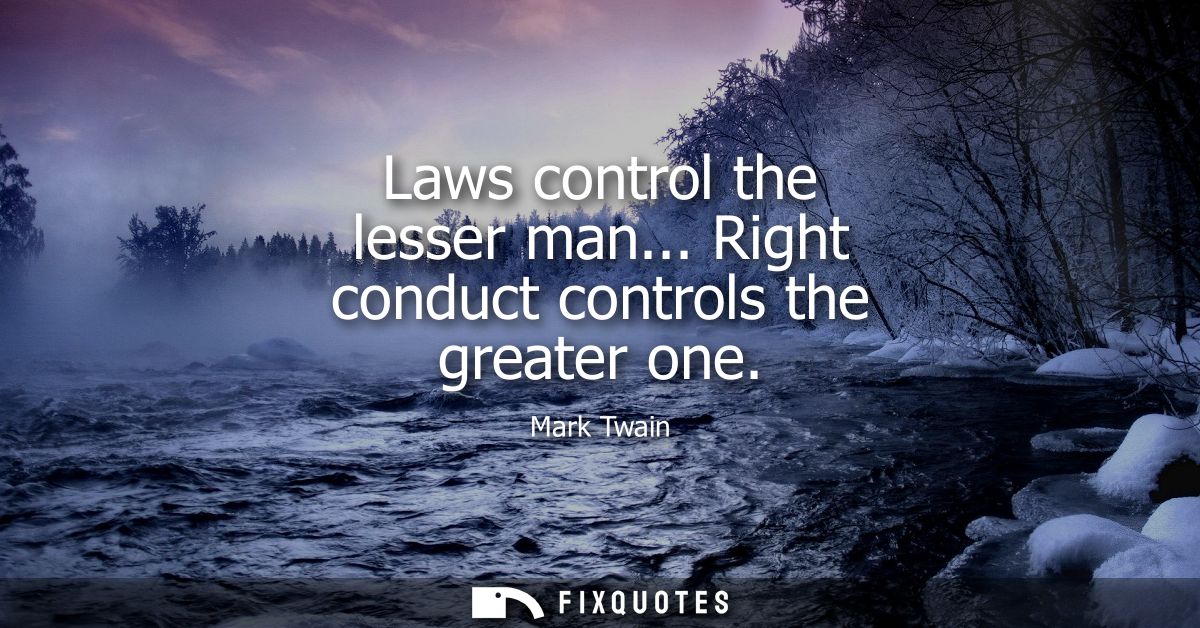
"Laws control the lesser man... Right conduct controls the greater one"
About this Quote
Twain lands a moral gut-punch in the space where America most likes to congratulate itself: the rule of law. "Laws control the lesser man" isn’t an ode to order; it’s a jab at people who need the threat of punishment to behave. He’s prying apart legality and morality and then daring you to notice how often we confuse them. The line works because it flatters and indicts at once. Everyone wants to imagine they’re the "greater one" guided by conscience, not cops. Twain knows that vanity and uses it as bait.
The subtext is classic Twain cynicism about respectability. In his world, laws are frequently written by the powerful, enforced unevenly, and treated as proof of virtue by people who benefit from them. So "lesser" isn’t just a personal failing; it’s a social type: the citizen who mistakes compliance for character, who can be herded by statutes because he’s outsourced his ethics. Meanwhile, "right conduct" suggests an internal compass that can survive bad laws, selective enforcement, or public applause. It’s an argument for integrity that doesn’t need witnesses.
Context matters: Twain watched a nation preach liberty while tolerating slavery’s afterlives, Gilded Age corruption, and moral posturing wrapped in legal language. The quote reads like a compressed version of his larger project: exposing how easily "law-abiding" becomes a substitute for being decent, and how true decency often requires resisting the legal order that claims to represent it.
The subtext is classic Twain cynicism about respectability. In his world, laws are frequently written by the powerful, enforced unevenly, and treated as proof of virtue by people who benefit from them. So "lesser" isn’t just a personal failing; it’s a social type: the citizen who mistakes compliance for character, who can be herded by statutes because he’s outsourced his ethics. Meanwhile, "right conduct" suggests an internal compass that can survive bad laws, selective enforcement, or public applause. It’s an argument for integrity that doesn’t need witnesses.
Context matters: Twain watched a nation preach liberty while tolerating slavery’s afterlives, Gilded Age corruption, and moral posturing wrapped in legal language. The quote reads like a compressed version of his larger project: exposing how easily "law-abiding" becomes a substitute for being decent, and how true decency often requires resisting the legal order that claims to represent it.
Quote Details
| Topic | Ethics & Morality |
|---|
More Quotes by Mark
Add to List