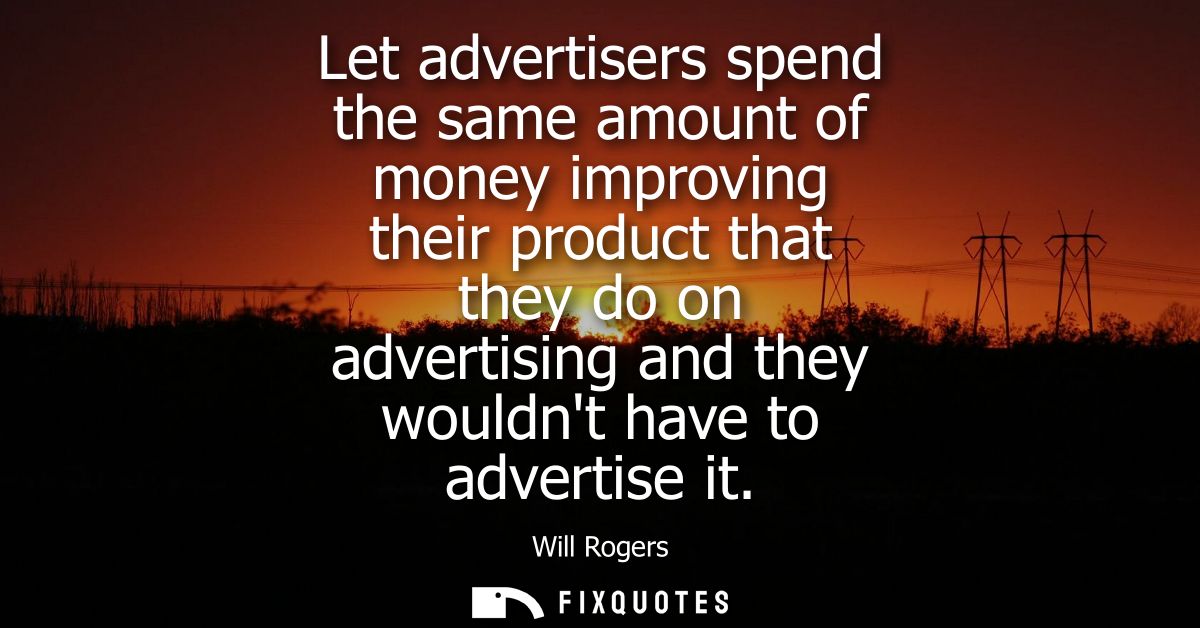
"Let advertisers spend the same amount of money improving their product that they do on advertising and they wouldn't have to advertise it"
About this Quote
Rogers lands the punch with a homespun if-then that sounds like common sense and bites like indictment. The line is built to feel fair: he isn’t banning advertising, he’s proposing a neat trade. But the neatness is the trick. By implying that the entire budget for persuasion is a confession of inadequate quality, he drags marketing out of the neutral realm of “information” and into the moral realm of “cover-up.”
The subtext is a suspicion about modernity itself. In Rogers’s America, mass production is scaling faster than trust. Brands are learning that you can manufacture desire as efficiently as you can manufacture soap, and the quote refuses to treat that as clever. It frames advertising as a kind of tax consumers pay for other people’s shortcuts: money spent polishing the story instead of the thing.
As an actor and public humorist, Rogers understood performance. That’s what gives the jab extra heat: he’s not naively opposed to selling; he’s pointing out that selling has become the product. The line also anticipates the psychological turn in advertising that accelerated in the 1920s and 1930s, when campaigns increasingly traded on status, fear, and aspiration rather than basic utility. His logic is intentionally reductive because the target is cultural: a system that rewards appearances, then congratulates itself for being “efficient.”
It still works because it names an uncomfortable dynamic we recognize instantly: when hype grows, faith in substance shrinks.
The subtext is a suspicion about modernity itself. In Rogers’s America, mass production is scaling faster than trust. Brands are learning that you can manufacture desire as efficiently as you can manufacture soap, and the quote refuses to treat that as clever. It frames advertising as a kind of tax consumers pay for other people’s shortcuts: money spent polishing the story instead of the thing.
As an actor and public humorist, Rogers understood performance. That’s what gives the jab extra heat: he’s not naively opposed to selling; he’s pointing out that selling has become the product. The line also anticipates the psychological turn in advertising that accelerated in the 1920s and 1930s, when campaigns increasingly traded on status, fear, and aspiration rather than basic utility. His logic is intentionally reductive because the target is cultural: a system that rewards appearances, then congratulates itself for being “efficient.”
It still works because it names an uncomfortable dynamic we recognize instantly: when hype grows, faith in substance shrinks.
Quote Details
| Topic | Marketing |
|---|
More Quotes by Will
Add to List