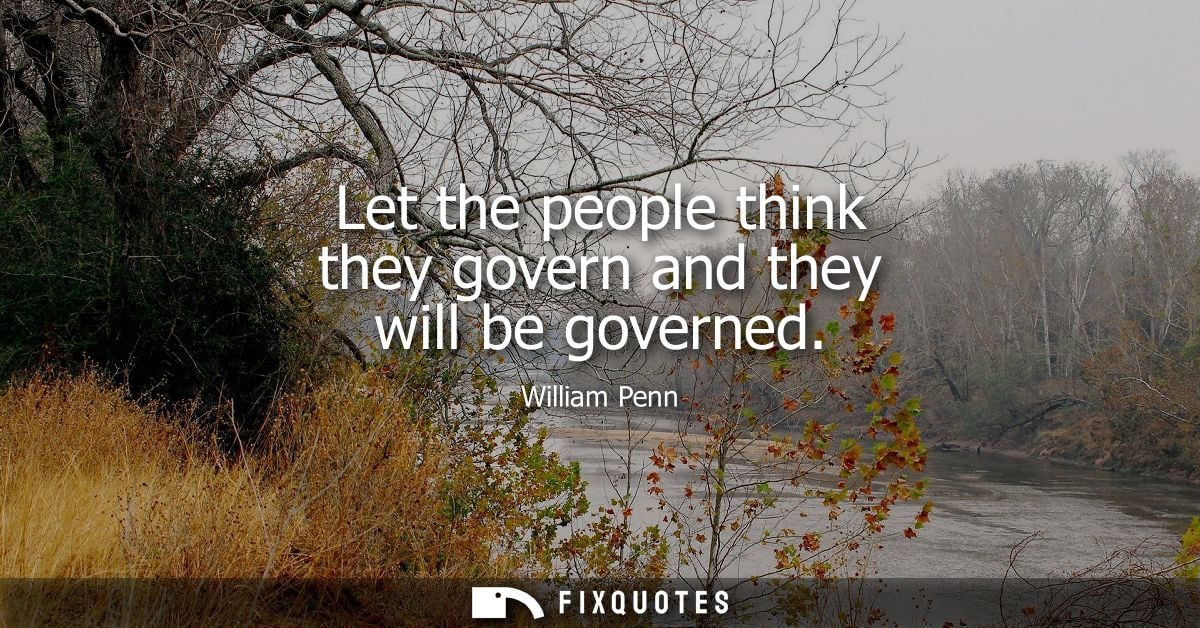
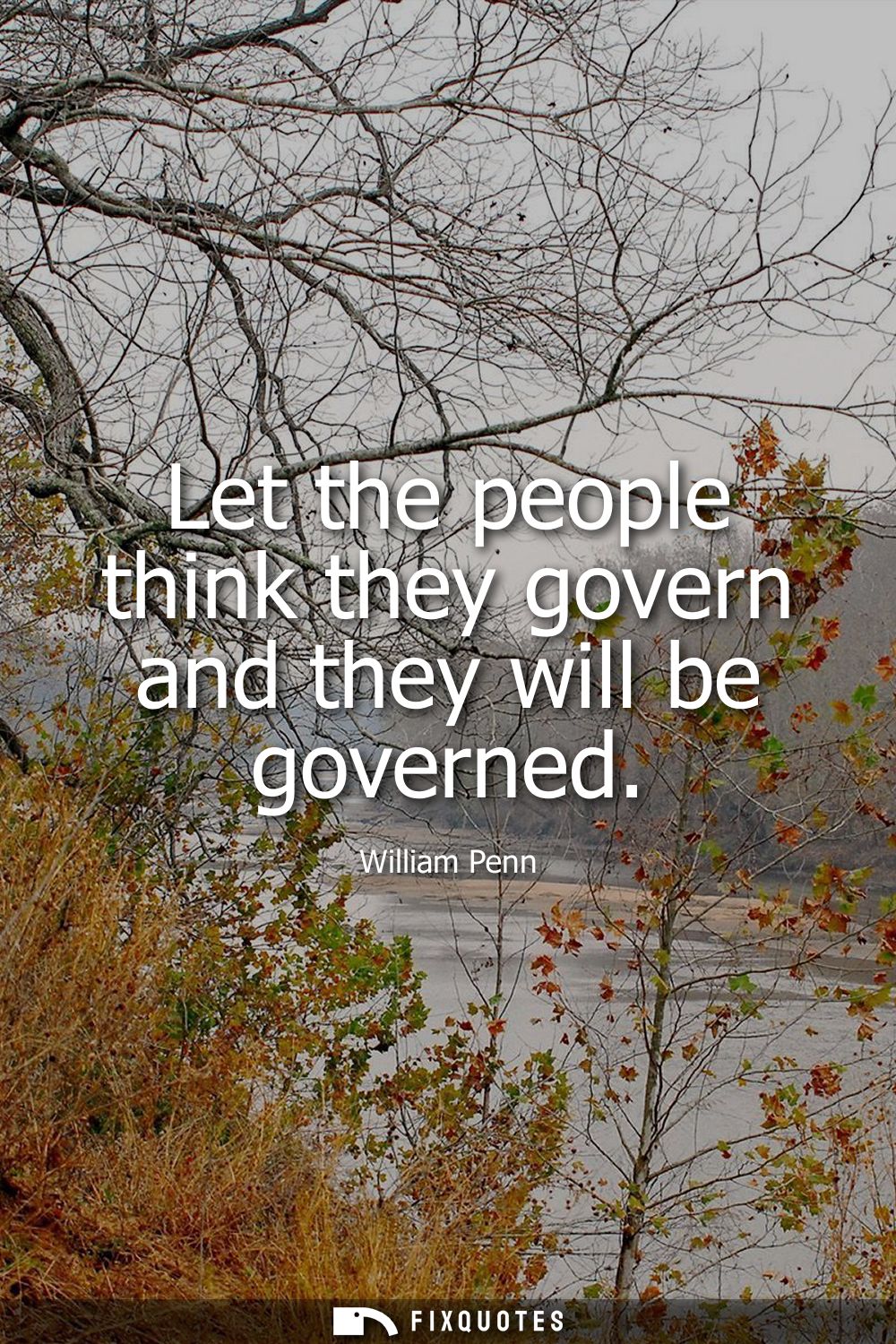
"Let the people think they govern and they will be governed"
About this Quote
Power rarely needs to announce itself; it just needs the public to feel consulted. William Penn's line is a cool, almost clinical summary of how authority survives in a society that insists on calling itself free. The genius of the phrasing is its soft coercion: "Let the people think" does the heavy lifting, turning governance into perception management. Rule can be maintained not only through force or law, but through a carefully staged sense of participation.
Penn wasn't some distant cynic scribbling in a vacuum. As founder of Pennsylvania and a Quaker navigating monarchy, charters, settlers, and Indigenous diplomacy, he lived inside the machinery of legitimacy. He needed consent to build a colony, but he also needed order to keep it from fracturing. The quote captures that balancing act: provide just enough voice, ritual, and representation to make governance feel self-authored, then watch compliance become voluntary. It's not a sneer at democracy so much as a warning about how easily its symbols can be repurposed.
The subtext lands uncomfortably well in modern life: elections that feel like brand exercises, "listening tours" that pre-decide outcomes, participation reduced to a survey checkbox. Penn's sentence isn't anti-people; it's anti-naivete. It suggests that the battle for self-government isn't only fought in constitutions, but in the psychological space where citizens decide whether they're actors or audience.
Penn wasn't some distant cynic scribbling in a vacuum. As founder of Pennsylvania and a Quaker navigating monarchy, charters, settlers, and Indigenous diplomacy, he lived inside the machinery of legitimacy. He needed consent to build a colony, but he also needed order to keep it from fracturing. The quote captures that balancing act: provide just enough voice, ritual, and representation to make governance feel self-authored, then watch compliance become voluntary. It's not a sneer at democracy so much as a warning about how easily its symbols can be repurposed.
The subtext lands uncomfortably well in modern life: elections that feel like brand exercises, "listening tours" that pre-decide outcomes, participation reduced to a survey checkbox. Penn's sentence isn't anti-people; it's anti-naivete. It suggests that the battle for self-government isn't only fought in constitutions, but in the psychological space where citizens decide whether they're actors or audience.
Quote Details
| Topic | Leadership |
|---|---|
| Source | Help us find the source |
| Cite | Cite this Quote |
Citation Formats
APA Style (7th ed.)
Penn, William. (n.d.). Let the people think they govern and they will be governed. FixQuotes. https://fixquotes.com/quotes/let-the-people-think-they-govern-and-they-will-be-91578/
Chicago Style
Penn, William. "Let the people think they govern and they will be governed." FixQuotes. Accessed February 2, 2026. https://fixquotes.com/quotes/let-the-people-think-they-govern-and-they-will-be-91578/.
MLA Style (9th ed.)
"Let the people think they govern and they will be governed." FixQuotes, https://fixquotes.com/quotes/let-the-people-think-they-govern-and-they-will-be-91578/. Accessed 2 Feb. 2026.
More Quotes by William
Add to List