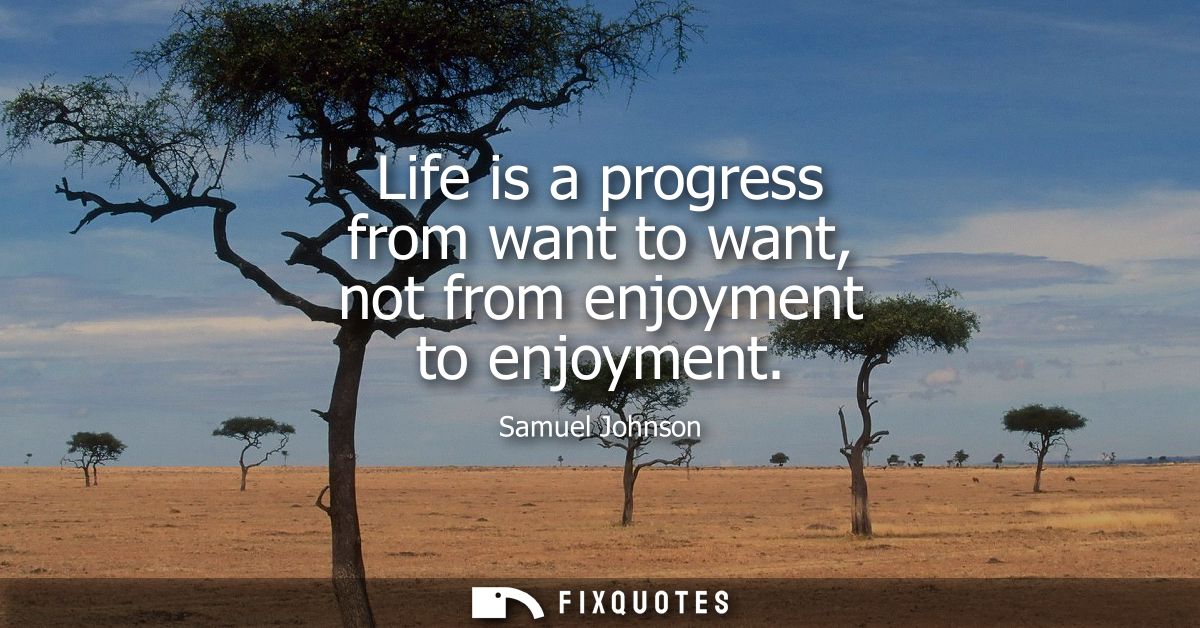
"Life is a progress from want to want, not from enjoyment to enjoyment"
About this Quote
Johnson’s line lands like a cold splash of water on the era’s polite optimism: don’t mistake motion for happiness. The structure is the trick. By repeating “from ... to ...” and swapping in “want” twice, he turns what sounds like an uplifting narrative of improvement into a treadmill. “Progress” is usually the flattering story we tell ourselves about time; Johnson yanks the word back to its literal meaning: movement, not arrival.
The subtext is both moral and psychological. Johnson isn’t simply calling life miserable; he’s diagnosing appetite as the engine of human behavior. We chase relief, status, novelty, security - and the moment one desire is met, it metabolizes into another. Enjoyment is demoted from destination to occasional side-effect, a brief intermission before the next itch. That’s why the sentence feels so modern: it anticipates today’s language of “hedonic adaptation,” but with the stern clarity of a man who watched longing masquerade as purpose.
Context matters. Johnson wrote from inside the 18th-century machine of ambition: literary fame, patronage politics, London’s competitive culture, his own bouts of melancholy and illness. The Enlightenment sold progress as a public good; Johnson pries open the private cost. There’s also a moral warning embedded in the cadence: if you build your life around satisfying wants, you won’t get a life of enjoyment, just a life of chasing. The sting comes from its refusal to offer consolation - only recognition.
The subtext is both moral and psychological. Johnson isn’t simply calling life miserable; he’s diagnosing appetite as the engine of human behavior. We chase relief, status, novelty, security - and the moment one desire is met, it metabolizes into another. Enjoyment is demoted from destination to occasional side-effect, a brief intermission before the next itch. That’s why the sentence feels so modern: it anticipates today’s language of “hedonic adaptation,” but with the stern clarity of a man who watched longing masquerade as purpose.
Context matters. Johnson wrote from inside the 18th-century machine of ambition: literary fame, patronage politics, London’s competitive culture, his own bouts of melancholy and illness. The Enlightenment sold progress as a public good; Johnson pries open the private cost. There’s also a moral warning embedded in the cadence: if you build your life around satisfying wants, you won’t get a life of enjoyment, just a life of chasing. The sting comes from its refusal to offer consolation - only recognition.
Quote Details
| Topic | Meaning of Life |
|---|---|
| Source | Help us find the source |
| Cite |
Citation Formats
APA Style (7th ed.)
Johnson, Samuel. (2026, January 18). Life is a progress from want to want, not from enjoyment to enjoyment. FixQuotes. https://fixquotes.com/quotes/life-is-a-progress-from-want-to-want-not-from-21070/
Chicago Style
Johnson, Samuel. "Life is a progress from want to want, not from enjoyment to enjoyment." FixQuotes. January 18, 2026. https://fixquotes.com/quotes/life-is-a-progress-from-want-to-want-not-from-21070/.
MLA Style (9th ed.)
"Life is a progress from want to want, not from enjoyment to enjoyment." FixQuotes, 18 Jan. 2026, https://fixquotes.com/quotes/life-is-a-progress-from-want-to-want-not-from-21070/. Accessed 6 Feb. 2026.
More Quotes by Samuel
Add to List