
Samuel Johnson Biography Quotes 151 Report mistakes
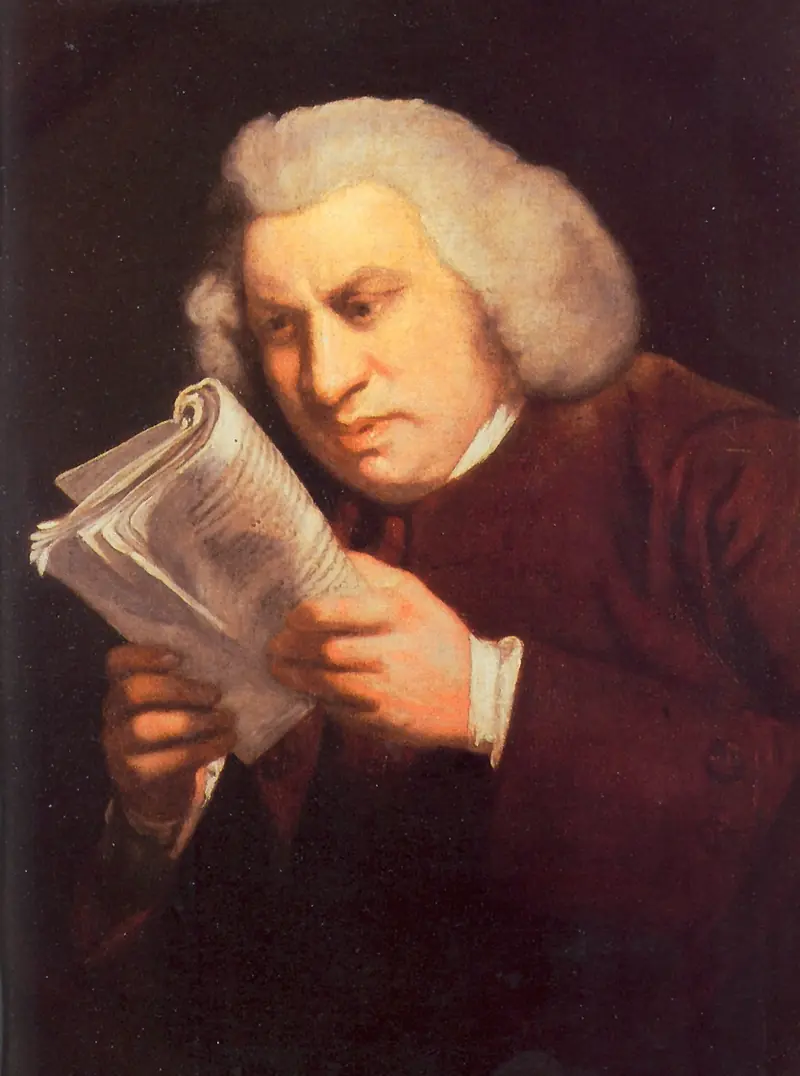
| 151 Quotes | |
| Occup. | Author |
| From | England |
| Born | September 18, 1709 |
| Died | December 13, 1784 |
| Aged | 75 years |
Samuel Johnson was born on 18 September 1709 in Lichfield, Staffordshire, the son of Michael Johnson, a bookseller and stationer, and Sarah Ford Johnson. England was entering an age of commercial print and partisan politics, and the Johnson household sat near that rising tide: his father handled books, pamphlets, and the daily talk of buyers, clergy, and local gentry. Yet the family finances were precarious, and Michael's later debt and decline left Johnson with an early, bruising intimacy with social embarrassment and the fear of failure.
As an infant he suffered scrofula, leaving facial scarring and impaired eyesight; throughout life he wrestled with bouts of melancholy, religious dread, and compulsive tics that contemporaries noticed. Those burdens did not soften him into quietness so much as drive him toward moral exactness and verbal force. The young Johnson grew up inside the double pressure of ambition and fragility - a mind hungry for mastery housed in a body that constantly reminded him of contingency.
Education and Formative Influences
Johnson was educated at Lichfield Grammar School under John Hunter and later at Stourbridge, then entered Pembroke College, Oxford, in 1728. He devoured Latin authors, theology, and modern controversy, absorbing the high Augustan ideal of order while noticing its hypocrisies; poverty forced him to leave without a degree in 1729, a wound that sharpened his sensitivity to status and exclusion. The period also set his lifelong habits of close reading and moral self-audit, and it taught him that learning was both refuge and ordeal - a discipline capable of steadying fear but also of amplifying scruple.
Career, Major Works, and Turning Points
After an unhappy stint as a schoolmaster and a brief, ill-fated attempt to run a school at Edial, Johnson went to London in 1737 with his former pupil David Garrick and made himself in the world of Grub Street. He emerged as a leading essayist with The Rambler (1750-1752) and The Idler (1758-1760), and as a major poet with The Vanity of Human Wishes (1749), an austere meditation on ambition and disappointment. His Dictionary of the English Language (1755) - produced with amanuenses but driven by his own critical intelligence - gave him national authority, later reinforced by his edition of Shakespeare (1765) and the Lives of the Poets (1779-1781), where biography became moral criticism. In 1762 a royal pension eased his chronic insecurity; in 1764 he founded The Club with Joshua Reynolds and soon gained James Boswell as an admiring, intrusive recorder. His later years were marked by travel to Scotland (A Journey to the Western Islands of Scotland, 1775), grief, asthma, gout, and an unrelenting religious seriousness until his death in London on 13 December 1784.
Philosophy, Style, and Themes
Johnson's inner life was a contest between appetite and judgment, sociability and dread. He distrusted cant because he knew how easily language could be used to launder motives; his famous sting at performative virtue, "Patriotism is the last refuge of the scoundrel". , is less an attack on love of country than a diagnosis of self-deception in public speech. He demanded that intellect answer to conscience, insisting that "Integrity without knowledge is weak and useless, and knowledge without integrity is dangerous and dreadful". The line reveals the core Johnsonian tension: he revered learning, but feared its capacity to furnish clever justifications for vice - a fear rooted in his own capacity for ruthless argument and in his religious terror of rationalized sin.
His style - balanced, antithetical, rhythmically weighty - sought to impose order on the flux of desire, and his themes return obsessively to time, habit, and the limits of human control. He watched the mind harden into routine and warned that "The chains of habit are too weak to be felt until they are too strong to be broken". That aphorism carries autobiographical force: the man who fought melancholy with prayer, talk, and work understood how easily repeated consolations could become dependencies. Yet he was no mere scold. In his essays and biographical criticism he grants ordinary people the dignity of struggle, insisting that virtue is not a mood but a practiced attention - to language, to conduct, to the claims of others. His conversation, preserved by Boswell, shows the same mixture of tenderness and severity: an insistence that life be faced without sentimental fog, and that compassion remain active even when judgment is sharp.
Legacy and Influence
Johnson helped stabilize modern English prose and elevated literary criticism into a form of moral inquiry grounded in lived experience. The Dictionary shaped lexicography and the public sense of what English could do; the Lives of the Poets set a template for biographical criticism in which works are inseparable from temper, circumstance, and choice. Boswell's Life of Johnson made him the most vividly remembered talker in the language, a presence through whom the eighteenth century still feels audible. Later writers from Coleridge to Woolf have argued with his authority, but few escaped his central demand: that intellect be accountable, that style carry ethical weight, and that a writer look steadily at the human mixture of grandeur and need.
Our collection contains 151 quotes who is written by Samuel, under the main topics: Witty One-Liners - Motivational - Ethics & Morality - Wisdom - Truth.
Other people realated to Samuel: John Dryden (Poet), Thomas B. Macaulay (Historian), Lord Chesterfield (Statesman), Oliver Goldsmith (Poet), Robert South (Clergyman), James Grainger (Poet), Abraham Cowley (Poet), Joseph Wood Krutch (Environmentalist), Christian Nestell Bovee (Author), Philip Stanhope (Statesman)
Samuel Johnson Famous Works
- 1779 The Lives of the Most Eminent English Poets (Book)
- 1759 Rasselas, Prince of Abyssinia (Novel)
- 1759 The History of Rasselas: Prince of Abissinia (Novel)
- 1755 A Dictionary of the English Language (Book)
- 1749 The Vanity of Human Wishes (Poem)
- 1738 London (Poem)
Source / external links