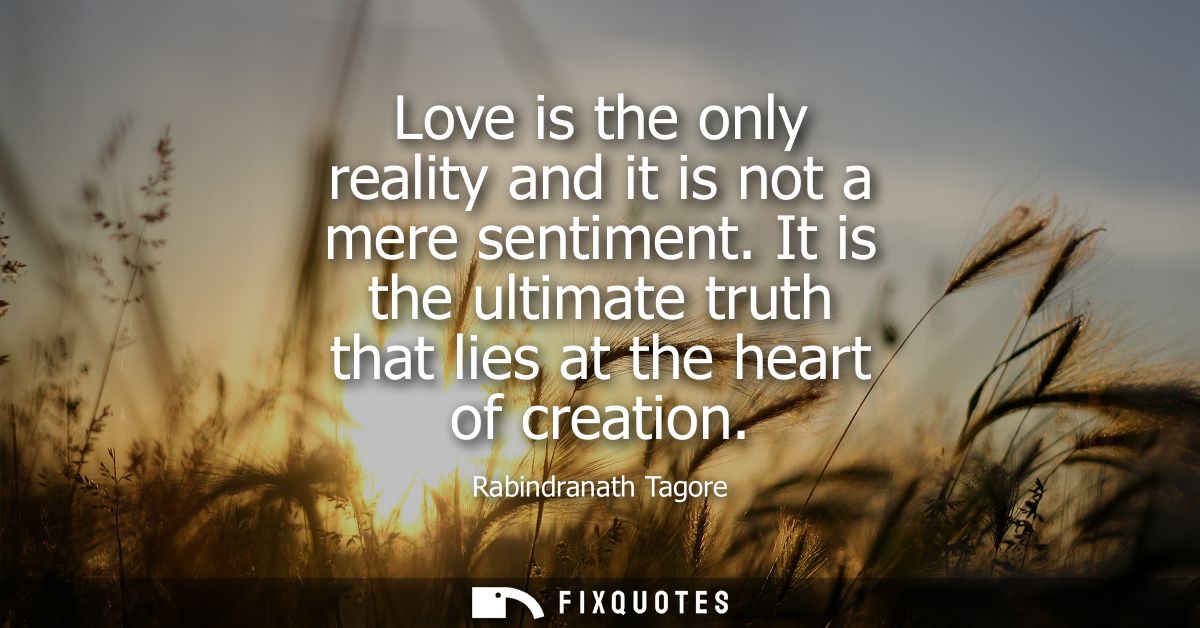
"Love is the only reality and it is not a mere sentiment. It is the ultimate truth that lies at the heart of creation"
About this Quote
Tagore isn’t praising romance here; he’s mounting a metaphysical coup. By calling love "the only reality", he flips the usual hierarchy where facts are hard and feelings are soft. The jab is aimed at modernity’s proud machinery of measurement: politics, markets, even nationalism, all of which claim to be "real" because they can be counted, enforced, or conquered. Tagore insists those are secondary effects. Love is the cause.
The phrasing matters. "Not a mere sentiment" is a preemptive strike against the Western tendency (and the colonial-era Bengali elite’s imported tendency) to file love under private emotion, feminine weakness, or poetic fog. He elevates it into ontology: love as "ultimate truth". That’s not greeting-card uplift; it’s a wager that the world is held together by relationship rather than domination.
Context sharpens the intent. Tagore wrote in a time of intensifying anti-colonial struggle and rising mass nationalism, and he was famously wary of nationalism’s moral shortcuts. In essays like Nationalism, he argues that the nation can become a machine that deforms human sympathy. This quote carries that critique in spiritual language: if love is the heart of creation, any project built on abstraction, rivalry, or dehumanization is literally unreal - a kind of collective hallucination.
The subtext is also artistic. Tagore is defending poetry itself as a way of knowing. If love is reality’s core, then the poet’s task isn’t decoration; it’s detection.
The phrasing matters. "Not a mere sentiment" is a preemptive strike against the Western tendency (and the colonial-era Bengali elite’s imported tendency) to file love under private emotion, feminine weakness, or poetic fog. He elevates it into ontology: love as "ultimate truth". That’s not greeting-card uplift; it’s a wager that the world is held together by relationship rather than domination.
Context sharpens the intent. Tagore wrote in a time of intensifying anti-colonial struggle and rising mass nationalism, and he was famously wary of nationalism’s moral shortcuts. In essays like Nationalism, he argues that the nation can become a machine that deforms human sympathy. This quote carries that critique in spiritual language: if love is the heart of creation, any project built on abstraction, rivalry, or dehumanization is literally unreal - a kind of collective hallucination.
The subtext is also artistic. Tagore is defending poetry itself as a way of knowing. If love is reality’s core, then the poet’s task isn’t decoration; it’s detection.
Quote Details
| Topic | Love |
|---|
More Quotes by Rabindranath
Add to List