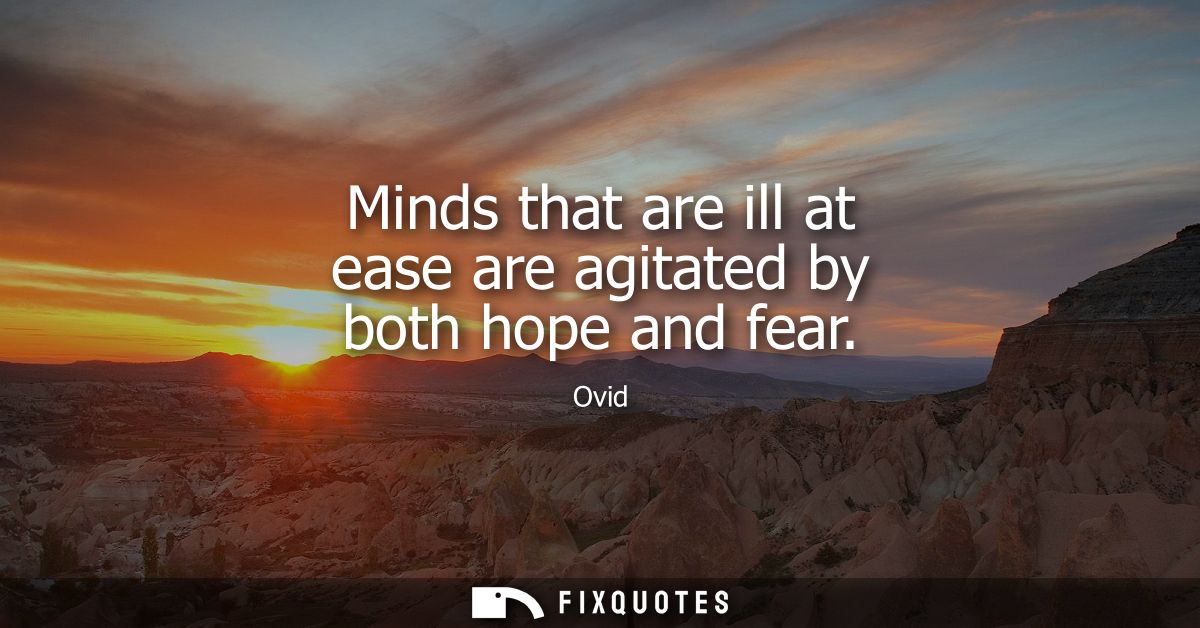
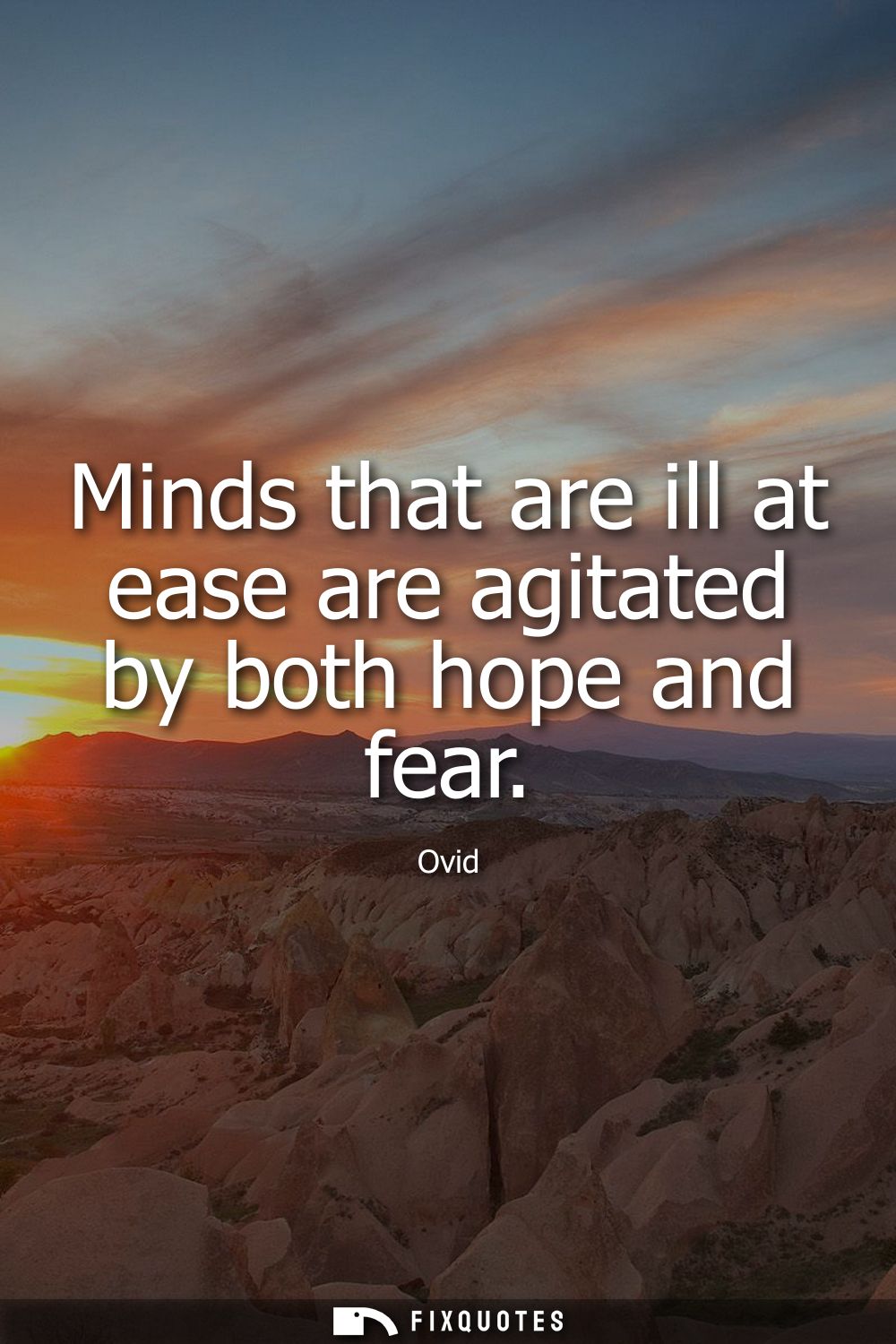
"Minds that are ill at ease are agitated by both hope and fear"
About this Quote
Restlessness has a way of weaponizing even the good news. Ovid nails that psychological trap in a single balanced line: the uneasy mind doesn’t get steadied by hope, it gets jolted by it. Hope promises a future, which means the anxious person immediately starts running simulations: What if it doesn’t happen? What if it does and I can’t hold onto it? Fear and hope become mirror images, twin engines of agitation.
The craft is in the symmetry. “Both hope and fear” sounds almost like a moral inventory, but it’s really a diagnosis: when your inner life is “ill at ease,” the problem isn’t the world’s threats alone. It’s the mind’s posture toward possibility. Ovid suggests that emotional turbulence isn’t cured by swapping pessimism for optimism; it’s cured by addressing the underlying unease that turns every outcome into suspense.
Context matters. Ovid wrote in an Augustan Rome obsessed with order, stability, and the management of desire, a culture where public calm was a political project. His own biography sharpens the line’s edge: exiled by Augustus to the empire’s margins, Ovid knew how quickly security becomes contingency. In that light, the quote reads less like timeless self-help than like a poet’s report from a civilization that demanded composure while trafficking in uncertainty. It’s a warning about how power, fate, and private longing conspire to keep the unsettled mind permanently on alert.
The craft is in the symmetry. “Both hope and fear” sounds almost like a moral inventory, but it’s really a diagnosis: when your inner life is “ill at ease,” the problem isn’t the world’s threats alone. It’s the mind’s posture toward possibility. Ovid suggests that emotional turbulence isn’t cured by swapping pessimism for optimism; it’s cured by addressing the underlying unease that turns every outcome into suspense.
Context matters. Ovid wrote in an Augustan Rome obsessed with order, stability, and the management of desire, a culture where public calm was a political project. His own biography sharpens the line’s edge: exiled by Augustus to the empire’s margins, Ovid knew how quickly security becomes contingency. In that light, the quote reads less like timeless self-help than like a poet’s report from a civilization that demanded composure while trafficking in uncertainty. It’s a warning about how power, fate, and private longing conspire to keep the unsettled mind permanently on alert.
Quote Details
| Topic | Anxiety |
|---|---|
| Source | Help us find the source |
| Cite |
Citation Formats
APA Style (7th ed.)
Ovid. (2026, January 18). Minds that are ill at ease are agitated by both hope and fear. FixQuotes. https://fixquotes.com/quotes/minds-that-are-ill-at-ease-are-agitated-by-both-18248/
Chicago Style
Ovid. "Minds that are ill at ease are agitated by both hope and fear." FixQuotes. January 18, 2026. https://fixquotes.com/quotes/minds-that-are-ill-at-ease-are-agitated-by-both-18248/.
MLA Style (9th ed.)
"Minds that are ill at ease are agitated by both hope and fear." FixQuotes, 18 Jan. 2026, https://fixquotes.com/quotes/minds-that-are-ill-at-ease-are-agitated-by-both-18248/. Accessed 7 Feb. 2026.
More Quotes by Ovid
Add to List