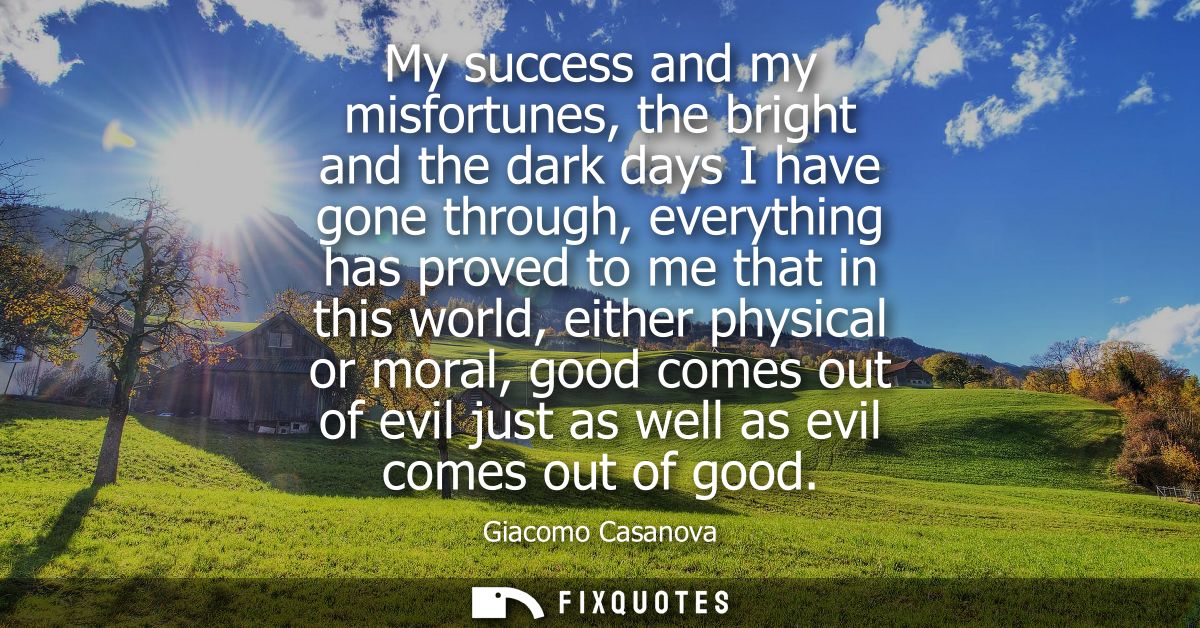
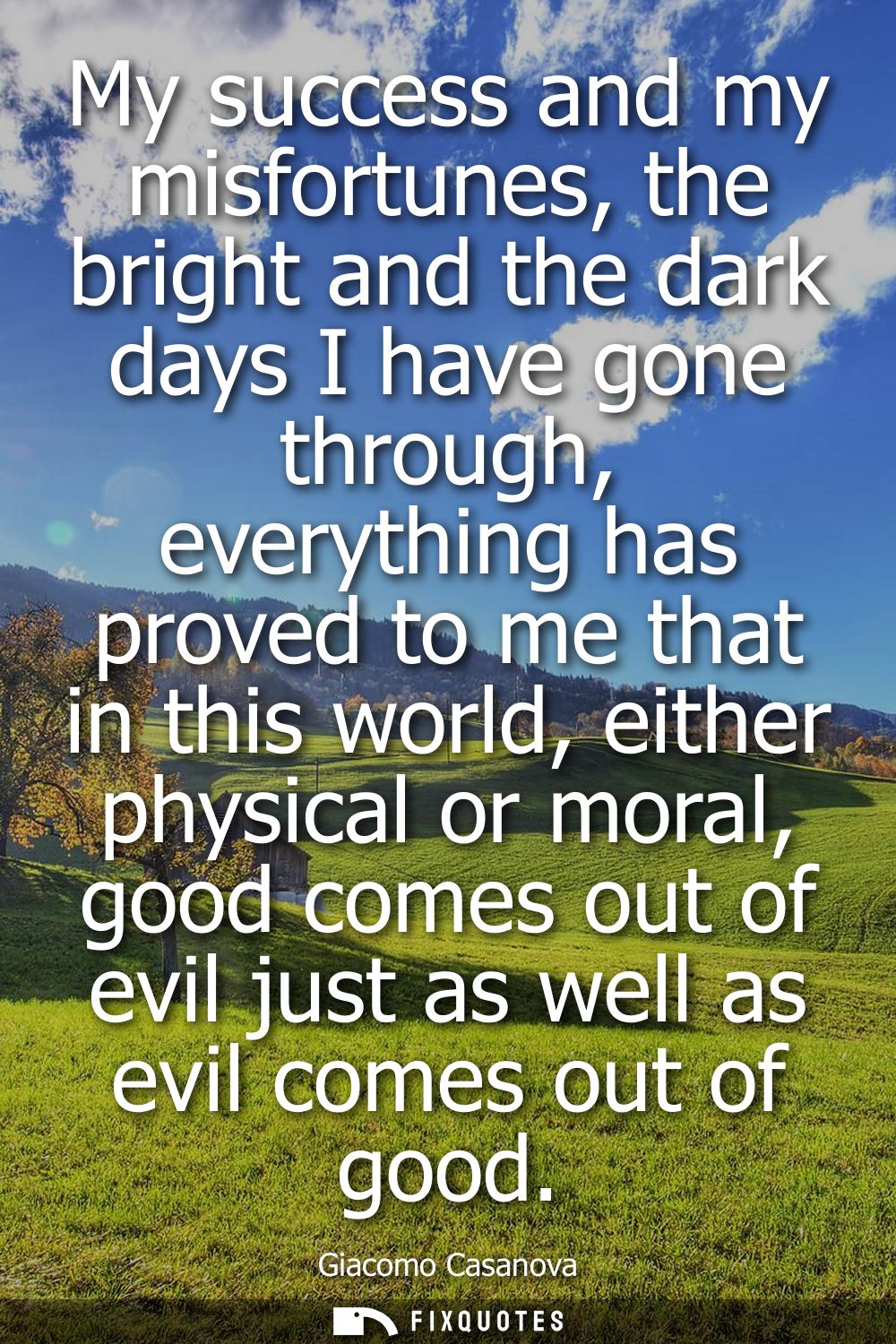
"My success and my misfortunes, the bright and the dark days I have gone through, everything has proved to me that in this world, either physical or moral, good comes out of evil just as well as evil comes out of good"
About this Quote
Casanova distills a lifetime of reversals into a sober recognition of moral and practical complexity. Success and misfortune, brightness and darkness, trade places so often that the boundaries blur. A good action may unleash harm; a calamity may open a door. The insight is not a celebration of vice or a denial of virtue, but a warning against tidy moral arithmetic and a reminder that outcomes are entangled with circumstance, chance, and human frailty.
The phrase "either physical or moral" widens the claim beyond ethics to the workings of nature. Destruction fertilizes creation; decay sustains growth. Casanova, who dabbled in alchemy and lived by keen observation, saw a similar alchemy in society: reputations are made and unmade by scandals, alliances, and accidents. He tasted both sides. Banishments propelled him into new circles; a prison became the stage for his famous escape; charms that won him patrons also drew envy and peril. His memoirs read like a ledger of unintended consequences, where pleasure and pain, prudence and folly, keep altering the account.
The statement carries an Enlightenment skepticism: trust experience over dogma, and expect mixed results from human designs. It also implies a kind of pragmatic ethics. If good can emerge from evil and evil from good, then moral responsibility lies less in claiming pure motives and more in attending to consequences, revising plans, and acknowledging the limits of control. Fortune remains fickle; agency remains real but provisional.
There is, too, a note of resilience. Recognize that setbacks can be converted into resources, and that triumphs demand vigilance because they breed new risks. Such realism does not excuse wrongdoing, nor does it doom idealism. It calls for humility, agility, and compassion when judging others. Lives, like Casanova’s, rarely move in straight lines; they coil through twists where light and shadow perpetually generate one another.
The phrase "either physical or moral" widens the claim beyond ethics to the workings of nature. Destruction fertilizes creation; decay sustains growth. Casanova, who dabbled in alchemy and lived by keen observation, saw a similar alchemy in society: reputations are made and unmade by scandals, alliances, and accidents. He tasted both sides. Banishments propelled him into new circles; a prison became the stage for his famous escape; charms that won him patrons also drew envy and peril. His memoirs read like a ledger of unintended consequences, where pleasure and pain, prudence and folly, keep altering the account.
The statement carries an Enlightenment skepticism: trust experience over dogma, and expect mixed results from human designs. It also implies a kind of pragmatic ethics. If good can emerge from evil and evil from good, then moral responsibility lies less in claiming pure motives and more in attending to consequences, revising plans, and acknowledging the limits of control. Fortune remains fickle; agency remains real but provisional.
There is, too, a note of resilience. Recognize that setbacks can be converted into resources, and that triumphs demand vigilance because they breed new risks. Such realism does not excuse wrongdoing, nor does it doom idealism. It calls for humility, agility, and compassion when judging others. Lives, like Casanova’s, rarely move in straight lines; they coil through twists where light and shadow perpetually generate one another.
Quote Details
| Topic | Wisdom |
|---|
More Quotes by Giacomo
Add to List