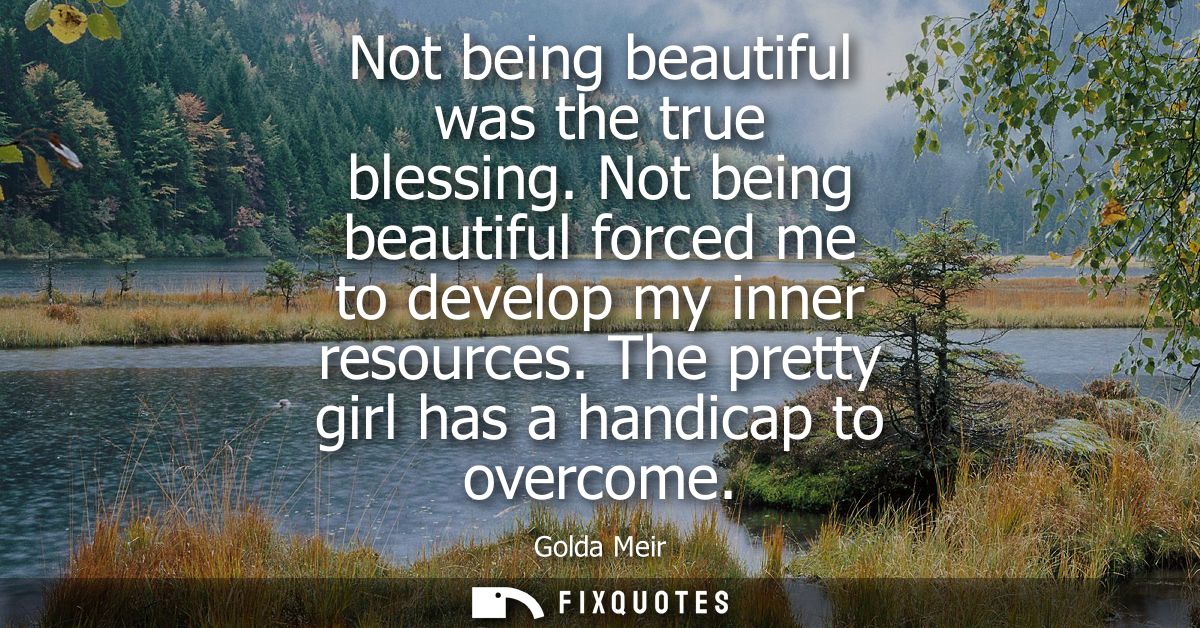
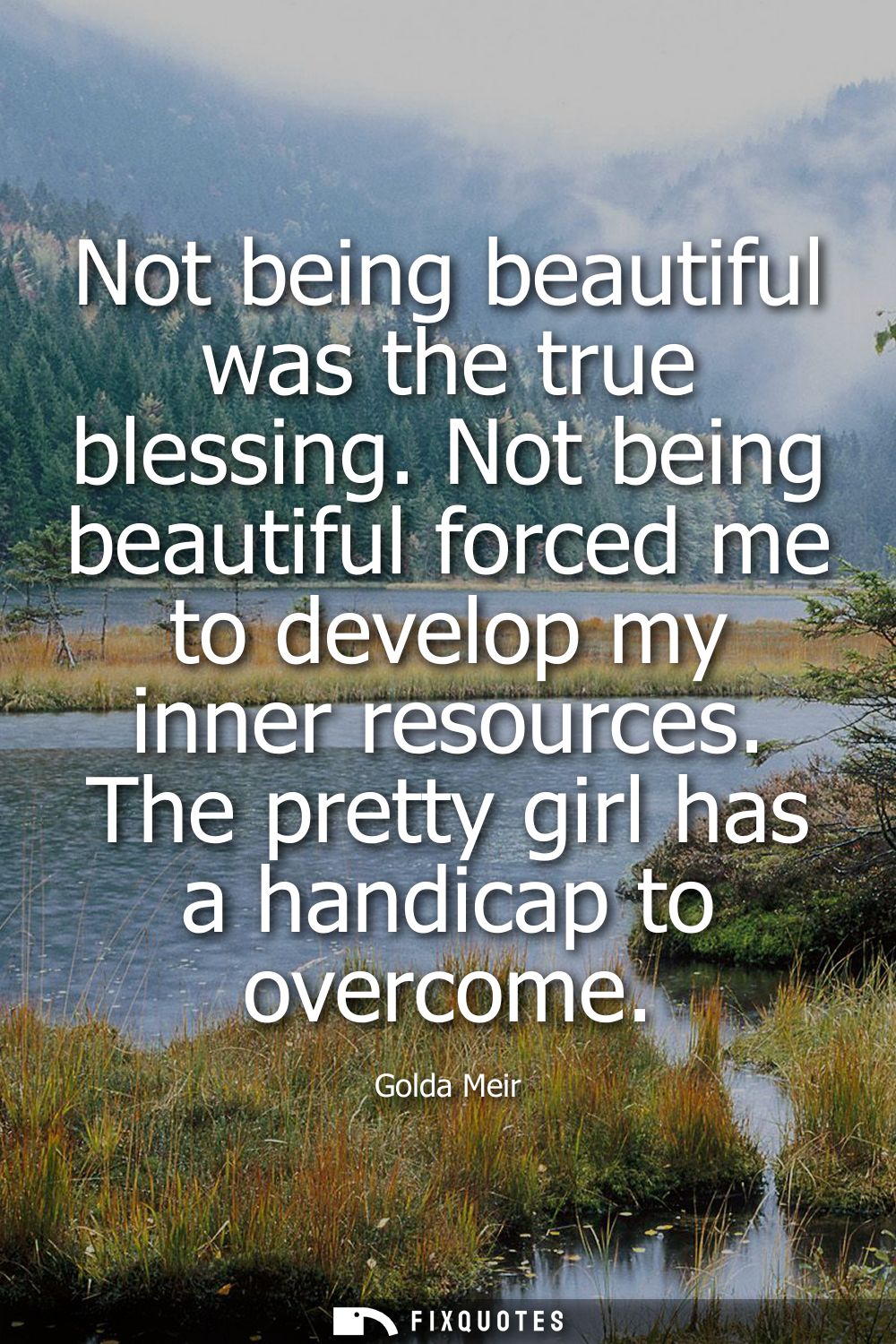
"Not being beautiful was the true blessing. Not being beautiful forced me to develop my inner resources. The pretty girl has a handicap to overcome"
About this Quote
Meir flips a familiar cruelty into an unsentimental theory of power: beauty, often treated as social currency, is recast as social debt. The line works because it refuses consolation. "Not being beautiful was the true blessing" isn’t a self-help mantra; it’s a cold appraisal of how attention is rationed, how credibility is assigned, and how women learn to survive inside that economy. Meir’s phrasing is almost strategic: "forced" implies compulsion, not choice, suggesting that competence is frequently a byproduct of exclusion rather than a freely chosen virtue.
The subtext is political as much as personal. As a female head of government in a century that still wanted women decorative before it wanted them authoritative, Meir is narrating a pathway from being overlooked to becoming unignorable. "Inner resources" reads like a euphemism for the hard toolkit of leadership: resilience, verbal force, stamina, the ability to withstand being disliked. She’s not claiming moral superiority; she’s describing training conditions.
Calling prettiness a "handicap" is the provocation. Meir isn’t denying that beauty opens doors; she’s arguing it can also trap you in a narrower role, where being pleasing substitutes for being taken seriously. The "pretty girl" has to overcome other people’s expectations, and maybe her own temptation to lean on them. In that sense, the quote is less about looks than about the cost of being legible to a culture that prefers women simple: admired, not listened to.
The subtext is political as much as personal. As a female head of government in a century that still wanted women decorative before it wanted them authoritative, Meir is narrating a pathway from being overlooked to becoming unignorable. "Inner resources" reads like a euphemism for the hard toolkit of leadership: resilience, verbal force, stamina, the ability to withstand being disliked. She’s not claiming moral superiority; she’s describing training conditions.
Calling prettiness a "handicap" is the provocation. Meir isn’t denying that beauty opens doors; she’s arguing it can also trap you in a narrower role, where being pleasing substitutes for being taken seriously. The "pretty girl" has to overcome other people’s expectations, and maybe her own temptation to lean on them. In that sense, the quote is less about looks than about the cost of being legible to a culture that prefers women simple: admired, not listened to.
Quote Details
| Topic | Self-Improvement |
|---|
More Quotes by Golda
Add to List