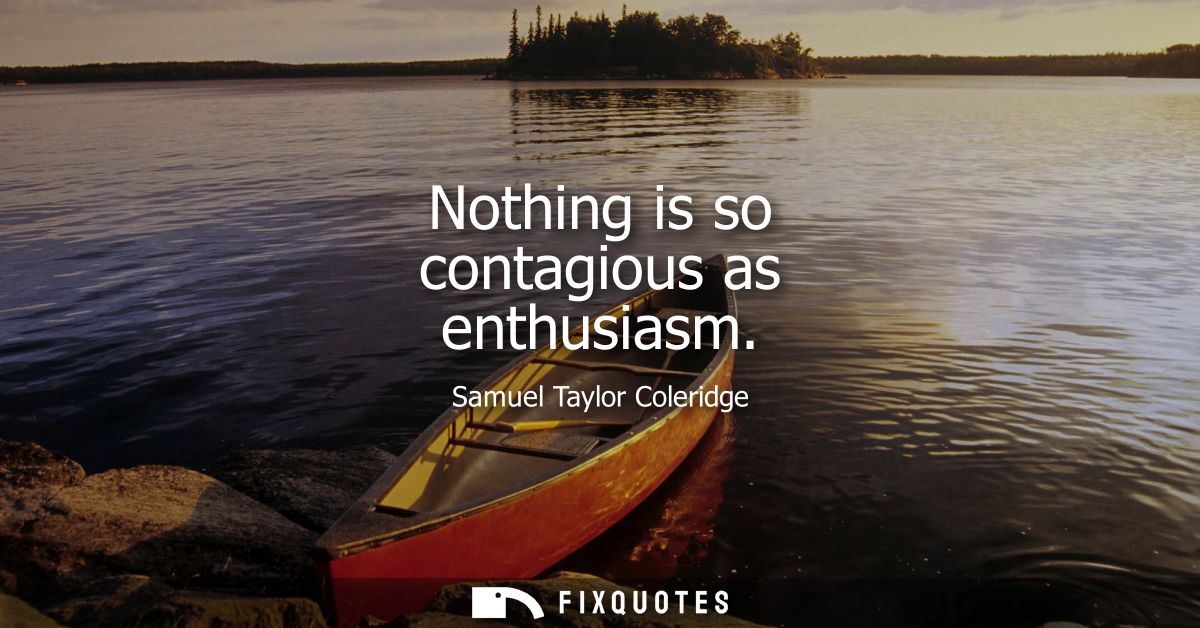
"Nothing is so contagious as enthusiasm"
About this Quote
Enthusiasm is framed here less as a private feeling than as a social force: it spreads, it recruits, it makes converts. Coleridge’s choice of “contagious” is the needle. He borrows the language of illness to describe inspiration, implying that passion isn’t purely noble or self-directed; it’s transmissible, crowd-made, capable of overruling individual judgment. That double edge is exactly what a Romantic poet would notice. Romanticism treated emotion as a kind of truth-generator, but Coleridge also lived through an era when mass fervor had a body count: the French Revolution’s early ideals curdled into the Terror, and public feeling became a political weather system.
The intent, then, isn’t simply to cheerlead motivation. It’s to point at a mechanism: enthusiasm works because humans are mimetic. We borrow mood from tone, posture, and conviction; we outsource certainty to the person who seems most certain. The line’s compactness mimics the phenomenon it describes. It’s aphoristic, easy to remember, easy to repeat - a miniature act of contagion.
Subtext: be careful what you “catch.” Coleridge, who wrote brilliantly about imagination and also wrestled with disillusionment and addiction, understood that heightened feeling can be both creative fuel and a liability. Enthusiasm can animate art, religion, politics, even commerce; it can also become a substitute for evidence. The phrase flatters passion while quietly warning that it travels faster than thought.
The intent, then, isn’t simply to cheerlead motivation. It’s to point at a mechanism: enthusiasm works because humans are mimetic. We borrow mood from tone, posture, and conviction; we outsource certainty to the person who seems most certain. The line’s compactness mimics the phenomenon it describes. It’s aphoristic, easy to remember, easy to repeat - a miniature act of contagion.
Subtext: be careful what you “catch.” Coleridge, who wrote brilliantly about imagination and also wrestled with disillusionment and addiction, understood that heightened feeling can be both creative fuel and a liability. Enthusiasm can animate art, religion, politics, even commerce; it can also become a substitute for evidence. The phrase flatters passion while quietly warning that it travels faster than thought.
Quote Details
| Topic | Motivational |
|---|---|
| Source | Help us find the source |
| Cite |
Citation Formats
APA Style (7th ed.)
Coleridge, Samuel Taylor. (2026, January 14). Nothing is so contagious as enthusiasm. FixQuotes. https://fixquotes.com/quotes/nothing-is-so-contagious-as-enthusiasm-96029/
Chicago Style
Coleridge, Samuel Taylor. "Nothing is so contagious as enthusiasm." FixQuotes. January 14, 2026. https://fixquotes.com/quotes/nothing-is-so-contagious-as-enthusiasm-96029/.
MLA Style (9th ed.)
"Nothing is so contagious as enthusiasm." FixQuotes, 14 Jan. 2026, https://fixquotes.com/quotes/nothing-is-so-contagious-as-enthusiasm-96029/. Accessed 3 Apr. 2026.
More Quotes by Samuel
Add to List