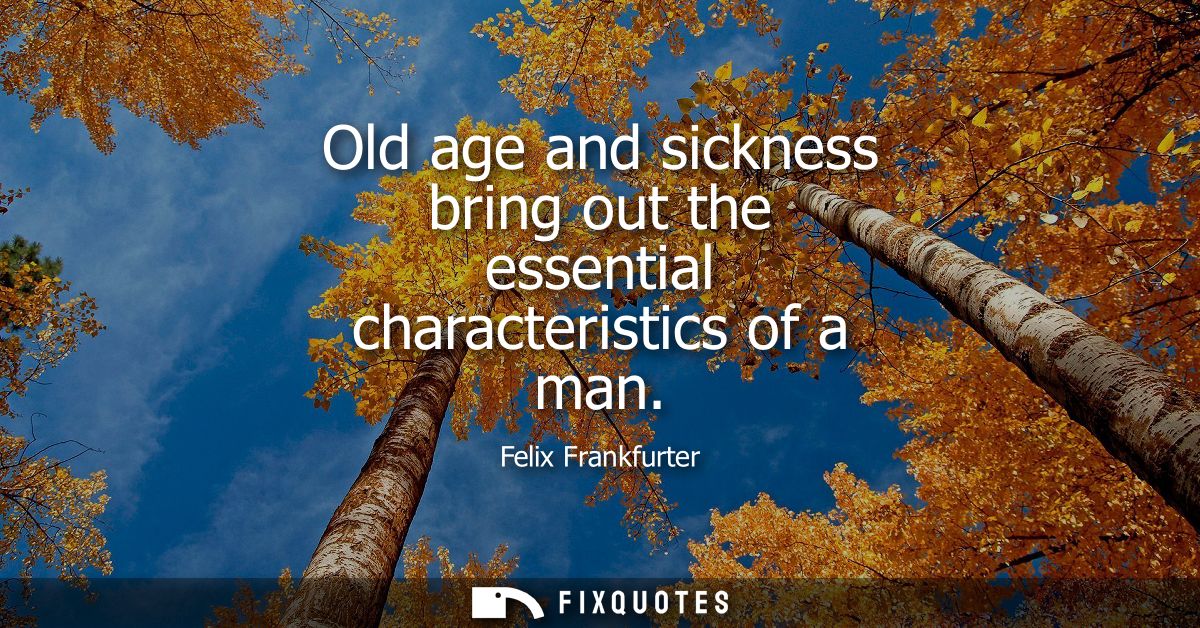
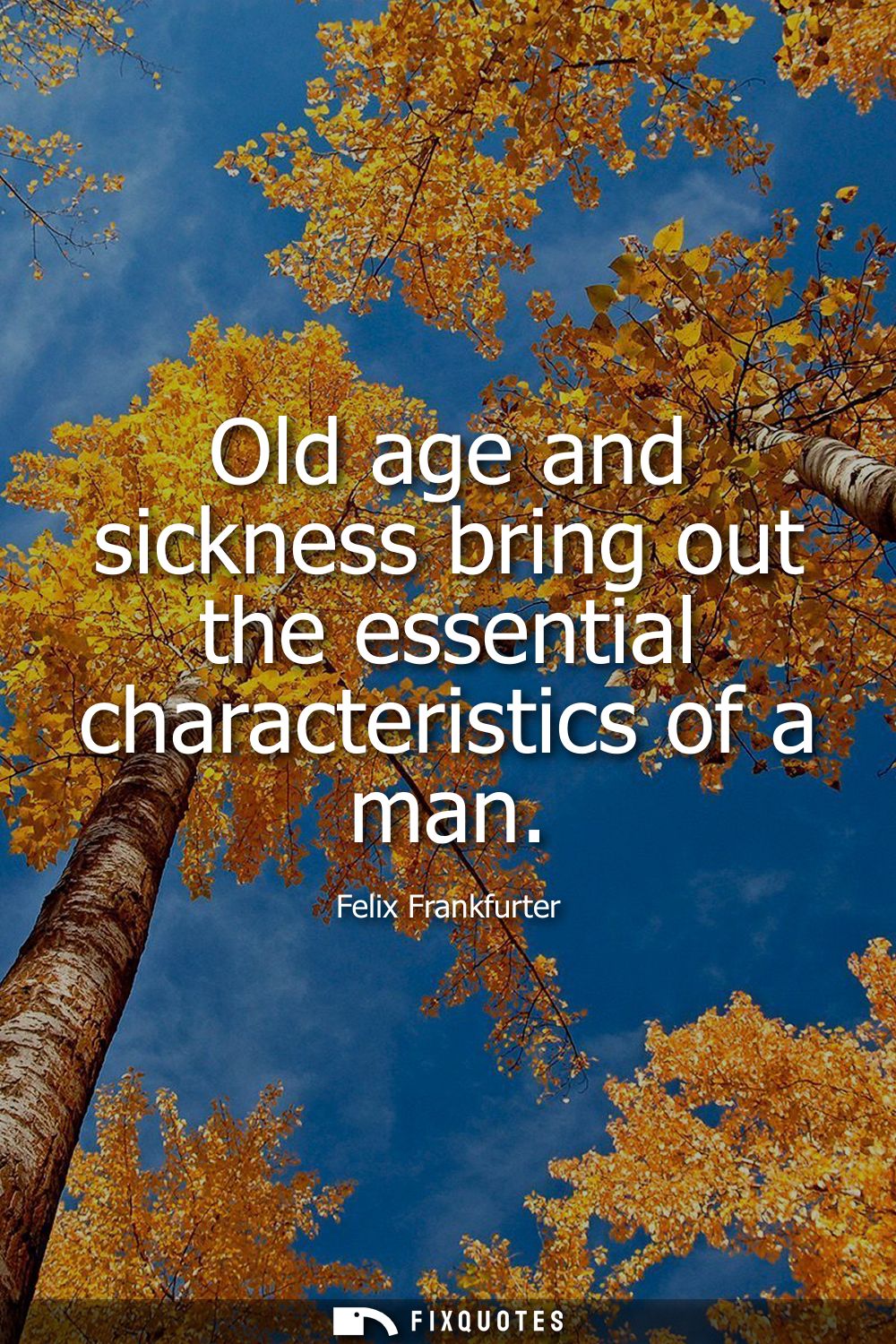
"Old age and sickness bring out the essential characteristics of a man"
About this Quote
Frankfurter’s line has the cool severity of a bench opinion: no comfort, no redemption arc, just the claim that time and infirmity act like a truth serum. Coming from a Supreme Court justice who watched reputations rise and curdle under pressure, it’s less a meditation on aging than a diagnostic tool. Old age and sickness are not portrayed as tragic detours; they’re stress tests. They strip away performance, leaving temperament, habits of mind, and moral reflexes exposed.
The subtext is pointedly anti-romantic. We like narratives where hardship ennobles, where illness reveals hidden courage. Frankfurter’s phrasing suggests the opposite: these conditions “bring out” what’s already there, for better or worse. The verb choice matters. It implies emergence, not transformation. Under depletion - less energy, less patience, less social incentive - people stop editing themselves. Kindness becomes more naked; so does cruelty. Generosity can sharpen into clarity; vanity can harden into grievance.
Contextually, this sits neatly inside Frankfurter’s broader suspicion of grand abstractions and his preference for observing institutions (and individuals) under constraint. The judiciary is a machine for manufactured stress: deadlines, dissent, public scrutiny, private doubt. He’s extending that logic to the body. Age and sickness function like cross-examination, forcing the witness to drop rehearsed lines.
There’s also an uncomfortable civic implication: we shouldn’t judge character only when someone is winning. The real measure arrives when the armor comes off, and what remains is not who you wished to be, but who you trained yourself to be.
The subtext is pointedly anti-romantic. We like narratives where hardship ennobles, where illness reveals hidden courage. Frankfurter’s phrasing suggests the opposite: these conditions “bring out” what’s already there, for better or worse. The verb choice matters. It implies emergence, not transformation. Under depletion - less energy, less patience, less social incentive - people stop editing themselves. Kindness becomes more naked; so does cruelty. Generosity can sharpen into clarity; vanity can harden into grievance.
Contextually, this sits neatly inside Frankfurter’s broader suspicion of grand abstractions and his preference for observing institutions (and individuals) under constraint. The judiciary is a machine for manufactured stress: deadlines, dissent, public scrutiny, private doubt. He’s extending that logic to the body. Age and sickness function like cross-examination, forcing the witness to drop rehearsed lines.
There’s also an uncomfortable civic implication: we shouldn’t judge character only when someone is winning. The real measure arrives when the armor comes off, and what remains is not who you wished to be, but who you trained yourself to be.
Quote Details
| Topic | Aging |
|---|
More Quotes by Felix
Add to List