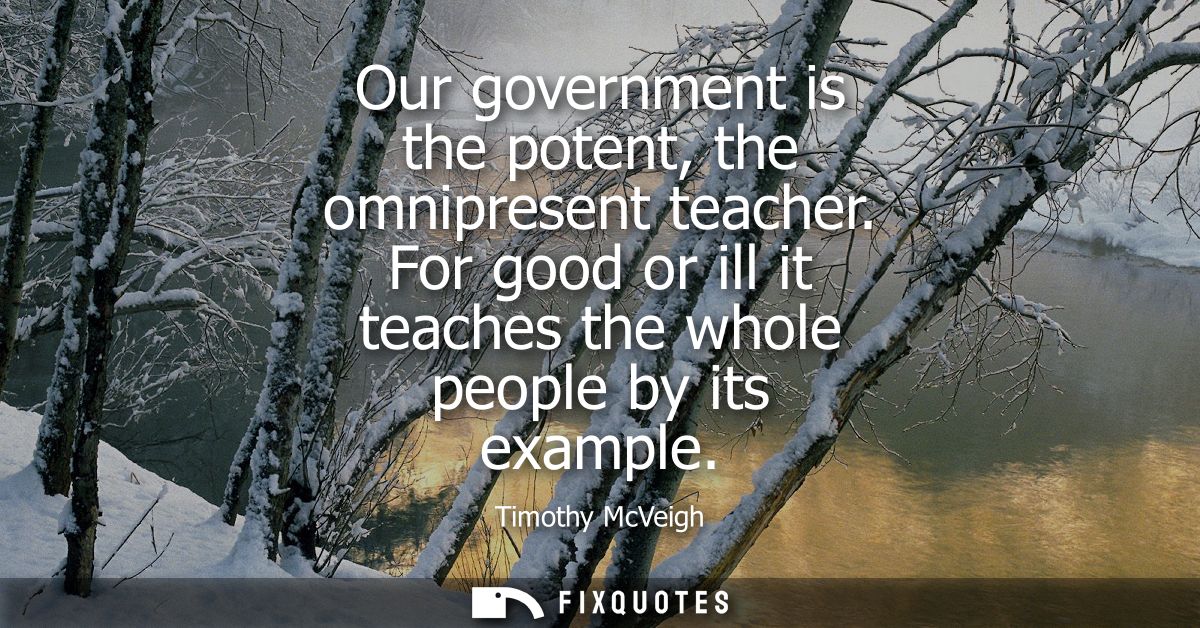
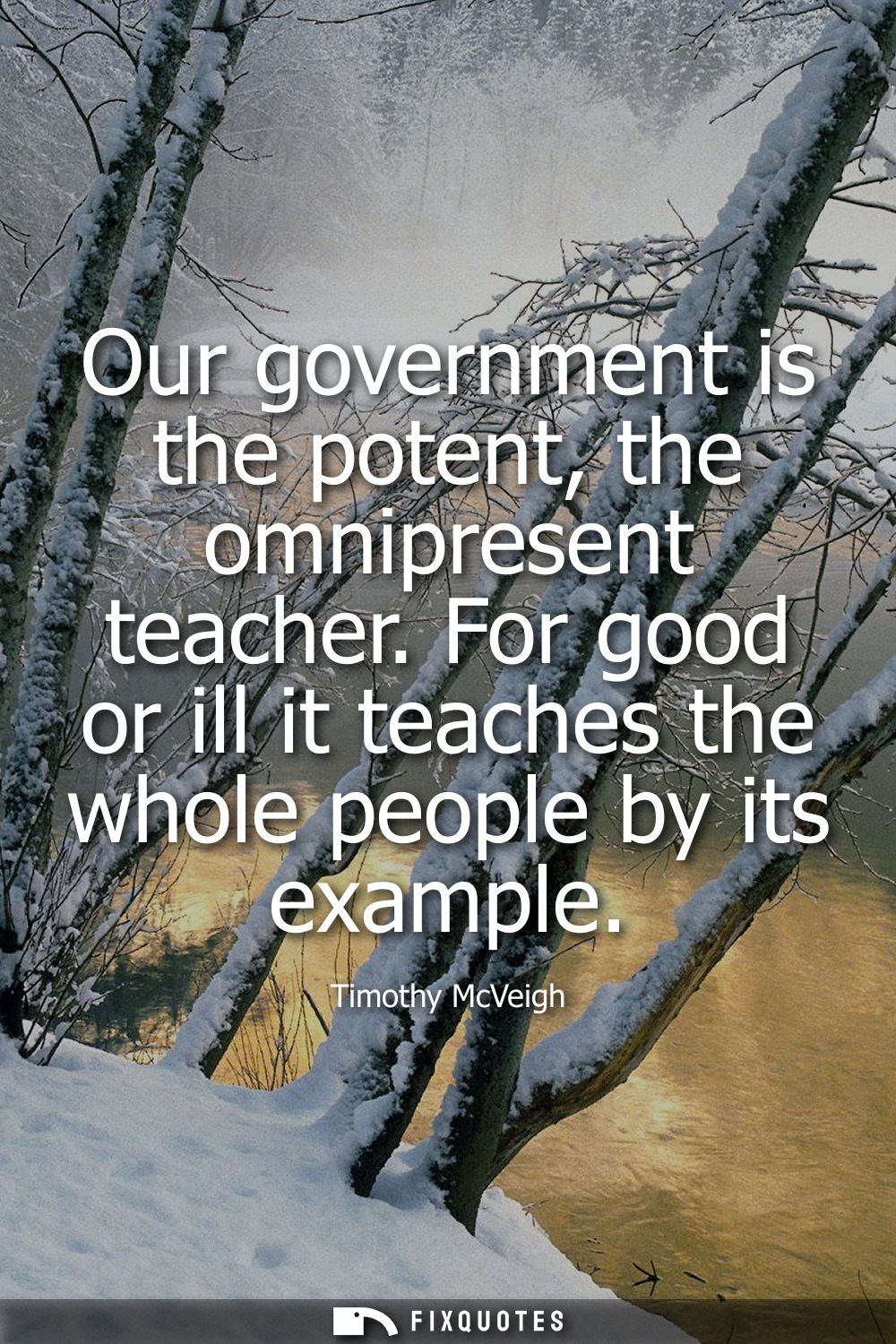
"Our government is the potent, the omnipresent teacher. For good or ill it teaches the whole people by its example"
About this Quote
Government does not merely enforce rules; it models values. Calling it the potent, omnipresent teacher captures how power communicates lessons through daily practice, not just statutes or speeches. Every arrest, policy rollout, courtroom argument, and press conference teaches the public what counts as acceptable conduct. For good or ill, those lessons sink in. When officials honor due process, tell the truth, and accept limits, they cultivate habits of fairness and restraint. When they cut corners, excuse brutality, or treat opponents as enemies, they normalize cynicism and reciprocal aggression.
The line originated in Justice Louis Brandeis’s 1928 dissent in Olmstead v. United States, where he warned that if the government becomes a lawbreaker, it invites contempt for law and breeds anarchy. He was not romanticizing rebellion; he was imposing a higher standard on the state precisely because its example holds such sway. Legitimacy depends less on coercion than on consistency between principle and practice.
Timothy McVeigh later quoted this sentence to frame his anti-government violence as a learned response to federal actions at Ruby Ridge and Waco. That appropriation reveals the danger of weaponizing the insight. Observing that government teaches by example does not license private vengeance; it underscores why state actors must be accountable and why citizens must pursue redress through lawful means. McVeigh’s reading turns a civic admonition into a justification for terror, proving how destructive the wrong lesson can be when grievance eclipses ethics.
In an age of ubiquitous cameras and instant media, the teaching never stops. Policing tactics, emergency powers, ethics rules, and leadership tone signal what the polity should imitate or resist. When authority models empathy, transparency, and fidelity to rights, it earns trust that makes collective action possible. When it models impunity, it breeds alienation and extremism. The message is blunt: power is always instructing, whether it intends to or not, and the character of the republic will mirror the example it sets.
The line originated in Justice Louis Brandeis’s 1928 dissent in Olmstead v. United States, where he warned that if the government becomes a lawbreaker, it invites contempt for law and breeds anarchy. He was not romanticizing rebellion; he was imposing a higher standard on the state precisely because its example holds such sway. Legitimacy depends less on coercion than on consistency between principle and practice.
Timothy McVeigh later quoted this sentence to frame his anti-government violence as a learned response to federal actions at Ruby Ridge and Waco. That appropriation reveals the danger of weaponizing the insight. Observing that government teaches by example does not license private vengeance; it underscores why state actors must be accountable and why citizens must pursue redress through lawful means. McVeigh’s reading turns a civic admonition into a justification for terror, proving how destructive the wrong lesson can be when grievance eclipses ethics.
In an age of ubiquitous cameras and instant media, the teaching never stops. Policing tactics, emergency powers, ethics rules, and leadership tone signal what the polity should imitate or resist. When authority models empathy, transparency, and fidelity to rights, it earns trust that makes collective action possible. When it models impunity, it breeds alienation and extremism. The message is blunt: power is always instructing, whether it intends to or not, and the character of the republic will mirror the example it sets.
Quote Details
| Topic | Justice |
|---|
More Quotes by Timothy
Add to List