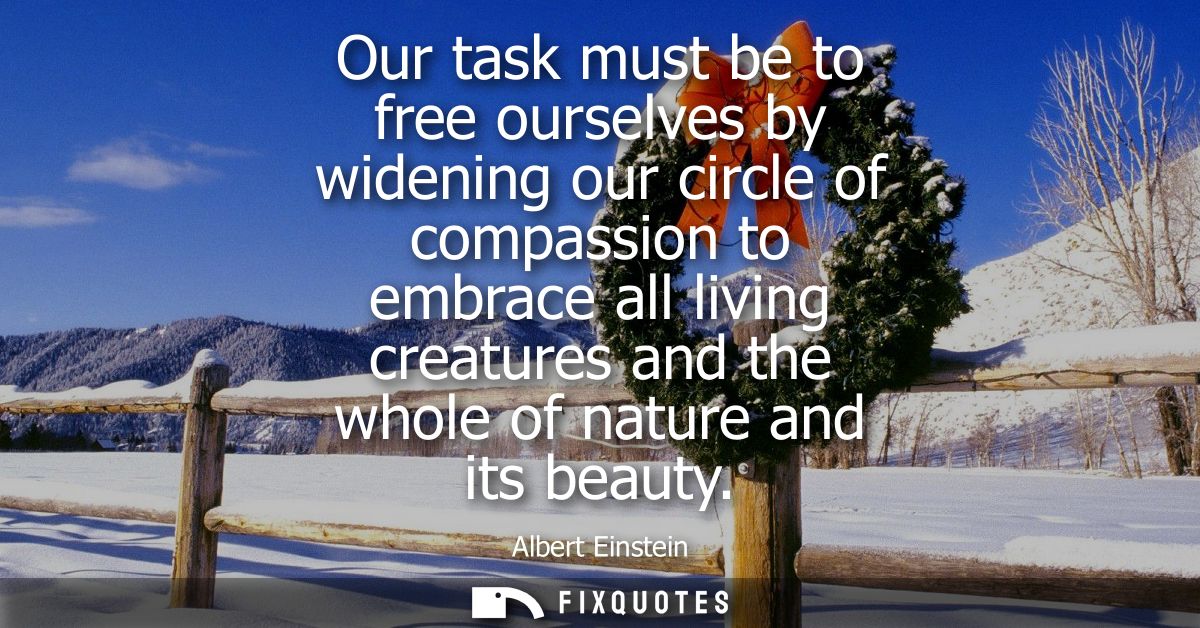
"Our task must be to free ourselves by widening our circle of compassion to embrace all living creatures and the whole of nature and its beauty"
About this Quote
Albert Einstein encourages an ethical evolution in human consciousness, calling for a life defined by a deep and inclusive compassion. The "circle of compassion" is symbolic of the boundaries we set around those we care for, often limited to family, friends, or our community. Einstein urges us to extend this circle outward, to encompass not just people, but all living creatures. This expansion requires an empathetic understanding that humans are not separate from, but intrinsically linked to, the rich tapestry of life.
To "free ourselves" implies that much of human suffering arises from a sense of separateness or isolation, a delusion of existing independently from the rest of the world. By widening our compassion, we break down these artificial walls, allowing ourselves to experience a profound connection to others and the environment. Compassion becomes not only a moral imperative but a path to inner liberation, as it dissolves self-imposed barriers and nurtures unity.
Embracing all living creatures challenges the anthropocentric worldview and calls for respecting animals and other life forms as sentient beings with intrinsic value. This attitude fosters responsibility in how we interact with and treat the natural world, guiding us toward practices that support both ecological balance and humane ethics. By honoring the "whole of nature and its beauty", we cultivate a gratitude and reverence that transcends utilitarian perspectives. Nature’s beauty becomes a source of inspiration and humility, reminding us of our shared origins and mutual dependence.
Such compassion, on both personal and societal scales, can redefine relationships, among humans, between species, and with the Earth itself. This transformation is not passive; it requires awareness, action, and a willingness to challenge ingrained assumptions about our place in the world. As we grow into this broader compassion, we contribute to healing not only ourselves, but also the fabric of life that sustains us all.
More details
About the Author