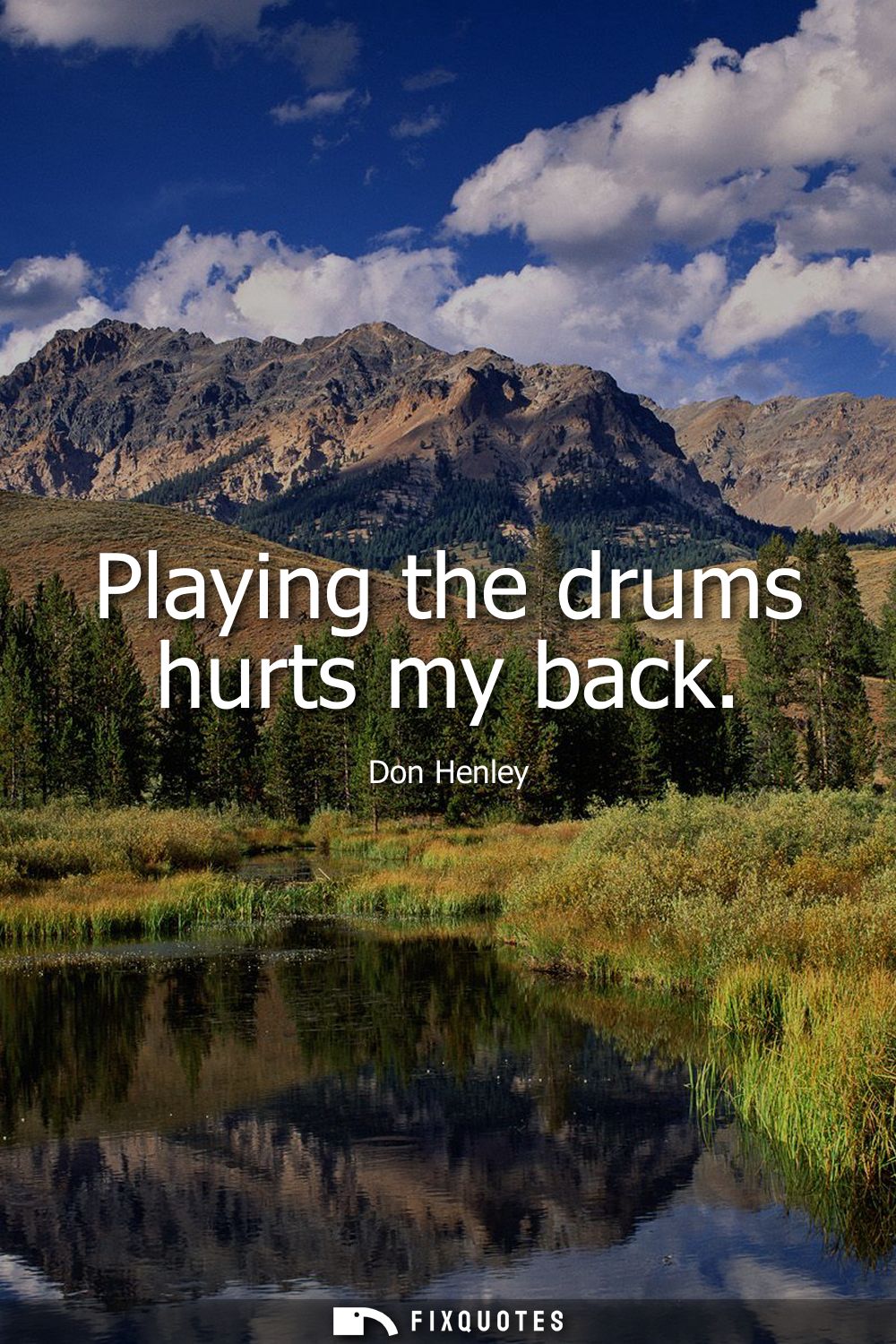
"Playing the drums hurts my back"
About this Quote
A wry confession from a musician who spent decades behind a kit and a microphone, the line lands with both humor and hard truth. Drumming is not just keeping time; it is a full-body sport that punishes the spine. Hours of seated torque, the twist of the torso, feet pumping pedals, shoulders lifting and dropping in relentless patterns, all while leaning into the snare and hi-hat. Add singing on top of that, as Don Henley so often did with the Eagles, and the core has to stabilize for breath support while the limbs do something entirely different. The glamour of a stadium chorus rests on a very mortal back.
Henley’s career makes the statement feel especially pointed. He became the face and voice of songs that defined 1970s radio while drumming lead, an unusual and demanding role. As the years piled up, he shifted more often to the front of the stage, with another drummer anchoring the beat. That choice was practical and aesthetic: better connection with the audience, better preservation of the voice, and relief from the grind that long tours and long sets exact on the body. The line carries the tacit acknowledgment that longevity in music requires adaptation, not heroics.
There is also a gentle unmasking here. Fans see harmony, ease, California sunlight; the body remembers load-in, rehearsal, repetition, the chair that is not really a chair but a perch that asks for sacrifice. The quip shrinks the myth of rock stardom to a quiet, literal ache, and in doing so honors the labor behind songs that seem effortless. It is not a complaint so much as a boundary: craft refined by experience to protect what matters most, the songs and the connection they make. Beneath the polish, cartilage and muscle tell their own story, and a drummer wisely chooses when to stand.
Henley’s career makes the statement feel especially pointed. He became the face and voice of songs that defined 1970s radio while drumming lead, an unusual and demanding role. As the years piled up, he shifted more often to the front of the stage, with another drummer anchoring the beat. That choice was practical and aesthetic: better connection with the audience, better preservation of the voice, and relief from the grind that long tours and long sets exact on the body. The line carries the tacit acknowledgment that longevity in music requires adaptation, not heroics.
There is also a gentle unmasking here. Fans see harmony, ease, California sunlight; the body remembers load-in, rehearsal, repetition, the chair that is not really a chair but a perch that asks for sacrifice. The quip shrinks the myth of rock stardom to a quiet, literal ache, and in doing so honors the labor behind songs that seem effortless. It is not a complaint so much as a boundary: craft refined by experience to protect what matters most, the songs and the connection they make. Beneath the polish, cartilage and muscle tell their own story, and a drummer wisely chooses when to stand.
Quote Details
| Topic | Music |
|---|
More Quotes by Don
Add to List