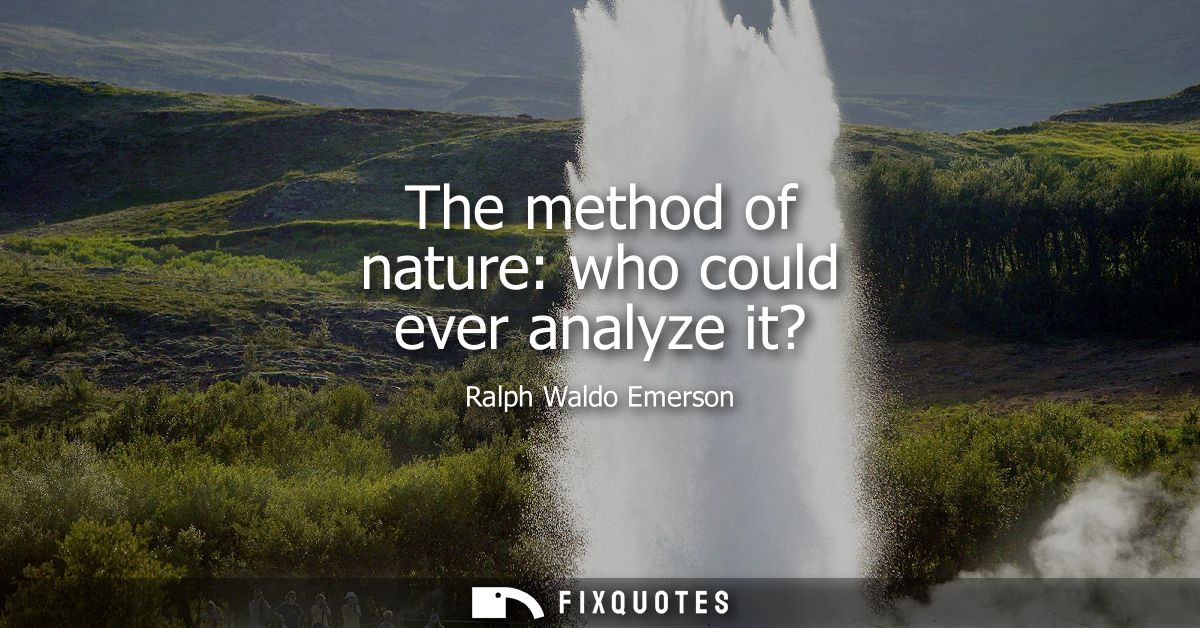
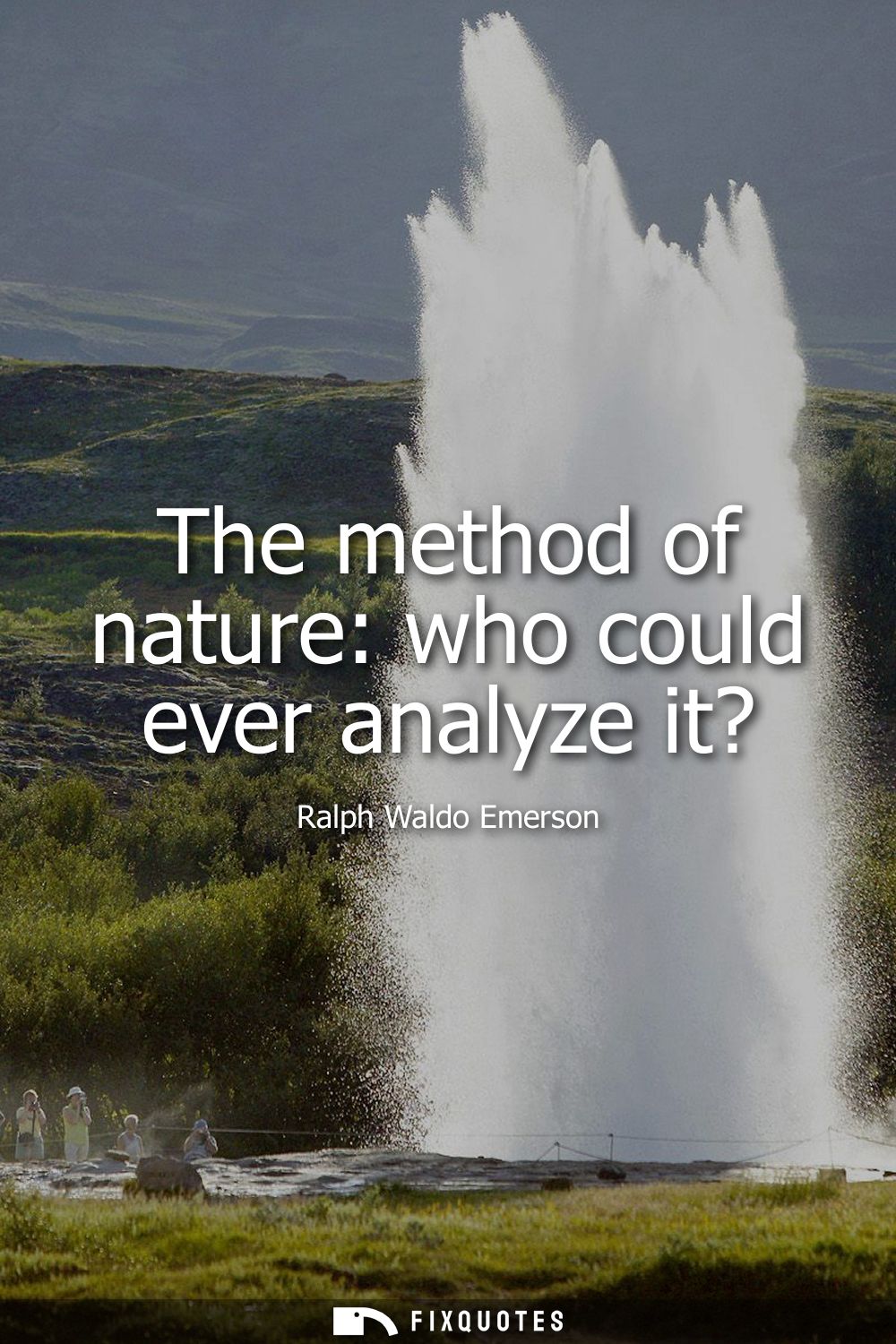
"The method of nature: who could ever analyze it?"
About this Quote
Emerson frames a humility before life when he asks, "The method of nature: who could ever analyze it?" The world does not sit still long enough to be measured into final formulas. Growth, decay, regeneration, and surprise are always underway; the stream keeps running while we take notes on the shore. He sees nature as lawful and economical, yet its law appears only in motion. Any attempt to freeze the process risks mistaking the parts for the living whole.
The line belongs to Emersons transcendentalist project, where nature is not just scenery or mechanism but a living symbol of spirit. Appearing in his essay Spiritual Laws (1841) and resonating with his Harvard address The Method of Nature delivered the same year, the remark questions the adequacy of purely analytic knowledge. Emerson does not dismiss science; he reveres empirical discovery. But he insists that the deepest order of things discloses itself to intuition, character, and participation rather than dissection alone. One learns the method of nature by moving with it, not by standing outside it.
Across essays like Compensation and Circles, he sketches traits of this method: balance without bookkeeping, progress by metamorphosis, power that arrives in pulses rather than plans, a perpetual self-correction that disciplines excess. Nature advances by contrasts and polarities, yet folds them into higher unities. Moral life, for Emerson, should mirror that dynamic. Action taken at the right moment, trust in the inner voice, and acceptance of flux place the individual in the currents by which the world actually works.
So the question is both caution and invitation. Caution, because mastery through analysis alone is an illusion; the living will always elude our diagrams. Invitation, because the method is not opaque to a receptive soul. Through attention, courage, and readiness to be changed, a person can align with the swift, subtle way things grow. Knowledge then becomes less a fixed map than a companionship with process.
The line belongs to Emersons transcendentalist project, where nature is not just scenery or mechanism but a living symbol of spirit. Appearing in his essay Spiritual Laws (1841) and resonating with his Harvard address The Method of Nature delivered the same year, the remark questions the adequacy of purely analytic knowledge. Emerson does not dismiss science; he reveres empirical discovery. But he insists that the deepest order of things discloses itself to intuition, character, and participation rather than dissection alone. One learns the method of nature by moving with it, not by standing outside it.
Across essays like Compensation and Circles, he sketches traits of this method: balance without bookkeeping, progress by metamorphosis, power that arrives in pulses rather than plans, a perpetual self-correction that disciplines excess. Nature advances by contrasts and polarities, yet folds them into higher unities. Moral life, for Emerson, should mirror that dynamic. Action taken at the right moment, trust in the inner voice, and acceptance of flux place the individual in the currents by which the world actually works.
So the question is both caution and invitation. Caution, because mastery through analysis alone is an illusion; the living will always elude our diagrams. Invitation, because the method is not opaque to a receptive soul. Through attention, courage, and readiness to be changed, a person can align with the swift, subtle way things grow. Knowledge then becomes less a fixed map than a companionship with process.
Quote Details
| Topic | Nature |
|---|
More Quotes by Ralph
Add to List