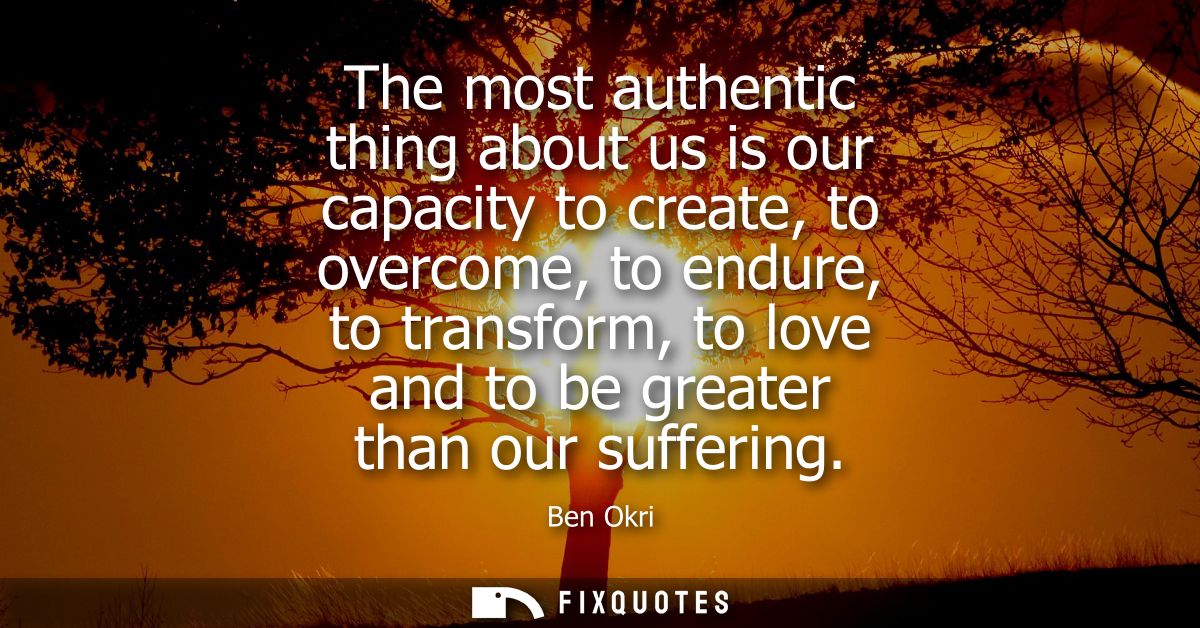
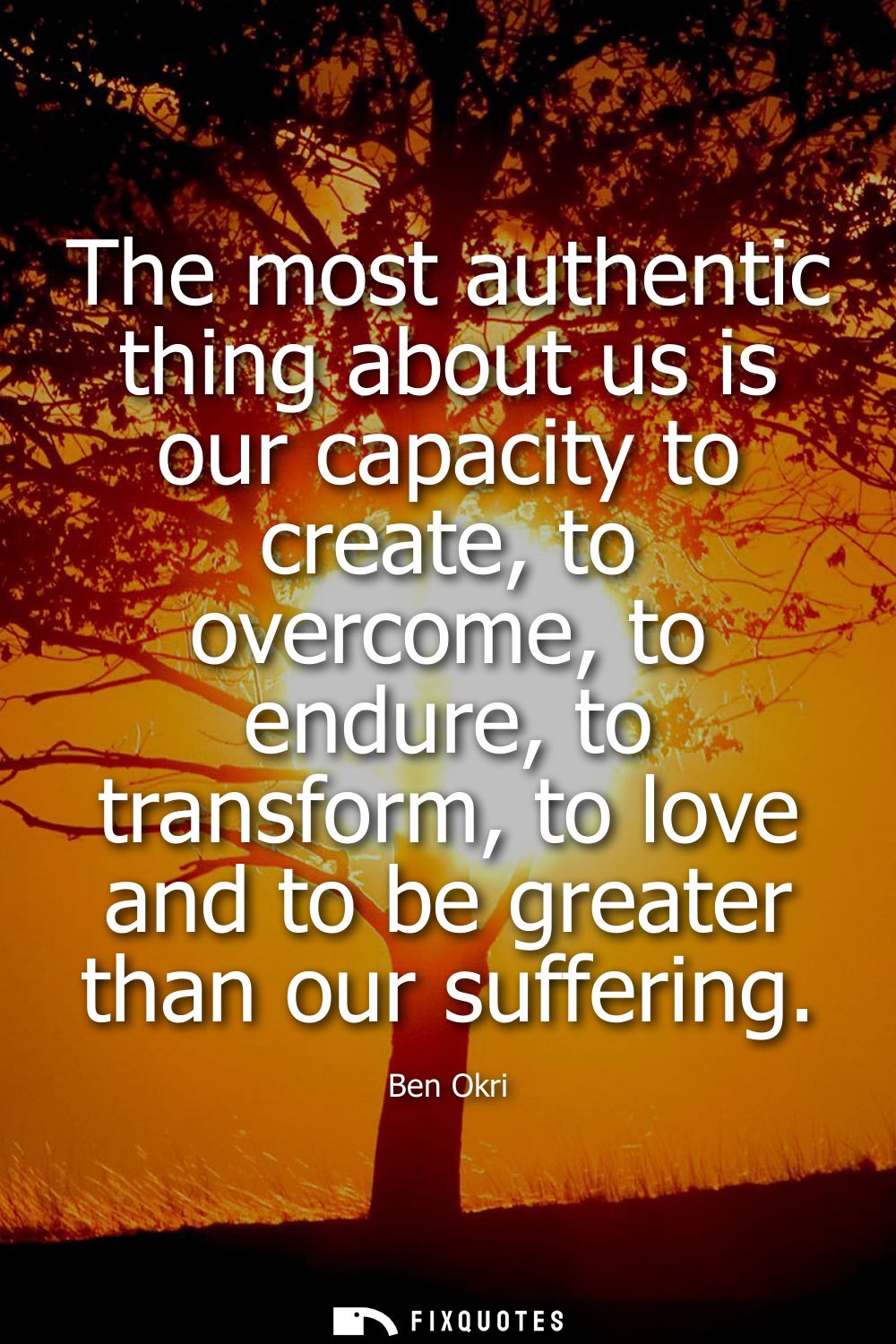
"The most authentic thing about us is our capacity to create, to overcome, to endure, to transform, to love and to be greater than our suffering"
About this Quote
Okri’s line refuses the fashionable idea that authenticity is something you “find” by excavating a pure, unchanging self. He flips it: the truest thing about us isn’t a stable essence, it’s motion. A capacity. In other words, you don’t prove you’re real by being raw; you prove it by what you can do with the rawness.
The sentence is built like a staircase: create, overcome, endure, transform, love. Each verb advances from survival to agency to generosity. “Endure” is the hinge word, admitting pain without giving it the last word. Then “transform” quietly smuggles in Okri’s lifelong belief that imagination is not decoration but a tool for changing reality. As a poet who came of age amid Nigeria’s political upheavals and the aftershocks of colonialism, Okri has often written against narratives that reduce people to damage: victims, statistics, cautionary tales. Here, he offers a different metric for personhood.
The subtext is a critique of suffering-as-identity, a moral and cultural posture that can become strangely addictive in public life. By ending with “be greater than our suffering,” Okri doesn’t deny trauma; he demotes it. Greatness isn’t conquest in the heroic sense, but scale: the self expanding beyond the circumference of pain. Even “love” arrives late in the list, not as sentiment, but as an achievement - the hardest transformation after endurance.
The sentence is built like a staircase: create, overcome, endure, transform, love. Each verb advances from survival to agency to generosity. “Endure” is the hinge word, admitting pain without giving it the last word. Then “transform” quietly smuggles in Okri’s lifelong belief that imagination is not decoration but a tool for changing reality. As a poet who came of age amid Nigeria’s political upheavals and the aftershocks of colonialism, Okri has often written against narratives that reduce people to damage: victims, statistics, cautionary tales. Here, he offers a different metric for personhood.
The subtext is a critique of suffering-as-identity, a moral and cultural posture that can become strangely addictive in public life. By ending with “be greater than our suffering,” Okri doesn’t deny trauma; he demotes it. Greatness isn’t conquest in the heroic sense, but scale: the self expanding beyond the circumference of pain. Even “love” arrives late in the list, not as sentiment, but as an achievement - the hardest transformation after endurance.
Quote Details
| Topic | Resilience |
|---|
More Quotes by Ben
Add to List