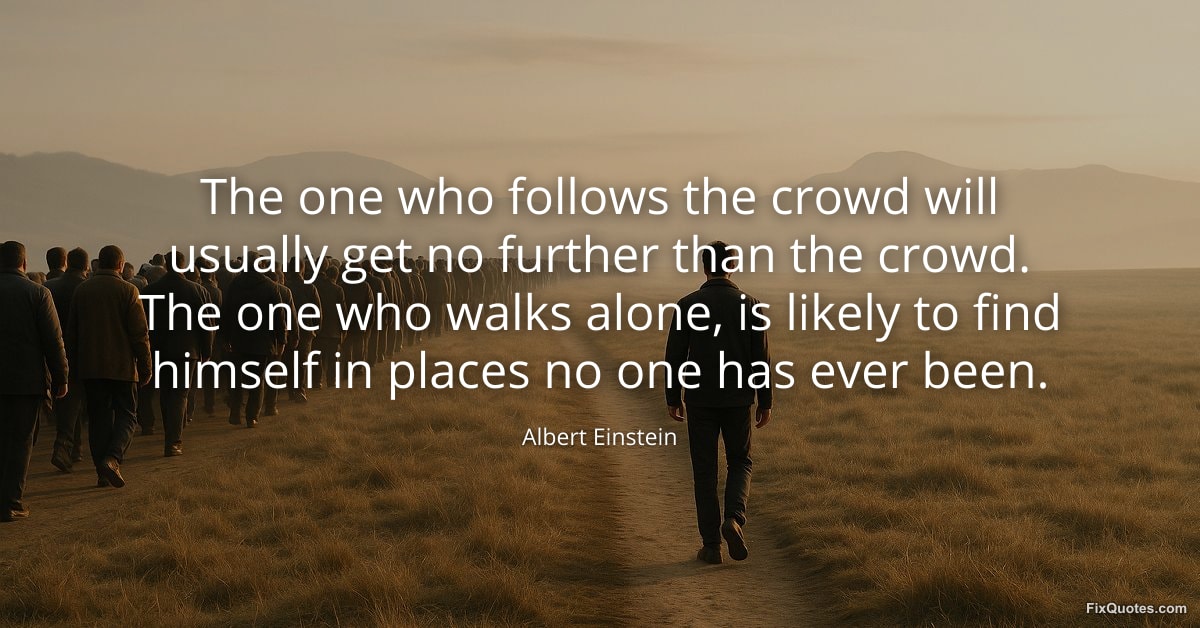
"The one who follows the crowd will usually get no further than the crowd. The one who walks alone, is likely to find himself in places no one has ever been"
About this Quote
Einstein’s genius was never just about having better answers; it was about refusing the social logic that determines which questions are “reasonable.” This line flatters the loner, sure, but its real bite is aimed at the crowd’s hidden bargain: conformity buys you safety, credibility, and a map. The cost is that you only travel routes already approved by committee.
The first sentence lands like a cool, empirical observation. “Usually” matters. Einstein isn’t selling rugged individualism as a guaranteed hack; he’s describing statistical gravity. Follow the crowd and you’ll reach the crowd’s destination because crowds optimize for consensus, not discovery. That’s true in science, where peer agreement can harden into dogma, and in public life, where popularity becomes a substitute for judgment.
Then he pivots to “walks alone,” a phrase that reframes solitude as motion, not misery. The subtext isn’t “be antisocial.” It’s “be willing to be illegible for a while.” New ideas are often lonely because they don’t have a ready-made audience; they require the speaker to endure being misunderstood before being validated. The reward isn’t just novelty but access: “places no one has ever been” is less wanderlust than epistemology, a claim about new mental territory.
In context, it reads like a scientist’s self-portrait and a quiet warning to institutions that prize orthodoxy. Progress depends on dissenters who can tolerate isolation long enough for the world to catch up.
The first sentence lands like a cool, empirical observation. “Usually” matters. Einstein isn’t selling rugged individualism as a guaranteed hack; he’s describing statistical gravity. Follow the crowd and you’ll reach the crowd’s destination because crowds optimize for consensus, not discovery. That’s true in science, where peer agreement can harden into dogma, and in public life, where popularity becomes a substitute for judgment.
Then he pivots to “walks alone,” a phrase that reframes solitude as motion, not misery. The subtext isn’t “be antisocial.” It’s “be willing to be illegible for a while.” New ideas are often lonely because they don’t have a ready-made audience; they require the speaker to endure being misunderstood before being validated. The reward isn’t just novelty but access: “places no one has ever been” is less wanderlust than epistemology, a claim about new mental territory.
In context, it reads like a scientist’s self-portrait and a quiet warning to institutions that prize orthodoxy. Progress depends on dissenters who can tolerate isolation long enough for the world to catch up.
Quote Details
| Topic | Motivational |
|---|---|
| Source | Later attribution: Mechanical Vibration (Haym Benaroya, Mark Nagurka, Seon Mi Han, 2022) modern compilationISBN: 9781978831070 · ID: 8VZ-EAAAQBAJ
Evidence: ... The one who follows the crowd will usually get no further than the crowd . The one who walks alone is likely to find himself in places no one has ever been . " ( Albert Einstein ) • " Creativity is just connecting things . When you ask ... Other candidates (1) Albert Einstein (Albert Einstein) compilation35.3% nk in the open sea having forgotten where they came from and not knowing whither they are drifting but once we fully ... |
| Video | Watch Video Quote |
| Featured | This quote was our Quote of the Day on December 6, 2025 |
More Quotes by Albert
Add to List