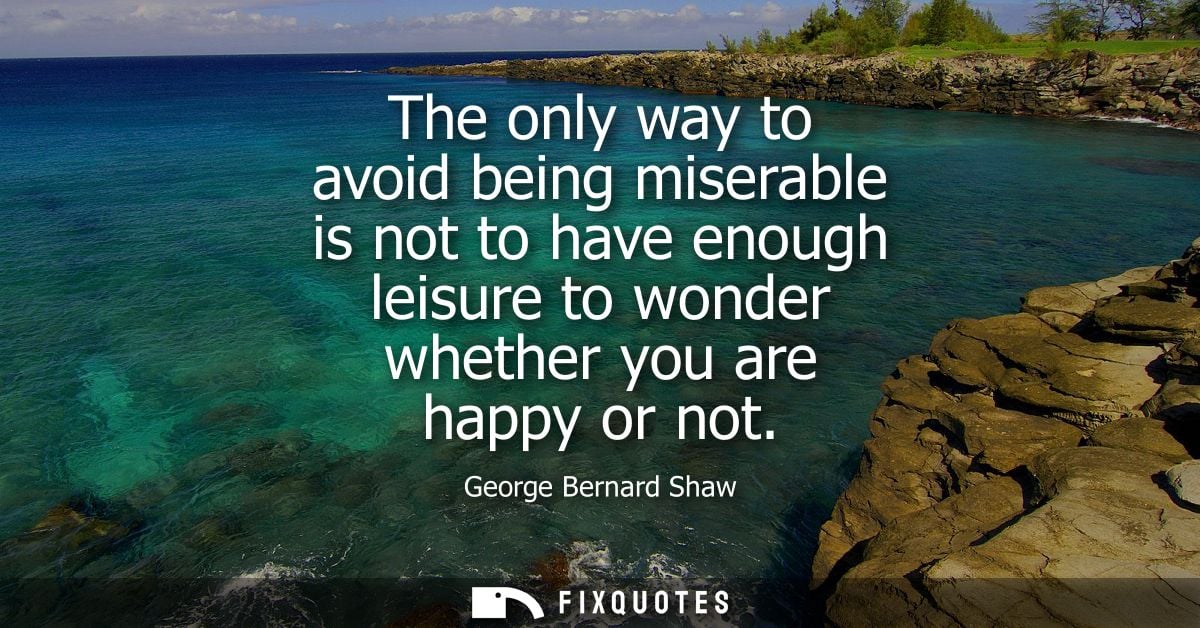
"The only way to avoid being miserable is not to have enough leisure to wonder whether you are happy or not"
About this Quote
Shaw wryly argues that happiness is a byproduct of absorbed activity rather than an object of anxious self-examination. The moment you have too much unstructured time, you may start auditing your feelings, measuring your life against ideals, and turning a passing mood into a verdict. Misery, in this view, is less a lack of pleasure than the presence of chronic self-scrutiny. Keep your hands, and therefore your mind, fully engaged, and the question of happiness tends to dissolve.
The line bears the mark of Shaw’s Edwardian wit and his critique of the idle leisure class. Writing across the late 19th and early 20th centuries, he delighted in puncturing genteel assumptions about culture, morality, and success. Leisure, for the privileged, was supposed to equal refinement and contentment. He flips that assumption: too much leisure becomes a breeding ground for ennui and self-absorption. The social edge is unmistakable; a society that prizes unearned ease may be incubating discontent.
There is also a psychological insight that anticipates modern research. Rumination is strongly linked to depression and anxiety, while deep engagement, sometimes called flow, correlates with well-being. Purposeful tasks, whether creative, manual, or communal, narrow attention to the present and grant a felt sense of progress. By contrast, the question Am I happy? can be a trap, inviting comparison, nostalgia, and imagined futures you can never quite match.
Shaw is not romanticizing grind for its own sake. He prized meaningful work and civic involvement, not mere busyness. The target is purposeless leisure that leaves one alone with a ceaseless internal accountant. The paradox he offers still stings: happiness arrives most readily when we stop hunting it and lose ourselves in a task, a cause, or the care of others. Make the day too full for self-surveillance, and happiness has room to slip in unnoticed.
The line bears the mark of Shaw’s Edwardian wit and his critique of the idle leisure class. Writing across the late 19th and early 20th centuries, he delighted in puncturing genteel assumptions about culture, morality, and success. Leisure, for the privileged, was supposed to equal refinement and contentment. He flips that assumption: too much leisure becomes a breeding ground for ennui and self-absorption. The social edge is unmistakable; a society that prizes unearned ease may be incubating discontent.
There is also a psychological insight that anticipates modern research. Rumination is strongly linked to depression and anxiety, while deep engagement, sometimes called flow, correlates with well-being. Purposeful tasks, whether creative, manual, or communal, narrow attention to the present and grant a felt sense of progress. By contrast, the question Am I happy? can be a trap, inviting comparison, nostalgia, and imagined futures you can never quite match.
Shaw is not romanticizing grind for its own sake. He prized meaningful work and civic involvement, not mere busyness. The target is purposeless leisure that leaves one alone with a ceaseless internal accountant. The paradox he offers still stings: happiness arrives most readily when we stop hunting it and lose ourselves in a task, a cause, or the care of others. Make the day too full for self-surveillance, and happiness has room to slip in unnoticed.
Quote Details
| Topic | Happiness |
|---|
More Quotes by George
Add to List