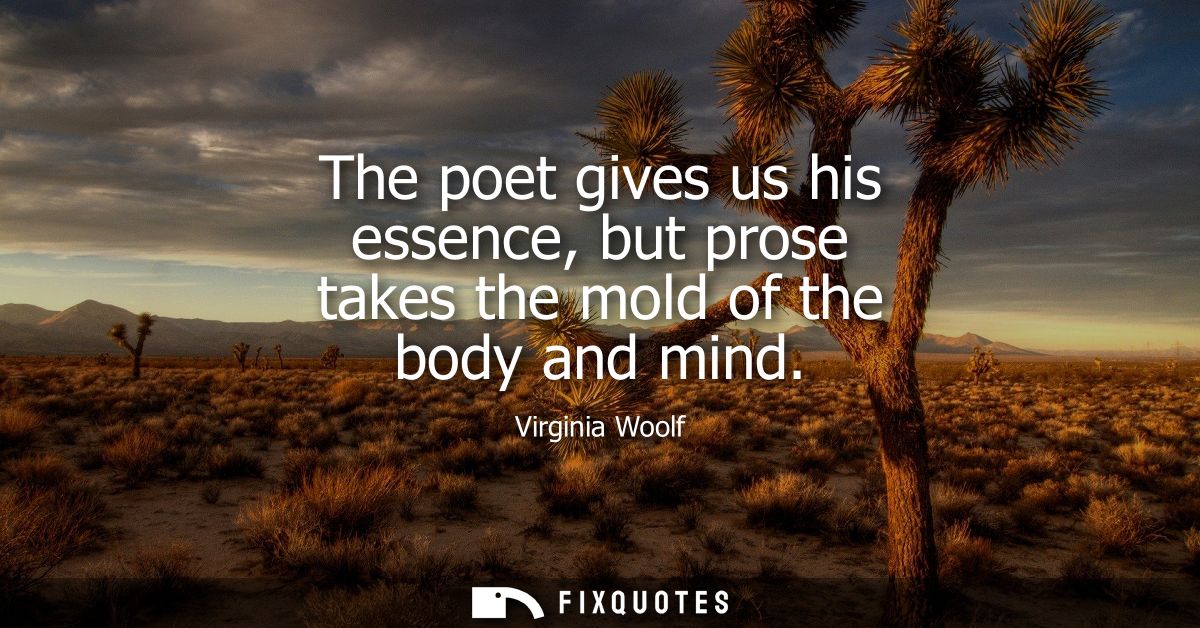
"The poet gives us his essence, but prose takes the mold of the body and mind"
About this Quote
The subtext is Woolf’s modernist argument with Victorian authority. If the old novel prized plot as scaffolding and character as a neat moral exhibit, Woolf wants prose that can register how a mind actually moves: associative, porous, interrupted by sensation, memory, fatigue. The “body” matters here because her project is anti-disembodied literature. She’s insisting that thought is not a sterile intellect performing on stage; it’s a lived, sensory condition, shaped by gender, illness, labor, time.
Context sharpens the intent. Writing amid the Bloomsbury circle and the high modernist push to remake form, Woolf was constantly defending the novel’s seriousness against the idea that poetry owned the higher ground. This line both concedes poetry’s hit of immediacy and reclaims prose as the deeper technology: not just to describe life, but to bear its full imprint. The wit is in the reversal - prose, the humble workhorse, becomes the more radical medium because it can hold the whole person, not just their highlight reel.
Quote Details
| Topic | Poetry |
|---|---|
| Source | Help us find the source |
| Cite |
Citation Formats
APA Style (7th ed.)
Woolf, Virginia. (2026, January 15). The poet gives us his essence, but prose takes the mold of the body and mind. FixQuotes. https://fixquotes.com/quotes/the-poet-gives-us-his-essence-but-prose-takes-the-28343/
Chicago Style
Woolf, Virginia. "The poet gives us his essence, but prose takes the mold of the body and mind." FixQuotes. January 15, 2026. https://fixquotes.com/quotes/the-poet-gives-us-his-essence-but-prose-takes-the-28343/.
MLA Style (9th ed.)
"The poet gives us his essence, but prose takes the mold of the body and mind." FixQuotes, 15 Jan. 2026, https://fixquotes.com/quotes/the-poet-gives-us-his-essence-but-prose-takes-the-28343/. Accessed 12 Feb. 2026.