
W. Somerset Maugham Biography Quotes 70 Report mistakes
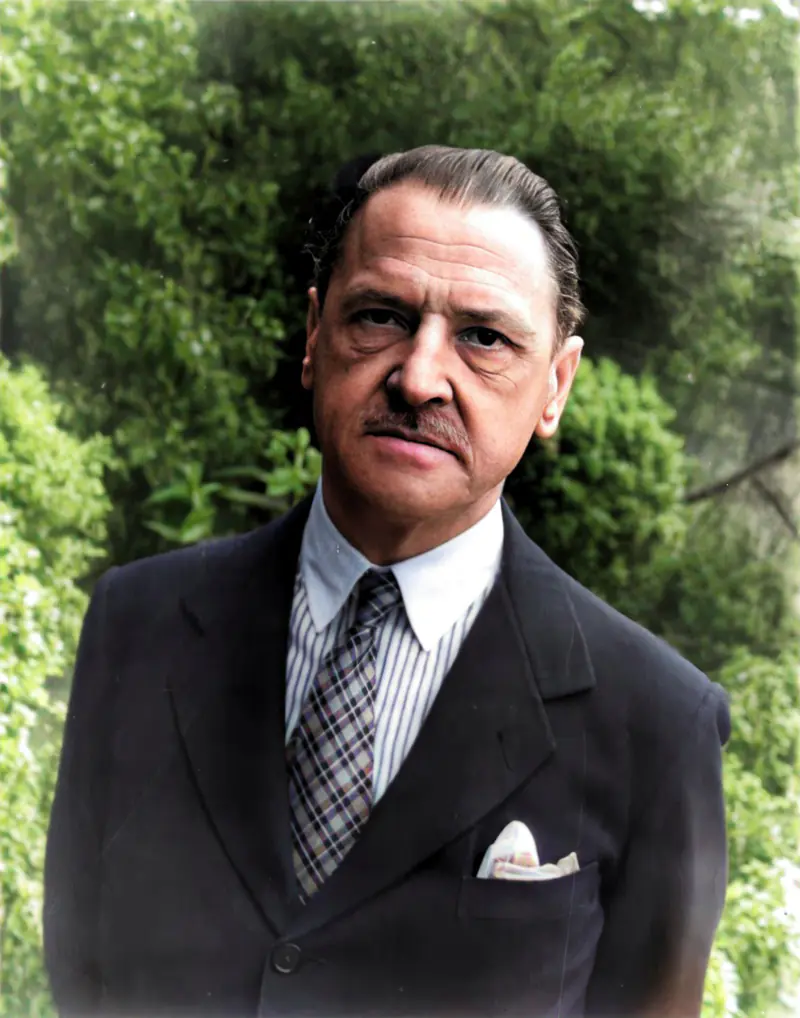
| 70 Quotes | |
| Born as | William Somerset Maugham |
| Occup. | Playwright |
| From | United Kingdom |
| Born | January 25, 1874 Paris, France |
| Died | December 16, 1965 Nice, France |
| Cause | Pneumonia |
| Aged | 91 years |
William Somerset Maugham was born on January 25, 1874, in Paris, where his father served at the British Embassy. The accidental doubleness of that origin - English by nationality, French by birthplace - mattered: he grew up listening to two cultures and learning early that identity could be performed. His mother, Edith Mary Maugham, died of tuberculosis when he was eight; his father followed two years later. The sudden orphaning left him with a private wound that never fully healed and a lifelong habit of emotional self-protection, later disguised as cool wit and narrative detachment.
Sent to England, he was raised by an uncle, the Rev. Henry MacDonald Maugham, in Whitstable, Kent. The household was clerical, respectable, and constricting; Maugham, small, foreign-accented, and shy, developed a stammer and a fierce capacity for observation. The boy who could not easily speak learned to watch how people spoke, lied, and spared themselves - the raw material of his future plays and stories. The late-Victorian moral climate also taught him the cost of being different, particularly as he came to understand his homosexuality in a world of criminalization and hypocrisy.
Education and Formative Influences
Maugham attended King's School, Canterbury, then studied in Germany at Heidelberg, where he encountered European realism and gained the liberating sense that English propriety was not the whole world. Returning to London, he trained in medicine at St Thomas' Hospital, qualifying but never practicing for long. The wards gave him what he later valued more than technique: a clinically unsentimental view of pain, desire, and self-deception across class lines. Out of this came his first major novel, "Liza of Lambeth" (1897), whose slum realism announced both his interest in ordinary lives and his instinct to write without pious consolation.
Career, Major Works, and Turning Points
The 1900s made him famous in the theater: comedies and social dramas such as "Lady Frederick" (1907), "Jack Straw" (1908), and "The Circle" (1921) turned his ear for dialogue into box-office power, and for a period he reportedly had multiple plays running simultaneously in London. His fiction expanded his range and his map. "Of Human Bondage" (1915) transformed autobiographical material - the stammer, the medical school, the humiliations of obsession - into a hard-earned study of freedom. During World War I he served with British intelligence, including work connected to Switzerland and Russia; afterward he traveled widely, converting experience into cosmopolitan, sharply plotted stories in collections like "The Trembling of a Leaf" (1921) and "Ashenden" (1928), and novels such as "The Painted Veil" (1925) and "The Razor's Edge" (1944). He spent much of his later life at the Villa Mauresque near Cap Ferrat, a celebrity and a craftsman, increasingly solitary, his public success shadowed by private complications and a bitter old age.
Philosophy, Style, and Themes
Maugham's style was classical in its discipline: lucid sentences, economical structure, and the dramatist's instinct for entrances, exits, and reversals. He distrusted the rhetoric of profundity and built psychological depth through surface accuracy - the tone of a drawing room, the hush of a sickbed, the quiet cruelty of a compliment. That coolness was not emptiness but armor. His characters often cling to romantic myths because the alternative is terror: that life is indifferent, and that love can be a trap rather than salvation. "The love that lasts longest is the love that is never returned". The line is less a pose than a confession of how longing can be safer than reciprocity, because unreturned love preserves control - and pain can be curated.
He also wrote against the sentimental doctrine that suffering improves people. "It is not true that suffering ennobles the character; happiness does that sometimes, but suffering for the most part, makes men petty and vindictive". This outlook, forged in childhood bereavement and refined in hospital wards, gives his work its unsparing moral temperature: he shows how deprivation narrows sympathies, how envy poisons, how boredom drives adultery, how respectability disguises appetite. Yet he was no nihilist; he believed in the dignity of clear seeing and in art as personal risk. "Every production of an artist should be the expression of an adventure of his soul". For a writer accused of coldness, that sentence reveals the private dare behind the polish: to translate concealed experience into forms the public will accept, without surrendering the self entirely.
Legacy and Influence
Maugham died on December 16, 1965, in Nice, having become one of the most widely read English-language authors of the 20th century. His plays helped modernize the Edwardian and interwar stage by making conversation itself a weapon and a mask; his stories set a durable standard for craft, narrative drive, and the unsentimental twist, influencing generations of popular and literary writers alike. More quietly, his work remains a document of a transitional era - from Victorian constraint through imperial travel to postwar disillusion - filtered through a mind both skeptical and hungry for meaning, always testing how much truth a person can bear about love, duty, and the self they perform to survive.
Our collection contains 70 quotes who is written by Somerset Maugham, under the main topics: Witty One-Liners - Ethics & Morality - Wisdom - Truth - Friendship.
W. Somerset Maugham Famous Works
- 1944 The Razor's Edge (Novel)
- 1930 Cakes and Ale (Novel)
- 1925 The Painted Veil (Novel)
- 1919 The Moon and Sixpence (Novel)
- 1915 Of Human Bondage (Novel)
Source / external links