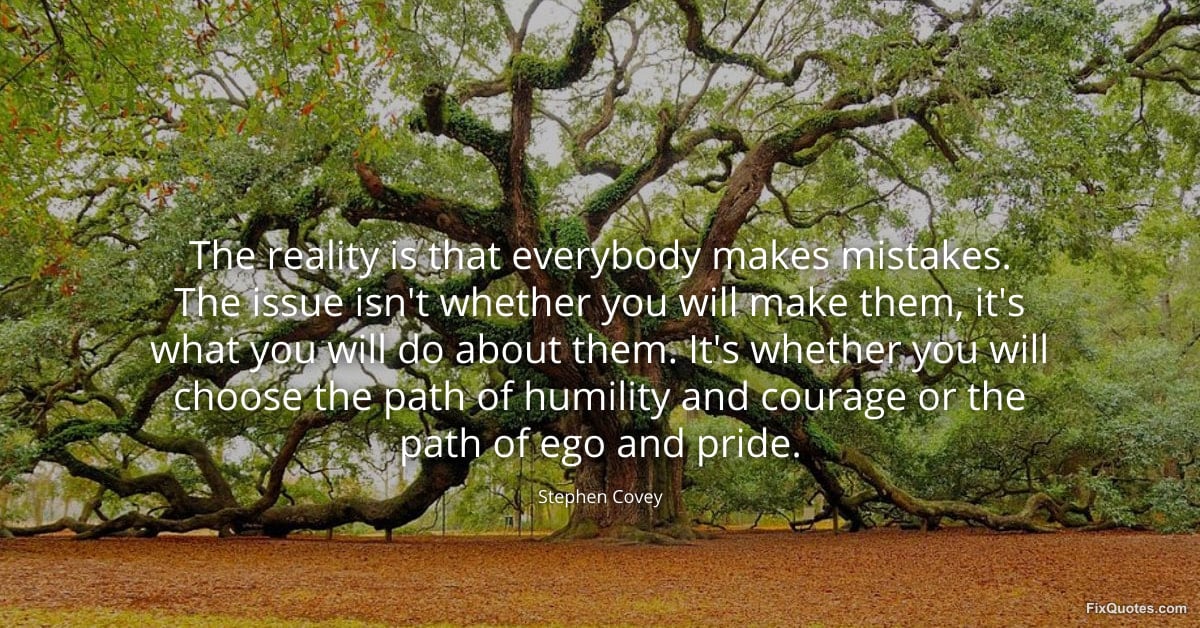
"The reality is that everybody makes mistakes. The issue isn't whether you will make them, it's what you will do about them. It's whether you will choose the path of humility and courage or the path of ego and pride"
About this Quote
Covey’s move here is to demote “mistakes” from scandal to background noise. In business culture, error often gets treated like a moral failing or a brand threat; he reframes it as weather: inevitable, predictable, and not the real story. The real story is identity under pressure - what kind of person (and by extension, what kind of organization) you become when the spreadsheet breaks and the meeting goes sideways.
The intent is managerial, but not in the sterile “best practices” sense. Covey is selling a discipline of character as operational strategy. By declaring the issue isn’t whether you’ll screw up, he takes away the false comfort of perfectionism and the false machismo of “I don’t miss.” That sets a trapdoor under ego: if mistakes are inevitable, then denial and defensiveness aren’t strength; they’re refusal.
The subtext is an indictment of corporate pride masquerading as competence. “Humility and courage” is an unexpectedly sharp pairing: humility admits fault; courage absorbs the social cost of admitting it. He’s quietly describing the hardest part of accountability - not fixing the problem, but facing the optics, the hierarchy, the fear of looking weak. “Ego and pride” aren’t just personal vices here; they’re organizational pathogens that turn small failures into cover-ups, blame games, and repeat incidents.
Contextually, this sits squarely in Covey’s late-20th-century leadership gospel: character over technique, principles over hacks. It works because it treats ethics as performance-critical, not decorative.
The intent is managerial, but not in the sterile “best practices” sense. Covey is selling a discipline of character as operational strategy. By declaring the issue isn’t whether you’ll screw up, he takes away the false comfort of perfectionism and the false machismo of “I don’t miss.” That sets a trapdoor under ego: if mistakes are inevitable, then denial and defensiveness aren’t strength; they’re refusal.
The subtext is an indictment of corporate pride masquerading as competence. “Humility and courage” is an unexpectedly sharp pairing: humility admits fault; courage absorbs the social cost of admitting it. He’s quietly describing the hardest part of accountability - not fixing the problem, but facing the optics, the hierarchy, the fear of looking weak. “Ego and pride” aren’t just personal vices here; they’re organizational pathogens that turn small failures into cover-ups, blame games, and repeat incidents.
Contextually, this sits squarely in Covey’s late-20th-century leadership gospel: character over technique, principles over hacks. It works because it treats ethics as performance-critical, not decorative.
Quote Details
| Topic | Learning from Mistakes |
|---|
More Quotes by Stephen
Add to List