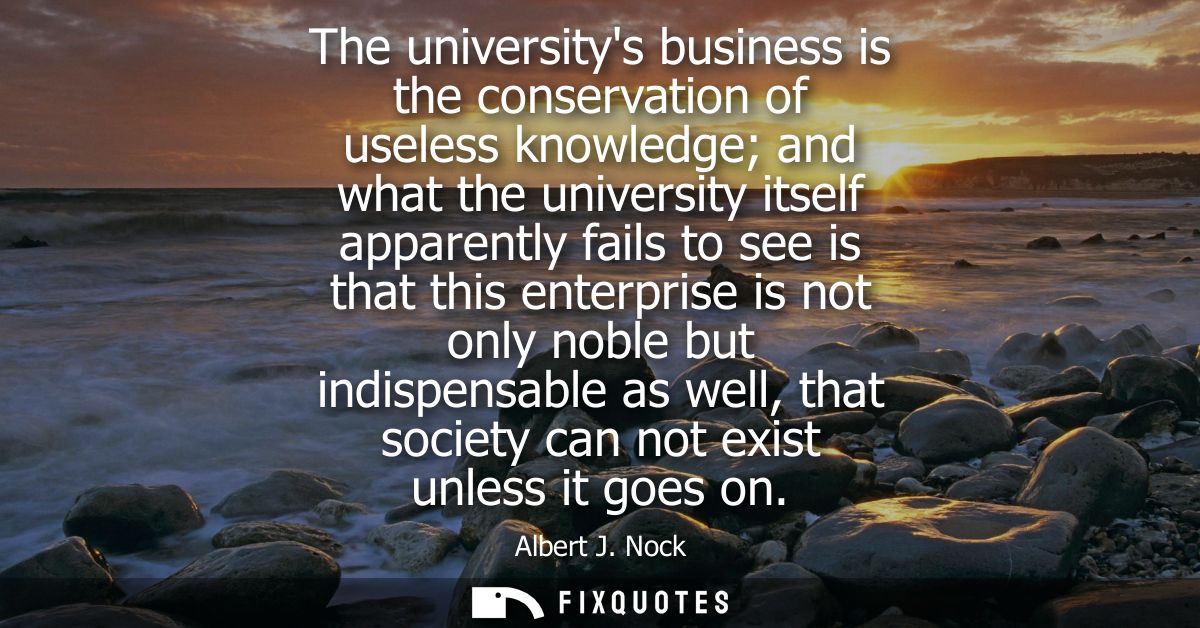
"The university's business is the conservation of useless knowledge; and what the university itself apparently fails to see is that this enterprise is not only noble but indispensable as well, that society can not exist unless it goes on"
About this Quote
“Useless” is Nock’s bait word: a deliberate provocation aimed at an America increasingly drunk on utility, efficiency, and measurable outcomes. He’s not defending trivia for trivia’s sake; he’s defending a social ecology where some forms of knowing are protected from the market’s demand to pay rent immediately. The line works because it flips the usual indictment of the university - ivory-tower irrelevance - into a mission statement. If universities look “useless,” Nock implies, that may be the point: they are one of the few institutions meant to keep ideas alive before they become profitable, popular, or politically convenient.
The subtext is quietly combative. Nock treats “business” with irony, borrowing the language of commerce to argue against the commercialization of thought. The university, he suggests, doesn’t even recognize its own highest purpose because it has started to internalize society’s suspicion: if knowledge doesn’t yield a job, a patent, or a talking point, it’s indulgent. He calls that suspicion civilizational self-harm. Societies don’t collapse only from famine or war; they also decay when they lose continuity - the long memory of languages, histories, philosophies, sciences, and arts that don’t justify themselves on quarterly reports.
Context matters: Nock writes in the early 20th century, when mass industrial society and managerial thinking were remaking education into credentialing and training. His “indispensable” is a warning: abandon “useless” knowledge and you don’t just shrink the curriculum - you narrow the human future.
The subtext is quietly combative. Nock treats “business” with irony, borrowing the language of commerce to argue against the commercialization of thought. The university, he suggests, doesn’t even recognize its own highest purpose because it has started to internalize society’s suspicion: if knowledge doesn’t yield a job, a patent, or a talking point, it’s indulgent. He calls that suspicion civilizational self-harm. Societies don’t collapse only from famine or war; they also decay when they lose continuity - the long memory of languages, histories, philosophies, sciences, and arts that don’t justify themselves on quarterly reports.
Context matters: Nock writes in the early 20th century, when mass industrial society and managerial thinking were remaking education into credentialing and training. His “indispensable” is a warning: abandon “useless” knowledge and you don’t just shrink the curriculum - you narrow the human future.
Quote Details
| Topic | Knowledge |
|---|---|
| Source | Help us find the source |
More Quotes by Albert
Add to List