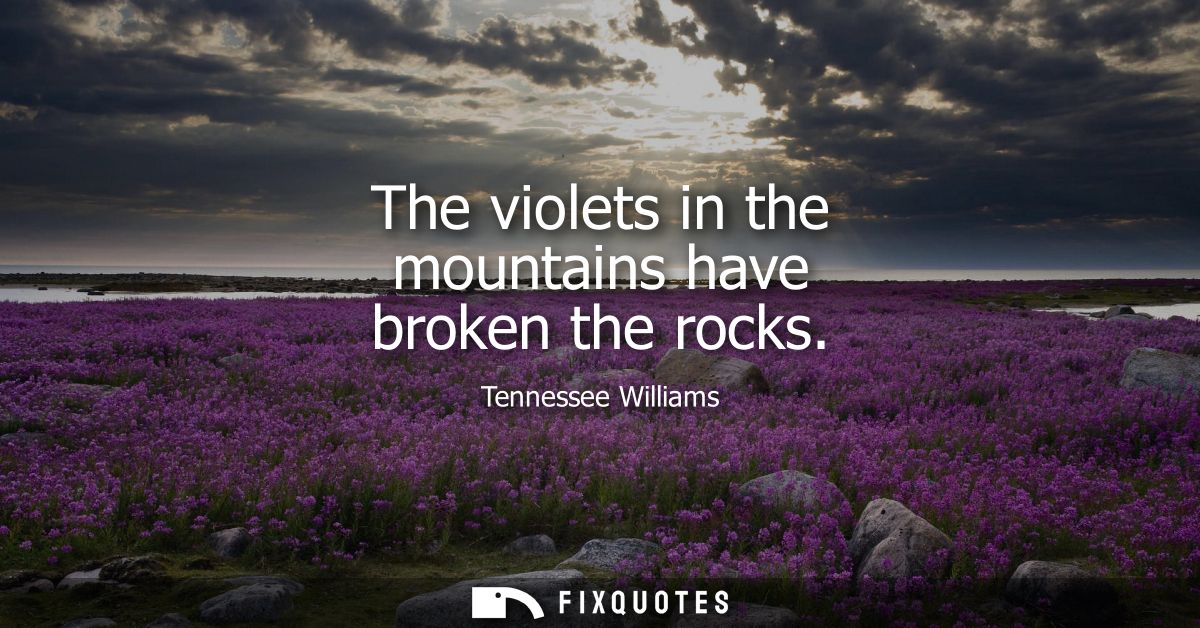
"The violets in the mountains have broken the rocks"
About this Quote
Softness doing damage is Tennessee Williams in a single breath: beauty as a quiet insurgency, fragility with teeth. “The violets in the mountains have broken the rocks” works because it refuses the macho physics of power. Rocks are supposed to win. Mountains are supposed to endure. Williams flips that hierarchy with a botanical fact turned mythic: small roots and patient growth can pry apart what looks permanent. It’s a line that sounds like consolation, but its subtext is more radical - a warning to the supposedly unbreakable.
As a dramatist obsessed with people trapped inside rigid social structures - respectability, gender roles, family mythologies - Williams understands that collapse rarely arrives as an explosion. It arrives as pressure, moisture, time. The violet isn’t a hero with a sword; it’s persistence made visible. That’s why the sentence lands with such emotional force: it smuggles hope into a world Williams often renders as claustrophobic. If the rocks can fracture, the prison can, too.
Context matters here: Williams wrote in mid-century America, when “hardness” was a moral ideal and deviation carried real risk. The line can be read as coded self-portraiture - queer tenderness and artistic sensitivity not merely surviving but reshaping the landscape that tried to contain them. It’s also Williamsian irony: the violets don’t break the rocks by trying to. They break them by being exactly what they are, long enough.
As a dramatist obsessed with people trapped inside rigid social structures - respectability, gender roles, family mythologies - Williams understands that collapse rarely arrives as an explosion. It arrives as pressure, moisture, time. The violet isn’t a hero with a sword; it’s persistence made visible. That’s why the sentence lands with such emotional force: it smuggles hope into a world Williams often renders as claustrophobic. If the rocks can fracture, the prison can, too.
Context matters here: Williams wrote in mid-century America, when “hardness” was a moral ideal and deviation carried real risk. The line can be read as coded self-portraiture - queer tenderness and artistic sensitivity not merely surviving but reshaping the landscape that tried to contain them. It’s also Williamsian irony: the violets don’t break the rocks by trying to. They break them by being exactly what they are, long enough.
Quote Details
| Topic | Overcoming Obstacles |
|---|---|
| Source | Unverified source: Camino Real (Tennessee Williams, 1953)
Evidence: Block Sixteen (final line); page varies by edition (often cited as p. 16 in the 2008 ND ed.). Primary source is Tennessee Williams’s play *Camino Real*. The line is spoken by Don Quixote at the end (commonly indexed as Block Sixteen). The play premiered March 17, 1953, and the first book publicat... Other candidates (2) The Making of Sylvia Plath (Carl Rollyson, 2024) compilation88.9% ... The violets in the mountains have broken the rocks!”—the sign, perhaps, of another resurrection. Tennessee Willia... Tennessee Williams (Tennessee Williams) compilation44.4% er for the wild at heart that are kept in cages this is the subtitle of the play |
More Quotes by Tennessee
Add to List